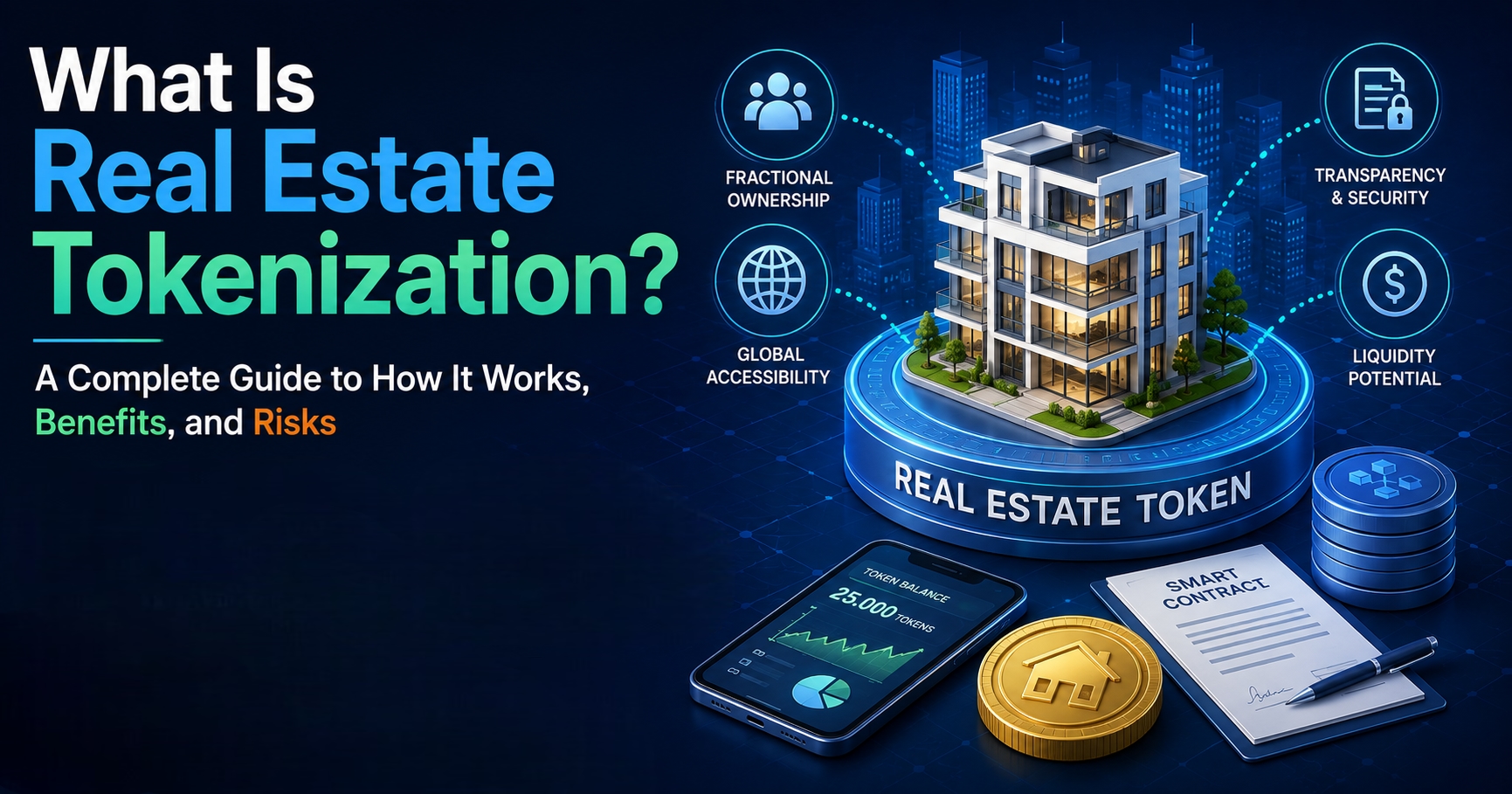
Real estate has traditionally been considered one of the most valuable but least liquid investment classes. Buying property usually requires substantial capital, extensive documentation, legal due diligence, intermediaries, and long settlement periods. Real estate tokenization is emerging as a blockchain-based approach to address some of these limitations by converting economic or ownership rights associated with a property into digital tokens.
Instead of purchasing an entire building, investors can potentially acquire smaller fractions represented by blockchain-based tokens. These tokens can be designed to represent ownership interests, shares in a property-holding entity, rights to rental income, debt claims, or other legally defined economic interests.
The concept is no longer purely theoretical with distributed and represented value together exceeding $480 million. Although this remains small compared with the global real estate market, it demonstrates that blockchain-based property markets are developing beyond early experiments.
What Is Real Estate Tokenization?
Real estate tokenization is the process of representing legally enforceable rights to a real estate asset through digital tokens recorded on a blockchain. The underlying property might be a residential building, commercial office, hotel, development project, warehouse, or portfolio of properties.
The important distinction is that tokenization does not simply mean putting a property's information on a blockchain. A token must have a clearly defined relationship with the underlying asset. Depending on the legal structure, an investor might own shares in a special-purpose vehicle (SPV) that owns the property rather than owning a portion of the physical building directly.
For example, imagine a commercial property valued at $10 million. Instead of asking one investor to purchase the entire property, the owner could establish an appropriate legal entity and issue 100,000 tokens representing defined interests in that entity. An investor purchasing 1,000 tokens would then have exposure to a 1% economic interest, subject to the offering's legal structure, restrictions, fees, and applicable securities regulations.
This fractionalization is one of the most important ideas behind real estate tokenization because it can lower the capital requirement for accessing certain property investments.
How Does Real Estate Tokenization Work?
A successful tokenization project combines legal structuring, property due diligence, financial modeling, blockchain infrastructure, investor onboarding, and ongoing asset management. Blockchain is only one component of the overall system.
1. Selecting and Evaluating the Property
The process begins with identifying a suitable property or real estate portfolio. Developers or asset managers evaluate factors such as market value, rental income, occupancy, debt, operating expenses, location, title documentation, and expected returns.
Independent valuation and legal due diligence are particularly important because a blockchain cannot correct problems with the underlying property. If the property's valuation is inaccurate or its title is disputed, putting the asset on-chain does not eliminate those problems.
2. Establishing the Legal Structure
The next step is determining what the token legally represents. In many structures, an SPV owns the property while investors receive shares, membership interests, debt claims, or other rights represented digitally.
This layer is critical because blockchain ownership and legal ownership are not automatically identical. The rights attached to a token must be enforceable under the laws of the relevant jurisdiction.
Depending on the offering, securities laws, investor eligibility requirements, property laws, tax rules, anti-money-laundering requirements, and transfer restrictions may all apply.
3. Creating the Digital Tokens
Once the legal framework is established, the property's economic interests can be represented through blockchain tokens. Smart contracts govern important functions such as token issuance, transfers, investor eligibility, supply management, and potentially distributions.
For regulated offerings, the smart contract may include permissioned transfer mechanisms so that only verified and eligible investors can hold or transfer the tokens.
This is where Real estate tokenization development services become important for businesses that want to build compliant token issuance infrastructure rather than simply launch an ordinary cryptocurrency.
4. Connecting Property Economics With the Token
Tokenization becomes meaningful when the digital asset is connected to the economics of the underlying property.
For example, if a token represents an interest in a rental property, the platform may calculate rental income after expenses and distribute eligible proceeds to token holders according to their contractual rights.
Similarly, when the underlying property is sold, the proceeds can potentially be distributed according to the ownership structure.
The blockchain can automate parts of these processes, but external information—such as rent payments, property valuations, expenses, and legal events—still has to enter the system accurately. This creates an important connection between on-chain technology and off-chain property management.
5. Launching and Managing the Investment Platform
After token creation, investors need a secure interface where they can complete onboarding, satisfy KYC/AML requirements, purchase eligible tokens, monitor holdings, receive distributions, and potentially transfer tokens through an approved secondary market.
Consequently, Real estate tokenization platform development services typically involve much more than smart contract programming. A complete platform can include investor dashboards, wallet integration, compliance systems, payment infrastructure, token management, property reporting, and secondary-market functionality.
Key Benefits of Real Estate Tokenization
Fractional Ownership
Fractionalization is perhaps the most visible benefit. Traditional real estate often requires investors to commit significant amounts of capital to a single property. Tokenization can divide an investment into smaller units, potentially allowing investors to gain exposure without purchasing the entire asset.
This can also help property owners reach a broader investor base and create alternative methods of capital formation.
Greater Transparency
Blockchain provides a shared transaction record that can make ownership transfers and token activity easier to audit. Smart contracts can also make certain rules transparent before an investor participates.
However, transparency should not be confused with complete information. Blockchain can show what happened to a token, but it does not automatically verify whether the property's valuation, rent collection, or financial reporting is accurate.
Potentially Faster Settlement
Traditional property transactions can involve banks, brokers, lawyers, registries, custodians, and extensive paperwork. Tokenized transactions can automate portions of the settlement process through blockchain infrastructure and smart contracts.
The BIS notes that tokenization can improve efficiency by combining asset information with programmable rules governing transactions. At the same time, it cautions that the benefits remain accompanied by operational and regulatory challenges.
Improved Accessibility
Tokenization can potentially make investment opportunities accessible to investors who could not afford an entire property. It may also make certain cross-border investment models more practical, provided investors meet local regulatory and eligibility requirements.
Programmable Ownership and Distributions
Smart contracts can automate certain financial functions. Depending on the legal structure, they may support dividend or rental-income calculations, transfer restrictions, investor whitelisting, corporate actions, and other rules.
This programmability is particularly valuable for property portfolios where manual administration can become expensive as the number of investors increases.
Real-World Examples and Market Development
The market provides evidence that tokenized real estate is moving from experimentation toward more structured financial products.real estate funds, REIT-related products, and real estate-backed debt. Its July 2026 dataset showed 104 assets across 11 countries and approximately 18,650 holders.
The development of tokenized real estate is also being studied academically. A 2025 BIS working paper analyzing U.S. tokenized property markets from 2019 to 2025 found that tokenized real estate tended to emerge in locations with lower property prices, weaker demand, and reduced liquidity. The research also found that trading activity in tokenized properties increased following certain natural-disaster-related liquidity shocks, although the effect depended on platform buyback mechanisms that introduced additional solvency risks.
These findings are important because they challenge the assumption that tokenization automatically creates liquidity. Instead, tokenization can create the infrastructure for more efficient ownership and transfer, while actual liquidity still depends on buyers, sellers, regulation, market design, and platform credibility.
What Are the Risks of Real Estate Tokenization?
Real estate tokenization introduces technological opportunities, but it does not eliminate traditional property investment risks.
Regulatory risk is one of the biggest concerns. Depending on jurisdiction and structure, tokenized property interests may qualify as securities or other regulated financial products. Issuers must therefore understand applicable securities, property, tax, KYC, AML, and investor-protection requirements.
Liquidity risk is another major issue. A token may technically be transferable, but that does not guarantee that someone will be willing to buy it. A secondary market needs sufficient demand, appropriate regulation, reliable pricing, and credible market infrastructure.
Smart contract risk also deserves attention. Bugs in token contracts can potentially cause unauthorized transfers, incorrect distributions, or other financial losses. Independent smart contract auditing and controlled deployment are therefore important.
Asset and valuation risk remain exactly as relevant as they are in conventional real estate. Property prices can fall, tenants can default, buildings can require expensive repairs, and rental income can decline. Tokenization changes the ownership and transaction infrastructure; it does not make the underlying property risk-free.
Finally, there is legal and operational dependency risk. Investors may depend on property managers, custodians, SPVs, administrators, valuation providers, and legal entities. A blockchain may provide excellent transaction records while the real-world asset itself remains dependent on traditional institutions.
The Future of Real Estate Tokenization
The future of tokenized real estate will probably depend less on creating tokens and more on building trustworthy financial infrastructure around them. The strongest platforms will need to connect blockchain technology with legal ownership, compliance, property management, valuation, payments, custody, and regulated secondary markets.
The BIS has emphasized that tokenization can improve efficiency, transparency, and access, but also warns that these benefits can involve trade-offs such as operational complexity, liquidity pressures, and regulatory uncertainty.
This means the industry's next stage is likely to focus on institutional-grade infrastructure rather than simply increasing the number of tokenized properties. Platforms that can establish clear legal rights, reliable asset reporting, secure smart contracts, strong compliance controls, and credible liquidity mechanisms will have a stronger foundation for long-term adoption.
Conclusion
Real estate tokenization represents a significant evolution in how property ownership and investment interests can be structured, managed, and transferred. By combining fractional ownership, blockchain-based records, smart contracts, and digital investment infrastructure, it has the potential to make selected real estate opportunities more accessible and operationally efficient. Nevertheless, tokenization does not remove property, regulatory, valuation, or liquidity risks, making legal structuring and platform security essential. Businesses exploring this model can work with experienced providers, and Blockchain App Factory provides best real estate tokenization services, helping businesses build secure, scalable, and feature-rich tokenization solutions tailored to their project requirements.
FAQs
1. What is real estate tokenization?
Real estate tokenization is the process of representing ownership or economic rights associated with property through blockchain-based digital tokens.
2. How does real estate tokenization work?
It generally involves property selection, legal structuring, token creation, smart contract deployment, investor verification, token issuance, and ongoing property and investor management.
3. Is tokenized real estate the same as owning physical property?
Not necessarily. A token may represent shares in an SPV, a debt claim, rental-income rights, or another legally defined interest rather than direct ownership of the physical property.
4. Does tokenization guarantee real estate liquidity?
No. Tokenization can make transfers more efficient, but actual liquidity depends on market demand, regulatory restrictions, trading infrastructure, and the availability of buyers and sellers.
5. What are the main risks of tokenized real estate?
Major risks include regulatory uncertainty, property depreciation, valuation problems, limited liquidity, smart contract vulnerabilities, cybersecurity issues, and dependence on property managers or other off-chain institutions.