
SEO has never been short of tools. There are platforms for tracking rankings, checking backlinks, auditing technical issues, researching keywords, and measuring competitors. For years, that approach worked well because most SEO teams could take information from several platforms, compare the findings, and decide what needed attention next.
But websites have become much more complicated. Large ecommerce stores can have thousands of pages, SaaS companies may compete across dozens of search categories, and publishers often manage enormous content libraries. At this scale, collecting more data is not necessarily the problem. Knowing what the data means when all the signals interact is.
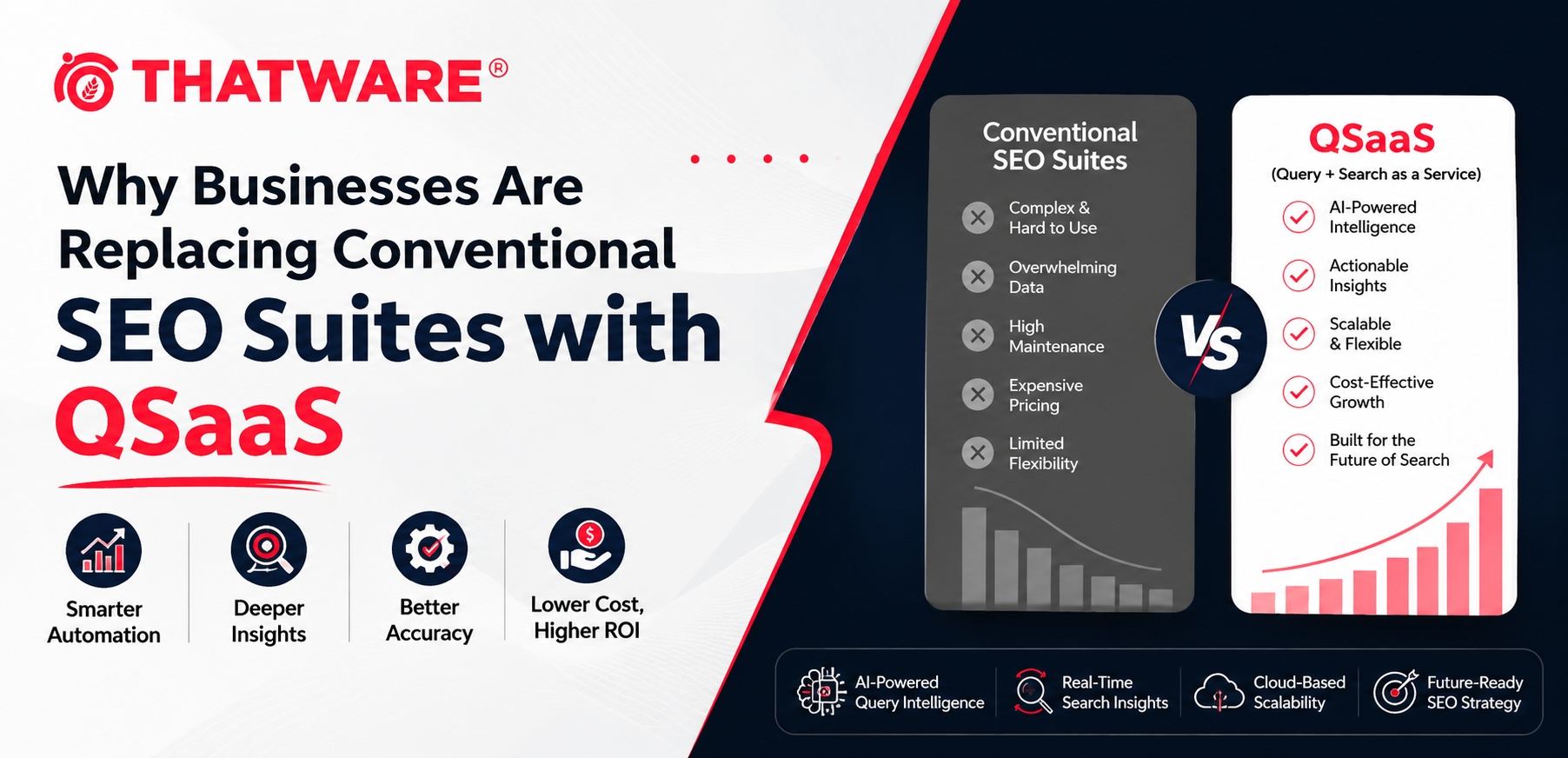
That is one reason QSaaS services are attracting attention from businesses with more complex SEO programs.
The Problem with Looking at SEO Signals Separately
A conventional SEO platform usually does a very good job of answering specific questions.
How many keywords are ranking?
Which pages have technical errors?
How many backlinks does the site have?
Which keywords moved up or down?
Where are competitors gaining visibility?
These answers are useful. The challenge begins when an SEO team has to connect them.
Imagine a website where three pages have weak content. At the same time, the domain has reasonable authority and one important commercial page is ranking around position eight for a valuable keyword.
A traditional tool may show all three facts separately.
The analyst then has to figure out whether the weak content is actually affecting the commercial page, whether the pages belong to the same topic, whether internal authority is being distributed effectively, and whether improving those pages could influence the target ranking.
That process depends heavily on human analysis.
For a small website, that may not be a major problem. For a large website with thousands of URLs and hundreds of competing terms, it can become a serious bottleneck.
QSaaS Looks at Relationships, Not Just Metrics
The biggest difference is analytical philosophy.
Conventional tools tend to present individual SEO signals. QSaaS approaches the problem by looking at how those signals interact.
Instead of simply saying that a page has thin content, the analysis can consider where that page sits within the site's topical structure, how it relates to other pages, how authority flows through the site, and how those relationships connect with competitive rankings.
This produces a different type of insight.
There is a major difference between being told that something is wrong and being shown why it matters.
For example, discovering that a page has a content gap is a diagnosis. Understanding that the gap may be weakening a broader topical cluster and limiting the potential of an important commercial page is closer to a prescription.
That distinction becomes increasingly valuable as SEO programs become more complicated.
From More Data to Better Decisions
One common misconception is that advanced SEO platforms are valuable simply because they provide more data.
That is not necessarily true.
Most experienced SEO professionals already have access to plenty of information. The real challenge is prioritization.
Suppose a website has hundreds of technical warnings, dozens of content opportunities, declining keywords, new competitors, and thousands of backlinks.
Which problem should the team solve first?
A conventional platform can provide the evidence. The SEO team still needs to determine which issue is likely to produce the greatest business impact.
This is where QSaaS can offer a different approach. By examining relationships between signals, the platform can help teams focus on opportunities that are connected to broader ranking or visibility outcomes.
The value is therefore not simply the amount of information available. It is the quality of the decision that comes from that information.
Where QSaaS SEO Services Make the Most Sense
Not every business needs this level of analytical infrastructure.
A small local website competing in a relatively simple market may be perfectly comfortable using traditional SEO platforms. If the site has a few hundred pages and a limited keyword set, an experienced SEO can usually combine the available data without too much difficulty.
The situation changes for large organizations.
Enterprise ecommerce websites, B2B SaaS businesses, publishers, marketplaces, and companies competing for highly valuable commercial keywords often have much more complicated optimization problems.
At that point, manually connecting hundreds or thousands of individual signals can consume significant analyst time.
That is where QSaaS seo services can become more attractive. The additional investment can make sense when better prioritization has a direct relationship with revenue, lead generation, customer acquisition, or market share.
The question should not simply be, “Is this tool more expensive?”
A better question is, “How expensive is it to make the wrong SEO decision?”
Configuration Is More Important Than It Looks
There is another issue businesses should consider before adopting a QSaaS platform.
These systems often require more initial configuration than a standard SEO subscription.
That is not necessarily a disadvantage. In fact, it can be one of their strengths.
A platform needs to understand the business context it is analyzing. That may include target rankings, competitors, commercial priorities, important topic areas, and the relative importance of different signals.
If those inputs are poorly configured, the resulting analysis can be misleading.
This is why teams should resist the temptation to accept every default setting and immediately start generating reports.
The setup stage deserves proper attention. A carefully configured platform is far more likely to produce analysis that reflects the actual business problem rather than a generic SEO scenario.
SEO Analysts Also Need Time to Adapt
Technology can change faster than working habits.
An SEO analyst who has spent years working with keyword reports, backlink profiles, technical audits, and ranking charts may initially find relationship-based analysis unfamiliar.
That does not mean the analyst lacks the necessary skills. It simply means the way information is being presented has changed.
A sensible transition is to use both approaches for a period of time.
Teams can compare the findings from conventional tools with QSaaS analysis and investigate the differences. When both approaches identify the same problem, confidence increases. When they disagree, the disagreement becomes an opportunity to understand how the underlying signals are being interpreted.
Over time, analysts can develop a better instinct for identifying which relationships are commercially important.
The Rise of Cloud-Based SEO Infrastructure
Another factor behind the shift is the growing need for scalable SEO technology.
Large marketing teams increasingly need systems that can process information across websites, markets, competitors, and large content inventories without relying entirely on manual spreadsheets and disconnected reports.
This is where cloud based SEO automation tools for enterprise marketing can become useful. Centralized infrastructure can make it easier for larger teams to work with large datasets and bring different parts of the SEO workflow into a more connected environment.
However, automation should not replace judgment.
The purpose of better infrastructure is to help specialists spend less time collecting and organizing information and more time understanding what the information means.
The Real Decision Comes Down to Complexity
There is no universal winner between conventional SEO tools and QSaaS.
For straightforward SEO campaigns, established platforms may provide everything a business needs. They are familiar, flexible, and often more affordable.
For organizations dealing with complicated websites, aggressive competitors, large keyword portfolios, and significant financial stakes, the calculation can look very different.
If a ranking decision can influence millions in potential revenue, spending more on analytical infrastructure may be entirely reasonable.
The important thing is to evaluate the tool against the problem rather than judging it by the number of features on the pricing page.
SEO is becoming less about collecting isolated metrics and more about understanding how those metrics influence one another. As businesses move toward larger, more interconnected search strategies, that distinction is becoming difficult to ignore.
For companies evaluating this transition, ThatWare represents the kind of SEO-focused approach that reflects the industry's movement toward more advanced, data-driven analysis. The broader lesson is simple: when SEO becomes complex enough, the advantage may no longer come from having more tools. It may come from having a better way to connect the information those tools produce.