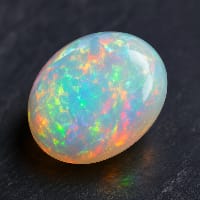
If you've ever held an opal up to natural sunlight, then moved it under indoor lighting, you've probably noticed something almost magical happen — the colors shift, dance, and sometimes completely transform. This isn't a trick of the eye or a flaw in the stone. It's actually one of the most fascinating natural phenomena in the gemstone world, and understanding why it happens makes you appreciate an opal gemstone even more.
The Science Behind the Color Shift
Unlike most gemstones that get their color from light absorption (like how a ruby is red because it absorbs all colors except red), opal works completely differently. An opal stone is made up of microscopic silica spheres arranged in a grid-like pattern. When light enters the stone, it bends and bounces between these spheres, splitting into different wavelengths — essentially breaking white light into a rainbow. This effect is called "play-of-color," and it's the reason opals never look exactly the same twice.
A few key factors determine how this opal color play appears:
Sphere size – smaller silica spheres tend to produce blues and violets, while larger ones create reds and oranges
Sphere arrangement – how tightly and uniformly the spheres are packed affects the intensity of the color flash
Light angle – the direction light hits the stone changes which wavelengths get reflected back to your eye
Viewing angle – tilting the stone even slightly can reveal colors you didn't notice a second ago
Why Lighting Makes Such a Big Difference
Different light sources interact with an opal's internal structure in different ways, which is why the same stone can look completely different depending on where you're standing:
Natural daylight – brings out the fullest, most accurate spectrum of colors, which is why many buyers prefer examining stones outdoors
Fluorescent/LED lighting – can mute certain colors or make the stone appear flatter than it really is
Warm indoor lighting – tends to enhance reds and oranges, making a fire opal look especially vibrant and glowing
Overcast or shaded light – softens contrast, often bringing out cooler blues and greens more clearly
This is also why two people can look at the same opal and describe completely different color experiences — it genuinely depends on the lighting, the angle of viewing, and even the background the stone is placed against. Even the surface a stone rests on, whether dark velvet or a white tray, can change how dramatically the colors pop.
The Unique Case of Raw Opals
Raw opals often display this color-shifting effect just as dramatically as polished ones, sometimes even more so because of their irregular, natural surfaces. Unlike a smoothly cut and faceted stone, raw opals retain their natural, uneven texture straight from the earth. This unevenness actually works in their favor when it comes to light play — every bump, ridge, and angle becomes a new opportunity for light to enter and refract differently, creating unexpected bursts of color you might not see in a polished counterpart.
Many collectors and jewelry makers are increasingly drawn to raw opals precisely because of this unpredictability. There's something deeply satisfying about owning a stone in its purest, untouched form — one that hasn't been shaped or altered to fit a conventional cut. When you rotate a raw opal slowly under changing light, you're essentially witnessing millions of years of natural formation revealing itself in real time. It's a more organic, raw connection to the stone, and for many buyers, that authenticity matters just as much as the visual beauty itself.
Choosing the Right Opal for You
When shopping for opals, it helps to observe the opal color under multiple lighting conditions before deciding. A few practical tips:
Ask sellers for photos or videos taken in different lighting setups, especially if you're buying online
Compare how the stone looks in direct sunlight versus indoor lighting
Check if the background and surface used in photos might be exaggerating the color
Don't dismiss a stone too quickly under poor lighting — it might look completely different in person
A stone that looks stunning in a store's spotlight should ideally hold up just as well in natural daylight or at home. Taking a little extra time during the buying process can save you from disappointment later.
For those looking to explore high-quality, ethically sourced opals — whether polished or in their raw form — Hornet Gems offers a curated selection of genuine Ethiopian opals known for their exceptional play-of-color and natural fire. Exploring their collection is a great way to experience firsthand just how dramatically lighting can transform these one-of-a-kind gemstones.