Building a digital product is rarely just about writing code. Before development begins, teams need to make decisions about features, user journeys, interfaces, and business requirements. When those decisions are based mainly on assumptions, even a well-developed product can miss what users actually need.
That is why successful product teams increasingly place greater emphasis on validation before development.
Instead of immediately turning an idea into a finished application, teams can first explore how the concept works, identify potential problems, and collect feedback. This approach can make the overall product development process more efficient while reducing unnecessary development work.
Start With the Problem, Not the Feature
One common mistake in product development is beginning with a feature rather than the problem it is supposed to solve.
For example, a team may decide that an application needs a new dashboard because competitors have one. But the more important question is whether users actually need that dashboard and what information they expect to find there.
Before development starts, teams should understand:
What problem are users experiencing?
Who is affected by the problem?
How are they currently solving it?
What outcome would make the experience better?
How can the proposed solution be evaluated?
Answering these questions early gives product teams a stronger foundation for making design and development decisions.
Turn Assumptions Into Testable Questions
Every product concept contains assumptions.
A team may believe users will understand a particular navigation structure. Designers may expect customers to follow a certain workflow. Product managers may assume that a new feature will reduce the time required to complete a task.
Instead of treating these assumptions as facts, teams can turn them into questions that can be tested.
For example:
Assumption: Users will understand the new onboarding process.
Better question: Can a first-time user complete onboarding without assistance?
This small change in thinking can have a major impact on product planning. It encourages teams to look for evidence rather than simply moving forward with an idea because it sounds logical.
Why User Feedback Should Come Early
User feedback is much more useful when there is still time to make meaningful changes.
If users struggle with a workflow after an application has already been developed, fixing the problem may require changes to design, frontend development, backend logic, documentation, or even the original product requirements.
Early feedback can reveal similar issues before they become expensive.
This is particularly important for:
Mobile apps
E-commerce websites
Internal business systems
Customer portals
AI-powered applications
Complex web platforms
A simple early representation of a product can give users something tangible to react to instead of asking them to imagine how a future system will work.
Not Every Test Requires a Finished Product
Another important principle is that validation does not always require a highly polished product.
Depending on the question being investigated, a team might use:
Wireframes: Useful for exploring structure and navigation.
Clickable prototypes: Helpful for testing workflows and interactions.
High-fidelity designs: Useful when visual details and realistic interactions need evaluation.
The right level of detail depends on what the team wants to learn.
If the goal is simply to determine whether users understand a workflow, spending days perfecting colors, animations, and visual details may not be necessary.
The prototype should be detailed enough to answer the important question—but not so detailed that the team becomes emotionally or financially attached to an idea that may still change.
A Better Product Development Cycle
Traditional product development can sometimes follow a straightforward pattern:
Plan → Design → Develop → Launch → Discover Problems
A more learning-focused approach introduces validation much earlier:
Define → Explore → Prototype → Test → Learn → Develop → Improve
The difference is significant.
Instead of discovering usability problems after development, teams attempt to uncover them while changes are still relatively easy.
This does not eliminate uncertainty. No development methodology can do that completely.
Instead, it helps teams manage uncertainty more intelligently.
Failed Tests Can Still Be Valuable
A prototype or early product test does not need to confirm the original idea to be successful.
Suppose a team expects users to complete a task through a particular workflow. During testing, users consistently choose another route.
That result may initially look like a failure.
But it provides valuable information.
The team now knows that its original assumption does not match user behavior. That knowledge can be used to redesign the experience before significant development resources are committed.
In this sense, discovering a problem early can be a positive outcome.
The objective is not to prove that every original idea is correct. It is to discover which parts of the idea need improvement.
Connect Design, Development, and Business Goals
Early validation can also improve communication between different teams.
Designers may have one interpretation of a requirement. Developers may understand it differently. Business stakeholders may have another expectation altogether.
A tangible representation of the proposed experience gives everyone something concrete to discuss.
Instead of debating abstract requirements, teams can examine:
How users move through the product
Where important actions appear
What information users receive
Which steps create friction
Whether the proposed workflow supports the business objective
This can help create better alignment before development begins.
Validation Is Especially Important for New Technologies
Emerging technologies can introduce additional uncertainty.
AI-powered applications, for example, may require users to interact with systems in unfamiliar ways. Teams may need to determine how users provide instructions, interpret generated results, correct mistakes, or understand system limitations.
These interactions are difficult to predict entirely from documentation or specifications.
Testing the experience early can therefore provide valuable insight into whether the proposed interaction actually makes sense to users.
The same principle applies to new SaaS workflows, mobile experiences, automation platforms, and other unfamiliar digital products.
Reduce Rework by Learning Earlier
One of the strongest arguments for early validation is simple: changes are generally easier to make before development becomes extensive.
Changing a rough workflow is different from changing a fully implemented system.
Early discovery can help teams identify:
Unclear requirements
Confusing navigation
Missing functionality
Unnecessary features
Incorrect assumptions
Weak user journeys
Communication gaps between stakeholders
The goal isn't simply to make development faster. It is to increase confidence that development is moving in the right direction.
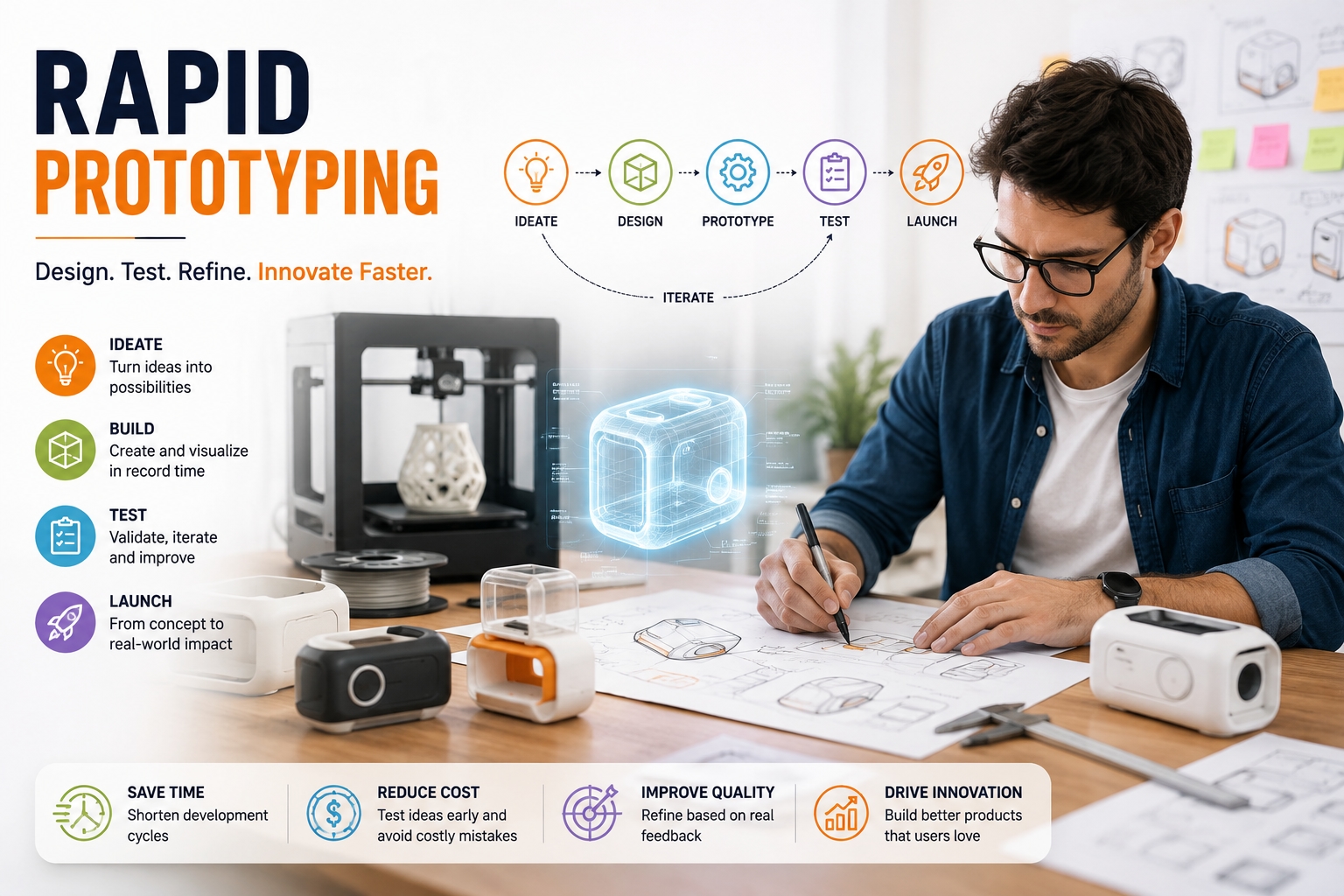
For a deeper look at how teams can use rapid prototyping to test assumptions, evaluate user experiences, and learn before committing to full development,
read How to Test Ideas Before You Build.
Build With Evidence
Great product development requires more than a good idea.
It requires a willingness to question assumptions, listen to users, and make adjustments before problems become expensive.
When teams validate concepts early, they gain an opportunity to understand what works, what doesn't, and what needs to change. That can lead to clearer requirements, stronger user experiences, better stakeholder alignment, and more focused development.
The most effective question isn't always:
“How quickly can we build this?”
Sometimes, the better question is:
“What can we learn before we build it?”
That shift can make the product development process more deliberate, evidence-driven, and resilient.