You Have Already Died Thousands of Times. Here's Why That's Not Scary.
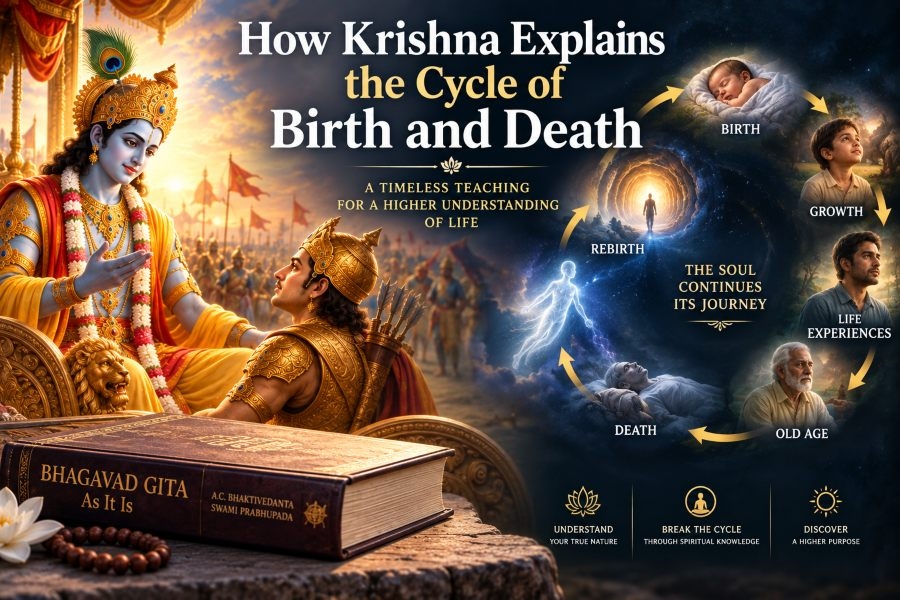
Picture Arjuna standing in his chariot, weapons lowered, staring at people he's about to kill — his teachers, his cousins, men who taught him to hold a bow before he could walk properly. He isn't afraid of losing. He's afraid of what death actually means, for them and for himself. That single moment of hesitation on a battlefield thousands of years ago opens up one of the most detailed explanations of death ever recorded — not as an ending, but as something closer to changing clothes.
This idea comes from the Bhagavad Gita, and it doesn't ease into the topic gently. Krishna tells Arjuna almost immediately that grief over death is, in a strange way, misplaced — because the thing everyone's grieving over was never actually destroyed in the first place. If you want to sit with the untranslated depth of this conversation rather than a watered-down paraphrase, the ISKCON Mayapur Store, carries editions built specifically for readers who want the full philosophical weight, not a highlight reel.
So let's actually walk through what Krishna says about birth, death, and the cycle connecting them — because it's more logically constructed than most people assume.
The Soul Never Actually Shows Up in the Story of Death
Here's the claim that reframes everything else: Krishna tells Arjuna that the soul (atma) was never born and will never die. What dies is the body. What's born is a body. The soul just occupies one temporarily, the way you occupy a room in a house you don't own.
This isn't a comforting metaphor tacked on for emotional relief — it's presented as a logical argument. Krishna points out that you were a child once, then a young adult, then whatever you are now, and at no point did you stop being you in some essential sense. Your body has already died and been reborn in a sense — cell by cell, decade by decade — and the person reading this sentence isn't disturbed by that fact. Death, in the Gita's framing, is just a more dramatic version of the same ongoing process you've already lived through without noticing.
Why does this matter practically? Because most of our fear around death is really fear of loss of identity — losing the body, the relationships, the memories tied to this particular life. Krishna's argument strips that fear of its foundation by insisting the core "you" was never on the line to begin with.
Changing Clothes: The Analogy That Does More Work Than It Seems
Chapter 2, Verse 22, gives one of the most quoted lines in the entire text: just as a person discards old clothes and puts on new ones, the soul discards old, worn-out bodies and takes on new ones.
It's easy to read that line, nod, and move on. But sit with it for a second, because the analogy is doing something specific. Clothes aren't random. You don't wake up and put on whatever's nearest — you choose according to weather, occasion, and need. The Gita's framework of karma suggests something similar happens with bodies: the next "outfit" isn't arbitrary. It's shaped by the tendencies, desires, and unfinished business carried over from the life before.
This is where reincarnation in the Gita stops sounding like a fairy tale and starts sounding like a system with internal logic:
Your consciousness at the moment of death matters. Krishna tells Arjuna in Chapter 8 that whatever state of being one remembers when leaving the body, that state tends to shape what comes next. This isn't superstition — it's consistent with how psychology already describes dominant mental patterns steering behavior; the Gita just extends that pattern past a single lifetime.
Desires that weren't resolved don't simply vanish. They're carried forward as tendencies (samskaras) that shape the next body's inclinations, environment, and circumstances.
The soul isn't punished by this cycle — it's constrained by its own unfinished momentum. Nobody outside is handing out sentences. You're finishing sentences you started.
Why Krishna Calls the Body "The Field" and Not "The Self"
One detail people miss is how carefully Krishna separates the body from the person occupying it. In Chapter 13, he uses the term kshetra (field) for the body and kshetrajna (knower of the field) for the soul observing and acting through it.
Think about what changes when you actually adopt that framing. A field can be planted, harvested, left fallow, replanted. It changes season to season. But the farmer who works the field isn't the field itself — he moves from one plot to another over a lifetime of farming without losing his identity as a farmer.
Applied to death, this means the ending of one field (one body, one lifetime) doesn't touch the farmer. The Gita isn't asking you to be indifferent about death — it's asking you to correctly locate where "you" actually reside before deciding how afraid to be about the field changing.
The Cycle Has a Name, and It's Not a Punishment System
The Sanskrit term for this repeating cycle is samsara — literally, "wandering through." It's easy to hear "cycle of birth and death" and assume it's a cosmic prison sentence, something imposed from outside as a consequence for bad behavior. The Gita's actual framing is closer to physics than to courtroom justice.
Action (karma) produces consequence, the way gravity produces a fall. Nobody is being cruel; it's simply how cause and effect operate across more than one lifetime.
The soul isn't trapped by an external judge — it's caught in patterns it keeps recreating through its own choices, attachments, and desires.
Liberation (moksha) isn't granted as a reward. It's what naturally happens once the underlying attachments driving the cycle are resolved, the same way a spinning top eventually stops once friction does its work.
This distinction matters more than it might seem. A punishment framework invites fear, guilt, and a sense of being controlled by something external. A cause-and-effect framework invites something more useful: agency. If the cycle continues because of unresolved attachment, then the way out isn't about begging forgiveness — it's about changing how you act and what you're attached to, starting now.
What the Text Itself Says About Facing This Head-On
It's worth pausing on how unusual it is that this teaching shows up in the middle of a war, not in a quiet monastery. Krishna doesn't wait for Arjuna to be in a reflective, peaceful state of mind to explain the deepest questions about existence — he does it while arrows are about to fly. That choice is deliberate. The Bhagavad Gita was never meant to be philosophy for calm afternoons only; it's built to hold up under real pressure, which is exactly when questions about death stop being abstract and start being personal.
This is part of why the text has stayed relevant across centuries and cultures far removed from the battlefield of Kurukshetra. The setting changes — a hospital room, a car accident, a phone call you weren't expecting — but the underlying question doesn't: what actually ends when a body stops functioning, and what, if anything, continues? Krishna's answer doesn't ask for blind faith. It asks Arjuna to reason through the evidence of his own continuous identity across a lifetime of bodily change, then extend that same logic one step further, past the boundary he was most afraid of.
Three Common Misreadings of Reincarnation the Gita Actually Corrects
"You come back as whatever you deserve, like a cosmic report card"
This makes it sound arbitrary and moralistic, almost like a fable. The Gita's version is closer to momentum than morality — the direction you were moving in, mentally and behaviorally, tends to continue unless something interrupts it. It's less "you get punished with the body of a lower animal" and more "unresolved tendencies tend to reproduce the conditions that match them."
"This life doesn't matter because there will be another one"
Krishna never says this, and it directly contradicts his message to Arjuna, which is essentially "act rightly, right now, in this exact situation." If anything, the doctrine of samsara raises the stakes on the present moment — this life is where the next set of tendencies gets shaped. Nothing here is a dress rehearsal.
"The goal is to escape life itself"
This gets it backwards. The goal isn't escaping existence — it's escaping the compulsive, attachment-driven repetition of the same unresolved patterns. Krishna doesn't tell Arjuna to abandon the battlefield and retreat into isolation. He tells him to act, fully and skillfully, without being enslaved by attachment to the outcome. Liberation happens through engaged action done with the right understanding, not through withdrawal.
"Only humans are part of this cycle"
The Gita's cosmology describes the soul passing through a vast range of species, not just human bodies — a detail that surprises people expecting a purely human-centered story. This isn't meant as a threat ("behave, or you'll come back as something lesser"). It's closer to a description of consciousness expressing itself through whatever form matches its current state of development. Human birth, in this framework, is considered rare and valuable precisely because it's the one form capable of asking the question you're reading about right now — the capacity for self-reflection that can actually interrupt the cycle instead of just repeating it.
What Death Actually Looks Like Through This Lens
If you strip away the fear response most people carry into any conversation about death, the Gita's picture is oddly practical. Death isn't an erasure. It's a transition point — the moment where the accumulated direction of a lifetime gets handed off to whatever comes next, the way momentum carries a thrown ball even after your hand releases it.
This reframes grief too. When Krishna tells Arjuna not to grieve for the dead, he's not asking for emotional suppression — Arjuna clearly loves these people. He's correcting a factual error: grieving as though the soul itself has been destroyed, when what actually happened is closer to someone changing location. You can still love someone and miss their presence in this particular form without believing the core of who they were has been erased from existence.
The Practical Weight of All This
You don't need to accept every metaphysical claim in the Gita to find the framework useful. Even taken as a psychological tool rather than a literal doctrine, it offers something most modern approaches to mortality don't:
It separates identity from the body, which reduces the raw terror that usually accompanies thinking about death.
It puts your current choices under a spotlight, since the tendencies you're building right now are, by this logic, the ones that carry forward.
It reframes loss as a change in form rather than a total erasure — which doesn't eliminate grief, but changes its shape.
It removes the idea of an external punisher, replacing fear-based morality with cause-and-effect responsibility.
None of this makes death painless to think about. Arjuna himself needed an entire conversation with Krishna to move past his paralysis. But the structure Krishna offers — soul as unbroken, body as temporary, cycle as consequence rather than punishment — gives you something sturdier to stand on than either denial or dread.
Why This Conversation Still Matters on an Ordinary Tuesday
Most people don't think seriously about death until they're forced to — a diagnosis, a funeral, a close call. The Gita's approach is different: it puts the conversation front and center, in the middle of an active crisis, precisely because Krishna knew that how you understand death shapes how you live before it arrives.
If the core of who you are was never actually at risk of being destroyed, the question shifts. It's no longer "how do I avoid death," which nobody can answer honestly. It's "what tendencies am I building right now, and are they the ones I want carried forward?" That's a question you can actually act on today, not just fear on some unspecified future date.
Arjuna picked up his bow after this conversation, not because he stopped caring about the people in front of him, but because he finally understood what was actually at stake — and what wasn't. That's the real weight of Krishna's teaching on birth and death: not a promise that nothing hurts, but a clearer map of what's temporary and what isn't, so you can stop wasting your fear on the wrong target.