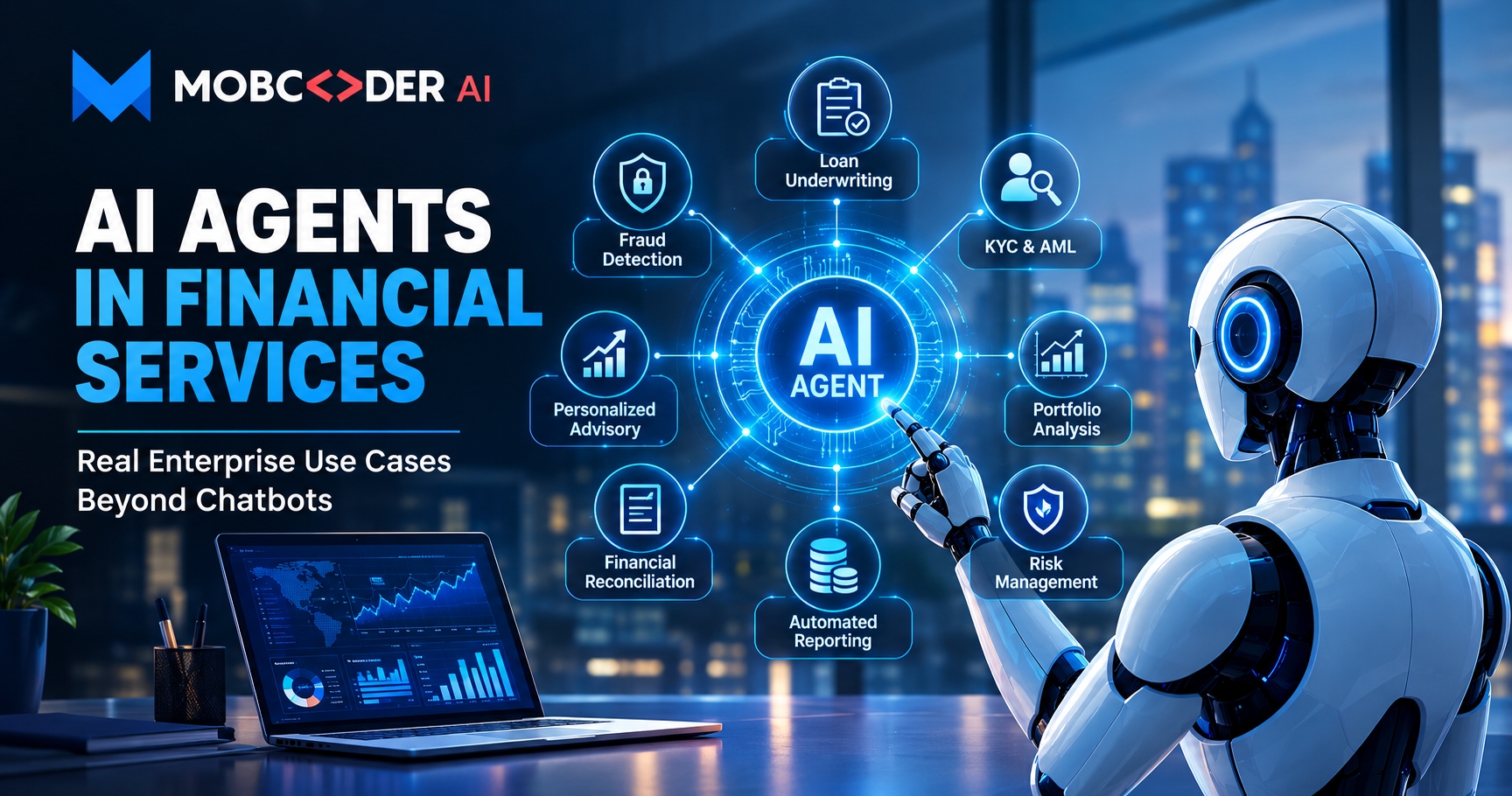
When people hear "AI agent" in a financial services context, they usually picture a customer-facing chatbot answering balance questions. That use case is real, but it is also the least interesting thing agents are doing inside financial firms right now. The bigger shift is happening in the back office, where agents are quietly taking over multi-step workflows that used to require a human moving between five different systems.
An AI agent, in the technical sense, is different from a chatbot. A chatbot answers a question. An agent plans a sequence of actions, calls tools or APIs to execute them, checks the results, and adapts if something goes wrong, ideally with a human able to step in at defined checkpoints. That distinction matters a lot in finance, where a wrong automated action can carry real regulatory and financial consequences.
Where Agents Are Actually Being Deployed
Reconciliation and exception handling. Reconciling transactions across ledgers, custodians, and payment rails is repetitive but unforgiving work. Agents can pull records from multiple systems, match them automatically, and route only the genuine exceptions to a human analyst, cutting the manual workload down to the cases that actually need judgment.
Compliance monitoring. Rather than running static rule-based alerts, agentic systems can continuously scan transaction patterns, flag anomalies against evolving typologies, and compile the supporting documentation an analyst needs to investigate, instead of just producing another alert queue.
Client onboarding. KYC and AML checks involve pulling data from multiple sources, verifying documents, and routing edge cases for manual review. An agent can orchestrate that entire pipeline, escalating only when a case falls outside defined confidence thresholds.
Portfolio and reporting workflows. Agents can assemble client reports by pulling data from portfolio management systems, market data feeds, and CRM notes, drafting a first version that an advisor reviews and finalizes rather than builds from scratch.
Vendor and contract management. Financial firms manage large numbers of vendor relationships with recurring compliance requirements. Agents can track renewal dates, flag missing documentation, and route approvals through the correct internal chain automatically.
Why Guardrails Matter More Here Than Anywhere Else
The reason agentic AI in financial services looks different from agentic AI in, say, e-commerce is the guardrail requirement. A well-built agent for a financial firm needs:
Defined scopes of what actions it can take without approval
Clear audit trails for every action, not just every output
Human-in-the-loop checkpoints for anything touching client funds or regulatory filings
The ability to halt and escalate the moment confidence drops below a set threshold
This is where a lot of off-the-shelf agent tooling falls short. Generic frameworks are built for flexibility, not for the kind of strict, auditable boundaries that a bank or asset manager needs. Custom-built agent architectures, developed with those constraints from the start, tend to hold up far better once compliance and internal audit start asking questions.
Working With New York's AI Engineering Teams
New York's financial sector has a specific advantage when it comes to adopting this technology: proximity to both the regulatory bodies that will eventually scrutinize these systems and the engineering talent that understands how to build for that scrutiny. New York's AI engineering teams working with financial clients are increasingly building agents with compliance logic baked into the architecture rather than layered on top after a pilot succeeds.
The firms getting the most value from agentic systems tend to start narrow: one workflow, one clear success metric, and a defined escalation path, before expanding scope once the first agent has proven reliable in production.
FAQs
1: What is the difference between an AI agent and a chatbot in financial services?
A chatbot responds to queries within a conversation. An AI agent plans and executes multi-step actions across systems, such as pulling data, reconciling records, or routing approvals, typically with defined checkpoints for human oversight.
2: Are AI agents safe to use for tasks involving client funds?
They can be, but only with strict scoping. Best practice restricts agents from executing irreversible financial actions autonomously, requiring human approval at defined checkpoints for anything involving money movement or regulatory filings.
3: How long does it take to deploy an AI agent for a financial workflow?
A narrowly scoped agent, such as one handling transaction reconciliation, can often be piloted in six to ten weeks. Broader multi-agent systems covering entire departments take considerably longer and are usually rolled out in phases.
4: Can AI agents replace compliance analysts?
Not in the near term. Agents are most effective at surfacing genuine exceptions and handling routine matching work, which frees analysts to focus on judgment calls, investigations, and relationship-driven decisions that still require human expertise.
5: What should a financial firm look for in an AI agent development partner?
Experience building auditable, permission-scoped systems matters more than general AI experience. Ask specifically how a vendor handles action logging, escalation thresholds, and rollback procedures, since those details determine whether the system survives an internal audit.
Conclusion
The financial firms getting real value from AI agents are not the ones chasing the most ambitious automation project. They are the ones picking one well-defined, high-friction workflow, building it with proper guardrails, and letting the results build the case for expansion. Agentic AI in finance succeeds on discipline, not scope.