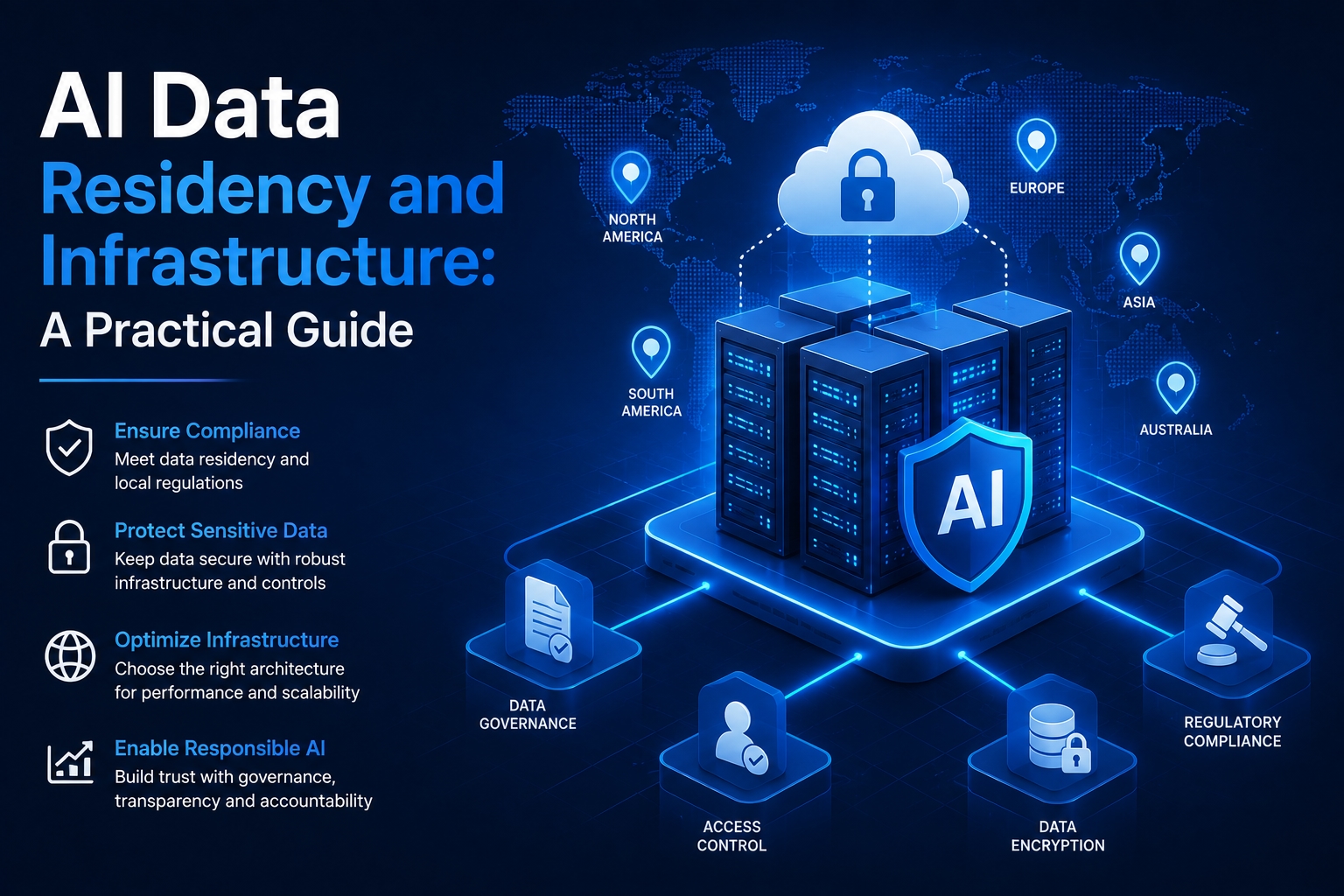
Most conversations about enterprise AI start with the model: which foundation model to use, how to fine-tune it, what it can generate. Almost none of them start where they should, with where the data actually lives while the model is working with it. That's a mistake that becomes expensive fast, because infrastructure decisions made late are far harder to unwind than infrastructure decisions made early.
Data residency, the physical and legal location where data is stored and processed, has quietly become one of the biggest blockers to AI deployment in regulated industries. A bank, hospital, or government entity can build a technically excellent AI system and still be unable to deploy it if the underlying architecture doesn't satisfy where that organization's regulator requires the data to sit. Mobcoder AI, an AI development company in Riyadh, can help enterprises account for these infrastructure and data-residency considerations during AI architecture planning, particularly for projects operating under Saudi Arabia's PDPL requirements and sector-specific frameworks from bodies such as SAMA and NDMO. Treating residency as an architectural requirement from day one helps reduce the risk of costly infrastructure changes later.
What Data Residency Actually Requires
Data residency isn't a single rule. It's a layered set of requirements that typically covers three things: where data is stored at rest, where it's processed during inference or training, and who has technical or legal access to it. A system can satisfy the first requirement and fail the second, for instance, storing data in-country but routing it through a foreign cloud region for model inference.
For organizations in regulated sectors, this distinction matters enormously. A healthcare provider under local data protection law might need patient records to never leave a specific jurisdiction, even temporarily, which rules out certain cloud-hosted AI services outright unless they offer in-region processing.
Architecture Decisions That Determine Compliance
Cloud region selection. Major providers like AWS, Azure, and Google Cloud now offer regional data centers in more markets, but availability varies by service. A team needs to verify that the specific AI service they want, not just general cloud storage, is available in the required region before committing to an architecture.
In-Kingdom or in-country hosting. For organizations bound by strict residency laws, this often means private cloud or on-premise deployment rather than relying entirely on public cloud infrastructure. This adds cost and operational overhead but removes ambiguity about where data sits.
Model hosting versus API calls. Calling a foundation model's API sends data to wherever that provider processes requests, which may not match the required jurisdiction. Self-hosting an open-source model, or using a provider's region-locked deployment option, avoids this problem but requires more infrastructure investment.
Zero data retention configurations. Many model providers now offer options where prompt and output data isn't retained after a request completes. For sensitive workloads, this closes a meaningful exposure window even when full in-country hosting isn't feasible.
Building AI Infrastructure That Holds Up to an Audit
A production-grade AI cloud infrastructure setup needs more than a working pipeline. It needs documentation that a compliance team can hand to a regulator without scrambling to reconstruct decisions after the fact. That means recording which region processed which workload, what access controls governed each system component, and how data moved between services at every stage.
Teams frequently underestimate this documentation burden until an audit forces the issue. Building it in from the architecture stage, rather than retrofitting it before a review, saves significant time and avoids the awkward position of not being able to answer a regulator's basic question about where a customer's data went.
GPU Infrastructure and Cost Considerations
Data residency requirements often collide with GPU availability. Not every region has the compute capacity to support demanding fine-tuning or inference workloads, which forces a tradeoff between strict residency and processing speed or cost. Organizations sometimes solve this with a hybrid approach: sensitive data processed in a compliant region even at higher cost, less sensitive workloads routed to wherever the compute is most efficient.
Autoscaling adds another layer of complexity here. A system that automatically scales inference capacity across regions for cost efficiency can inadvertently violate residency requirements if it isn't explicitly constrained to approved locations. This is a common oversight in infrastructure that was designed for performance first and compliance second.
Choosing a Partner Versus Building In-House
Standing up compliant AI infrastructure from scratch requires expertise most internal engineering teams haven't had reason to build yet, since data residency law is still relatively new territory for AI specifically. This is one of the more common reasons enterprises bring in an AI development company rather than attempting it alone: not because the AI models are hard to access, but because the compliance architecture around them requires specialized, ongoing attention as regulations continue to evolve.
Hybrid and Multi-Region Strategies
Very few large organizations end up running a single, uniform infrastructure setup across every AI workload. It's far more common to see a hybrid pattern: highly sensitive workloads, customer financial records or health data, kept on private or in-country infrastructure, while lower-risk workloads like internal knowledge search or marketing content generation run on public cloud where cost and speed matter more than strict residency.
Making that split work requires a clear data classification policy before infrastructure decisions get made, not after. A team needs to know, in advance, which categories of data are sensitive enough to require in-region hosting and which aren't, because retrofitting that classification onto an already-built system usually means re-architecting pieces of it. Organizations that get this right treat data classification as a governance exercise that happens alongside, not after, the infrastructure planning.
Vendor Lock-In and Portability
A less obvious risk in AI infrastructure planning is ending up locked into a single cloud provider's proprietary AI tooling in a way that makes switching providers, or adding a second provider for redundancy, disproportionately expensive later. This becomes a real problem if a provider's regional availability changes, pricing shifts significantly, or a new regulation requires a different hosting arrangement than the one already built.
Building with model-agnostic architecture and standard interfaces where possible, rather than deeply proprietary APIs specific to one vendor, preserves the option to move workloads later without a full rebuild. This costs a bit more flexibility upfront but tends to pay for itself the first time a compliance requirement or a pricing change forces a reconsideration of where a workload runs.
FAQs
What's the difference between data residency and data sovereignty?
Data residency refers to the physical location of data storage and processing. Data sovereignty is broader, referring to which country's laws govern that data regardless of where it's stored. A system can meet residency requirements while still raising sovereignty concerns if a foreign provider retains legal access rights.
Can I use a public cloud AI service and still meet strict residency requirements?
Often yes, if the provider offers a region-locked deployment in the required jurisdiction and you configure the service to disable cross-region data transfer. It requires careful configuration rather than default settings.
Does fine-tuning a model on sensitive data create additional residency risk?
Yes. Fine-tuning typically requires the training data to be processed somewhere, and that processing location is subject to the same residency rules as any other data handling. Confirm where the fine-tuning job actually runs, not just where the resulting model is hosted.
Is on-premise deployment always more secure than cloud deployment?
Not automatically. On-premise removes ambiguity about physical location but shifts the full burden of security patching, access control, and monitoring onto your internal team. A well-architected private cloud deployment can be equally secure with less operational overhead.
How often do data residency requirements change?
More frequently than most infrastructure teams expect, particularly in markets actively building out AI-specific regulation. Building monitoring for regulatory updates into your compliance process, rather than treating it as a one-time setup task, avoids falling out of compliance silently.
Conclusion
Data residency isn't a checkbox to clear before launch. It's an architectural constraint that should shape decisions from the first design conversation, because retrofitting compliance into a system built without it in mind is slower, more expensive, and riskier than getting it right from the start. Enterprises that treat infrastructure and compliance as one conversation, not two, end up with AI systems that survive their first audit instead of scrambling to explain themselves after one.