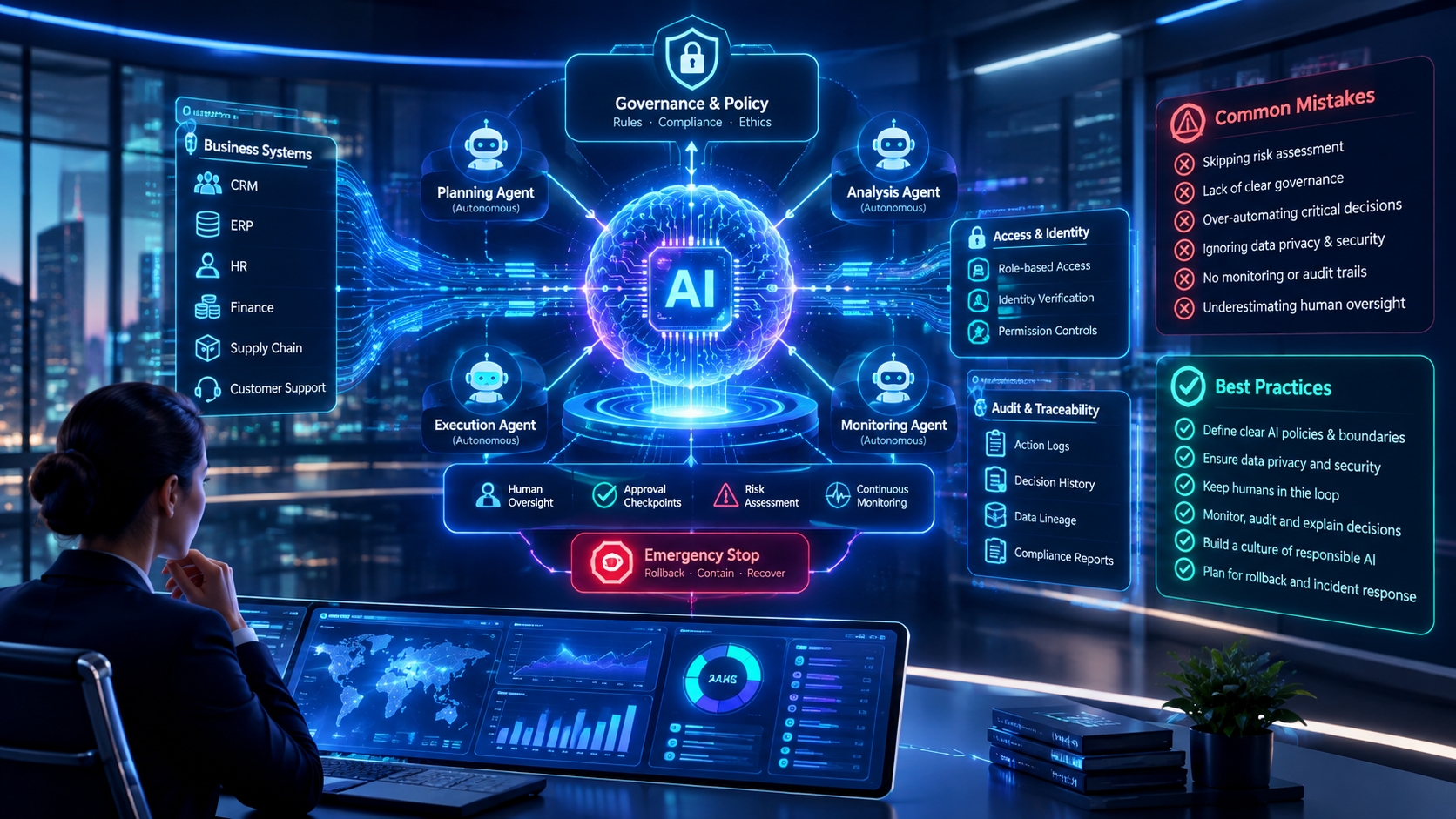
Most companies treat AI governance as a document, a policy PDF written by legal, filed away, and revisited once a year if a regulator asks. That approach worked reasonably well when AI systems mostly generated suggestions for a human to review. It stops working the moment those systems start taking action on their own, sending messages, approving transactions, modifying records, because by then the risk isn’t about what the AI might say. It’s about what it already did.
This shift is easy to underestimate because it happened gradually and across very different corners of a business at once. A team building better Image Search Techniques for a product catalog and a team deploying an autonomous customer service agent don’t seem to have much in common on the surface, but both are examples of AI making decisions that used to require a person, and both raise the same underlying question: who is accountable when the system gets it wrong, and how would anyone actually know?
Why This Is Suddenly Urgent
Three things changed roughly at once. Models got reliable enough at multi-step reasoning that giving them limited autonomy stopped being reckless and started being practical. The tooling to give AI systems real permissions, write access to databases, the ability to send communications, and control over workflows matured fast, turning “connect the agent to production” from a research exercise into a weekend project. And competitive pressure pushed teams to ship autonomous features quickly, often faster than their internal governance processes could keep pace with.
The result is a lot of AI systems running in production today with more authority than the organization deploying them has fully thought through.
The Mistakes That Show Up Again and Again
Treating governance as a one-time approval instead of an ongoing process. A model that was safe to deploy in January can behave differently by June, either because it was updated, because the data it’s working with shifted, or because users found new ways to interact with it that weren’t anticipated during testing. Governance that only happens at launch misses all of that.
No clear owner when something goes wrong. Ask who is accountable if an AI agent sends an incorrect message to a customer, approves a transaction it shouldn’t have, or leaks information it shouldn’t have accessed, and in a lot of organizations the honest answer is nobody’s entirely sure. That ambiguity isn’t a minor gap. It’s usually the first thing that surfaces, and the hardest thing to fix retroactively, when an incident actually happens.
Confusing explainability with a log file. Having a record that an action happened isn’t the same as being able to explain why it happened. A genuinely useful audit trail captures the reasoning an agent used, what information it had access to, and what alternatives it considered, not just a timestamp and an outcome.
Granting broad permissions because narrow ones are more work to set up. It’s faster to give an agent broad database access than to carefully scope exactly what it needs. It’s also the single most common way a contained mistake turns into a serious incident, because the blast radius of an error scales directly with the permissions the system was given in the first place.
No tested rollback plan. Teams plan carefully for how an agent should behave when everything works. Fewer plan carefully for how to detect that it’s misbehaving and shut it down cleanly before damage compounds, which matters far more once an agent has genuine write access to production systems.
What a Practical Governance Framework Actually Includes
Governance that survives contact with a real production incident tends to share a handful of features, regardless of industry.
Scoped permissions by default. An agent gets access to exactly what its task requires, nothing broader, with a documented reason for every permission it holds. Expanding access later is a deliberate decision, not a default setting nobody revisited.
A human in the loop at defined risk thresholds. Not every action needs human approval, that would defeat the purpose of automation, but high-stakes actions, anything involving money, customer communication, or irreversible changes, should have a clear, documented threshold above which a person signs off before the system acts.
Structured, reasoning-level logging. The system records not just what it did but why, including what context it had and what it considered, so an incident review can actually reconstruct the decision instead of guessing at it after the fact.
Named accountability. A specific person or team owns each deployed AI system’s behavior, the same way a specific team owns a piece of production software. “The AI did it” is not an acceptable answer during an incident review, and organizations that treat it as one tend to repeat the same category of mistake.
Regular re-evaluation, not a one-time sign-off. Governance reviews happen on a schedule, and specifically after any model update, data source change, or expansion of the agent’s permissions, not only when something has already gone wrong.
This is the same argument laid out in more depth in AI Transformation Is a Problem of Governance, and it applies just as directly to a narrow, purpose-built system like a messaging security agent screening for phishing as it does to any broader autonomous deployment. The technology differs. The accountability question doesn’t.
Getting Started Without Overcorrecting
Overcorrecting into governance that blocks every action for manual review defeats the purpose of building autonomous systems in the first place, and teams that go too far in that direction usually end up quietly routing around their own process. The more durable approach starts narrow: pick one AI system already in production, map exactly what it can access and act on, define what a human needs to review versus what it can handle independently, and build the audit trail before expanding its scope further. That’s a far more sustainable starting point than trying to write a comprehensive governance policy for systems that don’t exist yet.
Frequently Asked Questions
What is AI governance in simple terms?
It’s the set of processes, permissions, and accountability structures that determine how an AI system is allowed to act, who reviews its decisions, and who is responsible when something goes wrong.
Does every AI feature need the same level of governance?
No. The right level of oversight depends on the risk of the action, a chatbot suggesting a blog topic needs far less scrutiny than an agent with write access to financial systems.
Who should own AI governance inside a company?
It works best as a shared responsibility between technical teams who understand what the system can actually do and business or compliance teams who understand the regulatory and reputational stakes, rather than sitting entirely with one side.
How often should AI governance policies be reviewed?
At minimum, after any significant model update, data source change, or expansion of a system’s permissions, in addition to a regular scheduled review, since risk can shift even without an obvious trigger event.
Building an autonomous system with the right guardrails from the start is significantly easier than retrofitting them after an incident. That scoping work, defining permissions, oversight thresholds, and audit requirements before deployment, is a core part of what Mobcoder AI handles under its AI agent development services, so governance is built into the system rather than bolted on afterward.