
Think of a business that gets hundreds of enquiries every day. The sales team cannot call every lead on time. The support team answers the same questions again and again. Appointment reminders are still sent by hand. Some customers wait too long, and some never get a call back.
This is where the best AI voice call agent in India can help. An AI voice agent can handle suitable calls, reply quickly, and take repeat work off your team. Your staff can then spend more time on complex or high-value conversations.
In this guide, you will learn what an AI voice agent is, how it works, where it fits, how to choose one, and how to start. If you want a quick overview first, read our blog on AI Voice Agent for Business: Automate Calls, Support & Sales. Mishtel, a business communication provider, also offers related services such as IVR, SMS, and RCS messaging. We cover them later in this article.
What Is an AI Voice Call Agent?
An AI voice call agent is software that uses speech technology and artificial intelligence to understand what a person says on a call, reply in a natural voice, and complete set tasks. These tasks can include answering questions, booking appointments, or noting down lead details.
Many people confuse it with older call tools. Here is how they differ.
Approach | How it talks | Flexibility | Best for |
Traditional IVR | Plays menus: "Press 1 for sales" | Low | Simple call routing |
Recorded voice broadcast | Plays one message to many people | Very low | Announcements and alerts |
Rule-based auto calling | Follows fixed scripts and responses | Low to medium | Basic reminders |
Conversational AI voice agent | Understands speech and replies naturally | Medium to high | Enquiries, follow-ups, scheduling |
Human agent | Full human judgement and empathy | Highest | Complex, sensitive, high-value calls |
Keep one point in mind. What an AI voice agent can do depends on the platform, its setup, its integrations, and the languages it supports. Always test before you decide.
How Does an AI Voice Agent Work?
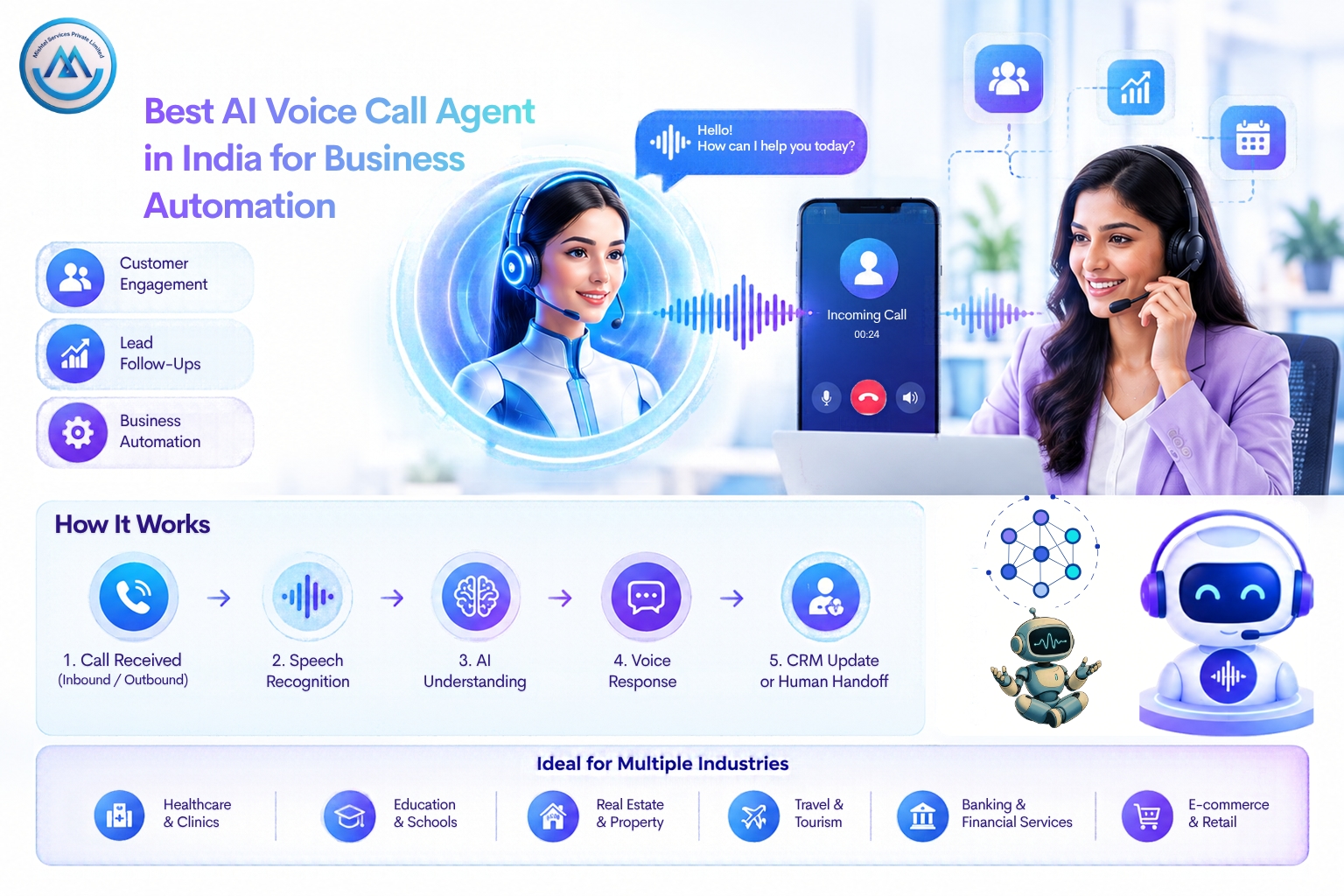
The process looks complex, but the idea is simple. Here is what happens in a typical call:
A customer calls your business, or the system makes an authorised outbound call.
The telephony platform connects the call.
Speech recognition turns the customer's voice into text.
The AI reads the request, using the conversation so far and your approved business information.
The AI prepares a suitable reply.
Text-to-speech turns that reply into spoken audio.
The agent speaks and the conversation continues.
The outcome is saved, and connected systems such as a CRM are updated if set up.
If the matter needs a person, the call is passed to a human agent, where the platform supports it.
Simple workflow:
Business Goal → Contact Data and Permissions → Call Initiation → Speech Recognition → AI Understanding → Spoken Response → Task or Escalation → CRM Update and Reporting
Not every platform works in exactly the same way. Some use real-time streaming for faster replies, and the technical design can differ from one provider to another. Telephony is the base of the whole process, so reliable [cloud telephony]([VERIFY: cloud telephony URL]) matters as much as the AI itself.
Read the Full Guide to Learn More