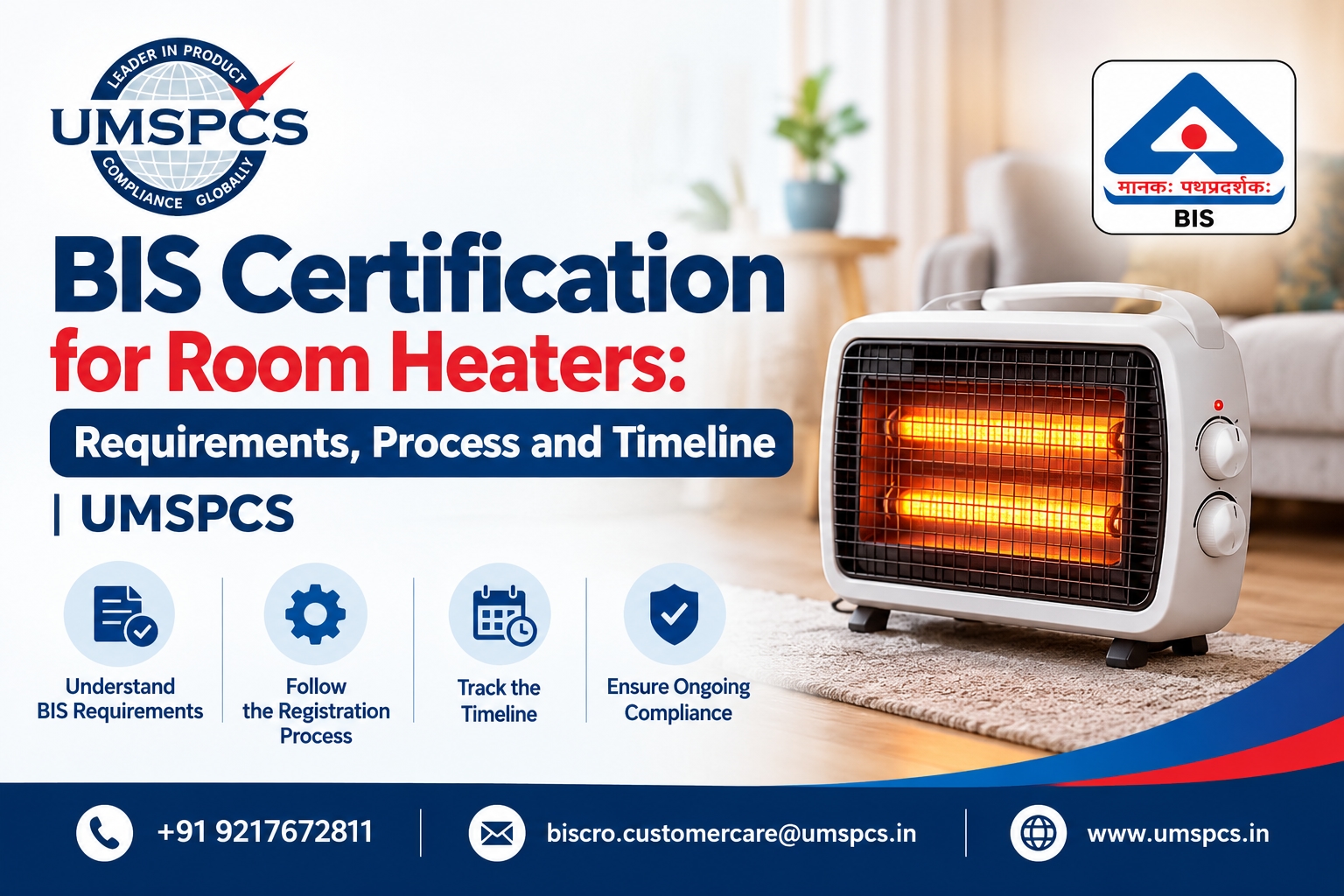
Every winter, thousands of room heaters move through Indian shops, online marketplaces and wholesale godowns. Regulators ask the question buyers don't. If you make, import or sell electric heaters here, BIS Certification for Room Heaters is not a nice-to-have badge. It is the legal ticket to the market, and getting it wrong can mean seized stock, blocked customs clearance and a lot of awkward phone calls.
This guide from UMSPCS sticks to what matters on the ground.
Why Room Heaters Fall Under BIS Rules
A room heater is a high-risk appliance by nature. It runs hot, it often runs unattended, and it sits close to curtains, bedding and children. That is the reason the Bureau of Indian Standards (BIS) treats electric heaters as a product that must be tested before sale.
Under the Indian Standards framework, room heaters are assessed against IS 302-2-30, the safety standard for household appliances that covers room heating appliances, read together with the general requirements of IS 302-1. Scopes get revised, so confirm the current notified scope before you start.
In short, the licence confirms that your product meets Indian safety norms and that your factory can keep making it to the same quality every time.
Who Needs BIS Certification for Room Heaters
You should plan for BIS Certification for Room Heaters if you are any of these:
· An Indian manufacturer of fan heaters, convection heaters, radiant heaters, oil-filled radiators or similar room heating products
· A foreign manufacturer exporting heaters to India
· An importer or brand owner selling heaters under your own label
Selling a heater without a valid ISI mark, where the order applies, can attract penalties under the BIS Act, and customs can hold consignments that lack the right paperwork. The real question is how quickly you can get certified.
How the ISI Mark Scheme Works
BIS Certification for Room Heaters runs under the BIS product certification scheme, which results in a licence to use the ISI mark certification in India. Unlike a one-time test report, this licence is tied to a specific factory and product. BIS looks at three things:
1. The product itself, tested against the relevant standard
2. The manufacturing unit and its in-house testing ability
3. The quality control system running day to day
That is why the process feels heavier than a simple lab test. You are proving the process, not one sample.
Step-by-Step Process for BIS Certification for Room Heaters
Here is how a typical application moves forward.
Step 1: Confirm scope and model grouping. Decide which heater models you want on the licence. Similar models can often be grouped.
Step 2: Prepare the factory. BIS expects a working test setup. You need calibrated instruments to check things like insulation resistance, leakage current, temperature rise and the operation of protective devices. Missing equipment is a common cause of delay.
Step 3: Gather documents. Usually this includes the application form, factory layout, a list of machines and test equipment, the quality control plan, circuit diagrams, a bill of materials, and proof of the business entity.
Step 4: Submit the application online. Applications go through the BIS portal with the prescribed fee.
Step 5: Factory inspection and sampling. A BIS officer visits the plant, reviews the quality system and draws samples of the heater.
Step 6: Independent testing. Samples go to a BIS-recognised laboratory. If a sample fails, you fix the issue and resubmit, which adds time.
Step 7: Grant of licence. After the reports and the inspection findings are cleared, BIS grants the licence and you can start marking products with the ISI mark.
Timelines depend on factory readiness and lab availability.
Read also Can a Vietnamese Manufacturer Apply Directly for BIS CRS Certification? A Practical Guide by UMSPCS
BIS Certification for Room Heaters: Foreign Manufacturers
Overseas brands usually apply under the Foreign Manufacturers Certification Scheme (FMCS). The structure is similar, but a few things change:
· You must appoint an Authorised Indian Representative (AIR) who handles communication with BIS
· Inspection happens at your overseas factory, and the inspection cost is borne by the applicant
· Documents may need to be submitted in English or with translations
· Testing is done in India or in a recognised lab, depending on the case
Many foreign companies underestimate the coordination this takes across time zones. A local partner who knows the paperwork and the officers' expectations avoids months of back-and-forth. This is where UMSPCS steps in.
Common Mistakes That Slow Things Down
A few patterns keep showing up:
· Wrong standard or scope. An outdated version wastes weeks.
· Weak in-house lab. Uncalibrated or missing equipment gets flagged.
· Inconsistent documents. Names and addresses must match exactly across documents.
· Poor labelling. Rating plates need the correct voltage, power rating and ISI marking in the prescribed format.
· Late planning. Brands remember certification after the winter stock is ordered. Start early.
Why Work with UMSPCS
Doing it alone is possible, but it eats time that most production heads do not have. At UMSPCS, our team handles the application, document preparation, lab coordination, inspection support and follow-up with BIS, and keeps you informed at each step. You get one point of contact, plus help with renewals and post-licence compliance.
Planning a new heater range this season? Speak to us before the factory is ready, not after.
Frequently Asked Questions
1. Is BIS certification mandatory for room heaters in India?
Room heaters are covered by BIS safety requirements, and products notified under the relevant order cannot be made, imported or sold without the ISI mark. Always confirm the current notification for your exact product type.
2. Which standard applies to BIS Certification for Room Heaters?
Room heaters are generally assessed against IS 302-2-30 along with IS 302-1. The scope can change, so we verify it at the start of each project.
3. How long does BIS Certification for Room Heaters take?
It varies with factory readiness, lab availability and whether any sample needs retesting. A prepared applicant usually finishes much sooner than one who has to fix gaps during inspection.
4. Can a foreign manufacturer apply directly for BIS Certification for Room Heaters?
Yes, under FMCS. You will need an Authorised Indian Representative, and the BIS inspection takes place at your overseas plant.
5. Can one licence cover several heater models?
Often yes. Models with similar construction and design can be grouped under one licence, though BIS decides what qualifies.
6. What happens if I sell heaters without BIS Certification for Room Heaters?
You risk penalties under the BIS Act, seizure of stock and customs holds on imports. Certifying costs far less than fighting enforcement.
7. Does the licence expire?
Yes. The licence is granted for a fixed period and must be renewed on time, with continued compliance and periodic surveillance by BIS.
Final Word
Winter demand does not wait for paperwork. Whether you manufacture in Noida or Nanjing, BIS Certification for Room Heaters is the step that decides whether your product reaches Indian homes legally. Plan it early, keep your factory records clean, and get experienced help.
Ready to start? Reach out to UMSPCS and we will map out your route to the ISI mark.