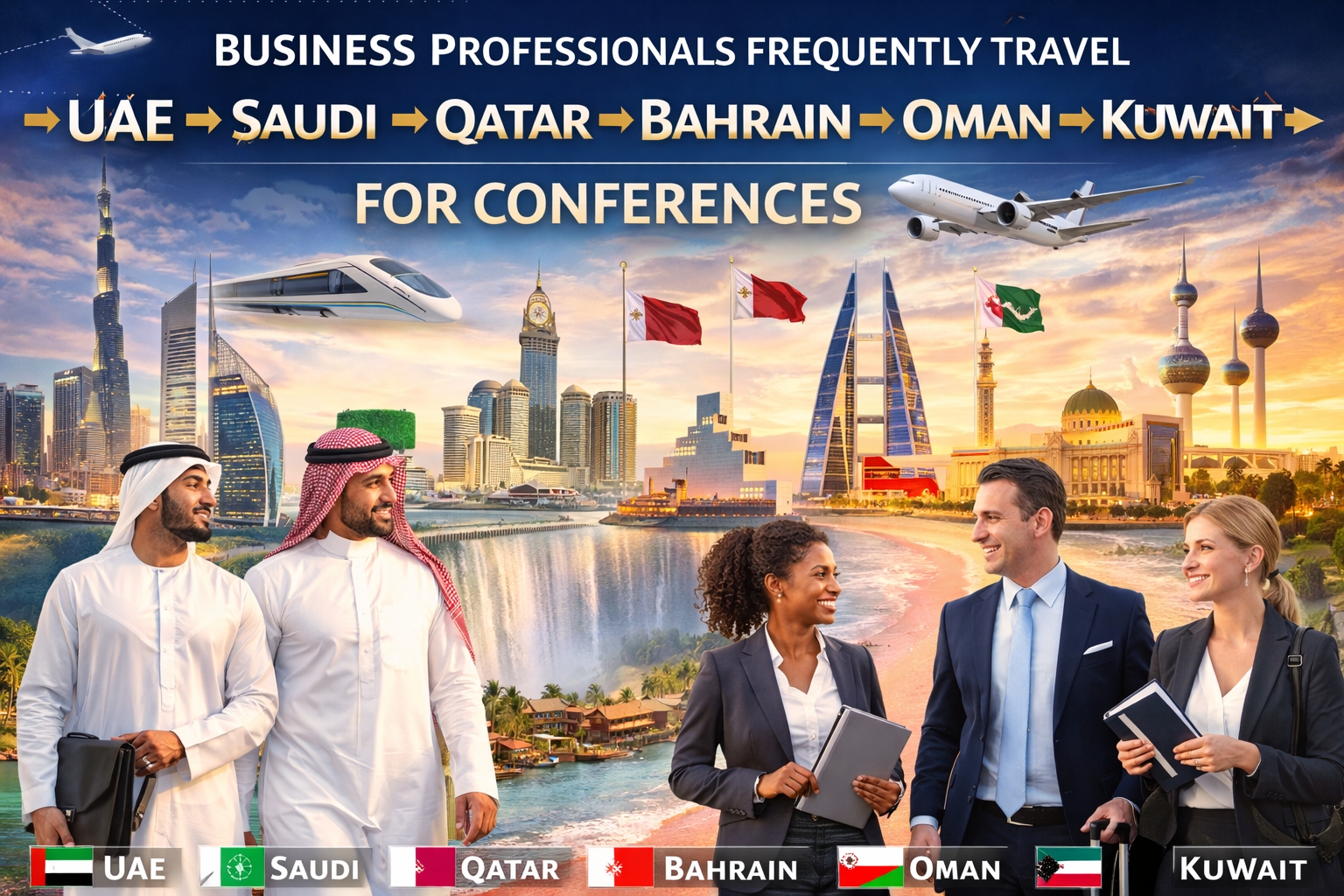
The Gulf Cooperation Council (GCC) region has rapidly transformed into one of the most significant corridors for global commerce. For business professionals, the route between the UAE, Saudi Arabia, Qatar, Bahrain, Oman, and Kuwait is no longer just a series of flights; it is a vital circuit for high-stakes conferences, networking, and investment. Whether you are a tech founder attending a summit in Riyadh or a logistics expert meeting partners in Jebel Ali, understanding the nuances of this region is key to your success.
In this comprehensive guide, we provide a deep dive into everything you need to know about navigating the GCC for business, ensuring your journey is as productive as it is seamless.
1. Why is the GCC becoming a global hub for business conferences?
The GCC’s ascent as a global hub is the result of decades of visionary planning and massive infrastructure investment. Countries like the UAE and Qatar have set the standard for "MICE" (Meetings, Incentives, Conferences, and Exhibitions) tourism. Cities like Dubai, Doha, and Riyadh boast world-class convention centers that can accommodate tens of thousands of delegates simultaneously.
Beyond the physical buildings, the region sits at a strategic "Goldilocks" zone—equidistant between Europe, Africa, and Asia. This makes it the ideal neutral ground for international organizations to host annual general meetings and global trade shows. From the World Economic Forum sessions to COP28, the world’s biggest decisions are increasingly being made in the Gulf.
2. What are the common visa requirements for a multi-country GCC trip?
Navigating the entry requirements for six different nations can seem daunting, but the digital transformation of the region has simplified things. For most international business travelers, the primary requirement is a passport with at least six months of validity.
While GCC nationals enjoy visa-free movement, foreign residents and international visitors must secure specific permits for each country. The most common solution is the eVisa. These electronic authorizations allow you to skip the consulate and handle everything from your laptop. However, it is important to note that a "business visit" often requires different documentation than a simple "tourist visit," though many eVisas now cover both categories for short-term stays.
3. Can I get a single visa for all six GCC countries?
The most frequent question asked by corporate travelers is whether a "Schengen-style" visa exists for the Gulf. The answer is: almost. The GCC member states have officially approved the "GCC Grand Tours Visa," a unified permit that will eventually allow travelers to move across all six nations on one single document.
While this system is in its final stages of rollout and pilot testing, travelers currently still need to apply for individual visas for each stop. Keeping a digital folder with your passport copies, flight bookings, and invitation letters will make these individual applications much easier to manage until the unified system is fully operational.
4. How do I apply for a Saudi Arabia eVisa for business?
Saudi Arabia is currently the fastest-growing market in the region, driven by the ambitious Vision 2030 project. To facilitate this growth, the Kingdom has made entry incredibly accessible. Business travelers from eligible countries can quickly apply for Saudi Arabia eVisa online.
The process typically takes less than 24 hours. The eVisa is usually a multiple-entry permit valid for one year, allowing you to stay for up to 90 days per visit. This is perfect for consultants and executives who need to visit Riyadh or Jeddah multiple times throughout the year for ongoing projects.
5. What is the process for a Bahrain business visa?
Bahrain is often referred to as the "Gateway to the Gulf" due to its liberal business environment and strategic link to Saudi Arabia via the King Fahd Causeway. For those attending financial summits or tech meetups in Manama, obtaining a Bahrain business visa is a priority.
The Bahraini government offers a very efficient electronic system. Most business eVisas are processed within 3 to 5 working days. It is advisable to have your local sponsor’s details or a conference invitation letter ready to upload, as this ensures your application is processed without delays.
6. How can I quickly secure a Kuwait eVisa?
Kuwait remains a powerhouse in the energy and finance sectors. While its visa rules can be slightly stricter than its neighbors, the online system has made it much faster for professionals to enter. You can initiate the Kuwait eVisa process if you belong to the list of 50+ eligible nationalities or hold residency in another GCC country.
When applying for Kuwait, ensure that your professional title on your passport matches your business intent. The Kuwaiti authorities are thorough, so double-checking your entry and exit dates is essential for a smooth arrival at Kuwait International Airport.
7. What are the latest entry rules for Qatar?
Following the global spotlight of the 2022 World Cup, Qatar has streamlined its entry procedures significantly. Doha is now a premier destination for maritime and aviation conferences. To enter for a meeting or trade show, securing a Qatar business visa is the most reliable method.
Qatar also utilizes the "Hayya" platform for certain events, but for standard business travel, the eVisa remains the gold standard. It allows for a stay of up to 30 days and can often be extended if your business negotiations require more time on the ground.
8. Is an eVisa required for business meetings in Oman?
Oman offers a unique blend of traditional culture and modern business infrastructure. With the development of the Duqm Special Economic Zone, more professionals are heading to Muscat. For these travelers, utilizing Oman eVisa services is the most efficient way to clear immigration.
Oman generally offers several types of visit visas, including short-term 10-day stays and longer 30-day stays. For a quick conference, the 10-day option is cost-effective and very fast to obtain.
9. How do I manage UAE visa requirements for frequent hops?
The UAE is usually the "base of operations" for most professionals in the region. With Dubai and Abu Dhabi serving as global aviation hubs, you may find yourself entering and exiting the UAE several times in a single month. Checking the latest UAE business visa regulations is vital.
Depending on your nationality, you might be eligible for a visa-on-arrival, but for those who aren't, a pre-arranged eVisa is mandatory. The UAE has also introduced "Green Visas" and "Golden Visas" for long-term investors, which are worth exploring if you plan to make the Emirates your permanent regional headquarters.
10. What is the best way to travel between GCC capitals?
Aviation is the lifeblood of GCC travel. The region is home to some of the world’s best airlines, including Emirates, Qatar Airways, and Etihad. For budget-conscious business travelers, carriers like Flydubai and Flynas offer frequent "shuttle" style flights between major cities like Dubai and Riyadh.
If you are traveling between Bahrain and Saudi Arabia's Eastern Province, the King Fahd Causeway offers a unique road travel experience, though be prepared for potential traffic during peak weekend hours. For most, the 45-minute to 2-hour flights between capitals remain the most productive use of time.
11. What should I know about business etiquette in the Gulf?
Business in the GCC is built on relationships and trust. Unlike the purely transactional nature of some Western markets, "small talk" in the Gulf is actually a vital part of the negotiation process. Do not be surprised if the first 20 minutes of a meeting are spent discussing health, family, and travel over traditional Arabic coffee (Gahwa).
Patience is a virtue here. Decisions may take time as they often involve multiple layers of consensus. Always use your right hand for eating, drinking, and shaking hands, and be mindful of prayer times, which may briefly pause the business day.
12. Are there specific dress codes for conferences?
While cities like Dubai and Doha are very international, the GCC is generally conservative. For men, a standard business suit is expected in professional settings. For women, business attire that covers the shoulders and knees is the standard.
In Saudi Arabia and Kuwait, the dress code is slightly more formal. While female foreign visitors are not required to wear the Abaya (traditional cloak) in most settings anymore, dressing modestly is a sign of respect that goes a long way in building professional rapport.
13. How can I ensure reliable internet and connectivity?
Connectivity is rarely an issue in the Gulf, which boasts some of the world’s fastest mobile internet speeds. Most airports have kiosks where you can pick up a local SIM card in minutes. However, for the multi-country traveler, a "Regional eSIM" is a better investment, allowing you to maintain data across all six countries without swapping cards.
Apps like WhatsApp and LinkedIn are essential for business communication here, though be aware that some VOIP features (like WhatsApp calling) may have restrictions in certain countries, requiring you to use Zoom or Microsoft Teams for virtual meetings.
14. What are the peak times for business travel in the region?
The business calendar in the GCC is heavily influenced by two factors: weather and religion. The peak season is from October to April when the weather is mild and pleasant. This is when the largest conferences take place.
During the holy month of Ramadan, the pace of business slows down significantly. Working hours are shortened, and many senior decision-makers may be less available for meetings. Similarly, the summer months (June to September) are extremely hot, and many local executives travel abroad, making it a quieter time for the MICE industry.
15. How do I handle currency and payments?
The financial systems in the GCC are highly advanced. Most currencies (the UAE Dirham, Saudi Riyal, Qatari Riyal, Omani Rial, and Bahraini Dinar) are pegged to the US Dollar, providing a stable exchange rate environment. The Kuwaiti Dinar is pegged to a basket of currencies but remains very stable.
Credit cards and digital wallets (Apple Pay, Google Pay) are accepted almost everywhere, from high-end hotels to small cafes. However, carrying some local cash is still recommended for tipping, small taxi fares, or visiting traditional souqs (markets).
16. What are the top tips for a stress-free business trip?
Documentation: Always carry a printed copy of your eVisa. While digital copies are usually sufficient, some border points prefer physical documents.
Logistics: Download local ride-hailing apps like Careem or Uber. They are far more reliable and transparent than street taxis for getting to conference venues on time.
Health: Stay hydrated. Even if you are spending most of your time in air-conditioned halls, the desert climate can be dehydrating.
Insurance: Ensure your travel insurance covers the entire GCC region, not just a single country.
Why Choose Us?
Reliable Travel Visa Services Our global approach has assisted numerous travelers in obtaining their Visa with ease and precision. We understand the high stakes of business travel and ensure your documentation is handled with the utmost care.
Round-the-Clock Assistance Business doesn't sleep, and neither do we. Reach out to us 24/7, and our experts will respond to your inquiries within 72 hours, providing you with peace of mind regardless of your time zone.
Experienced Visa Consultants Navigate complex and ever-changing regional regulations with confidence. Receive expert guidance from specialists who stay updated on the latest policy shifts to ensure the highest chance of acceptance for your application.
Efficient Visa Application Process Time is the most valuable asset for any professional. Apply for your Visa in minutes with our simplified and intuitive form, designed to get you from the screen to the sky as quickly as possible.