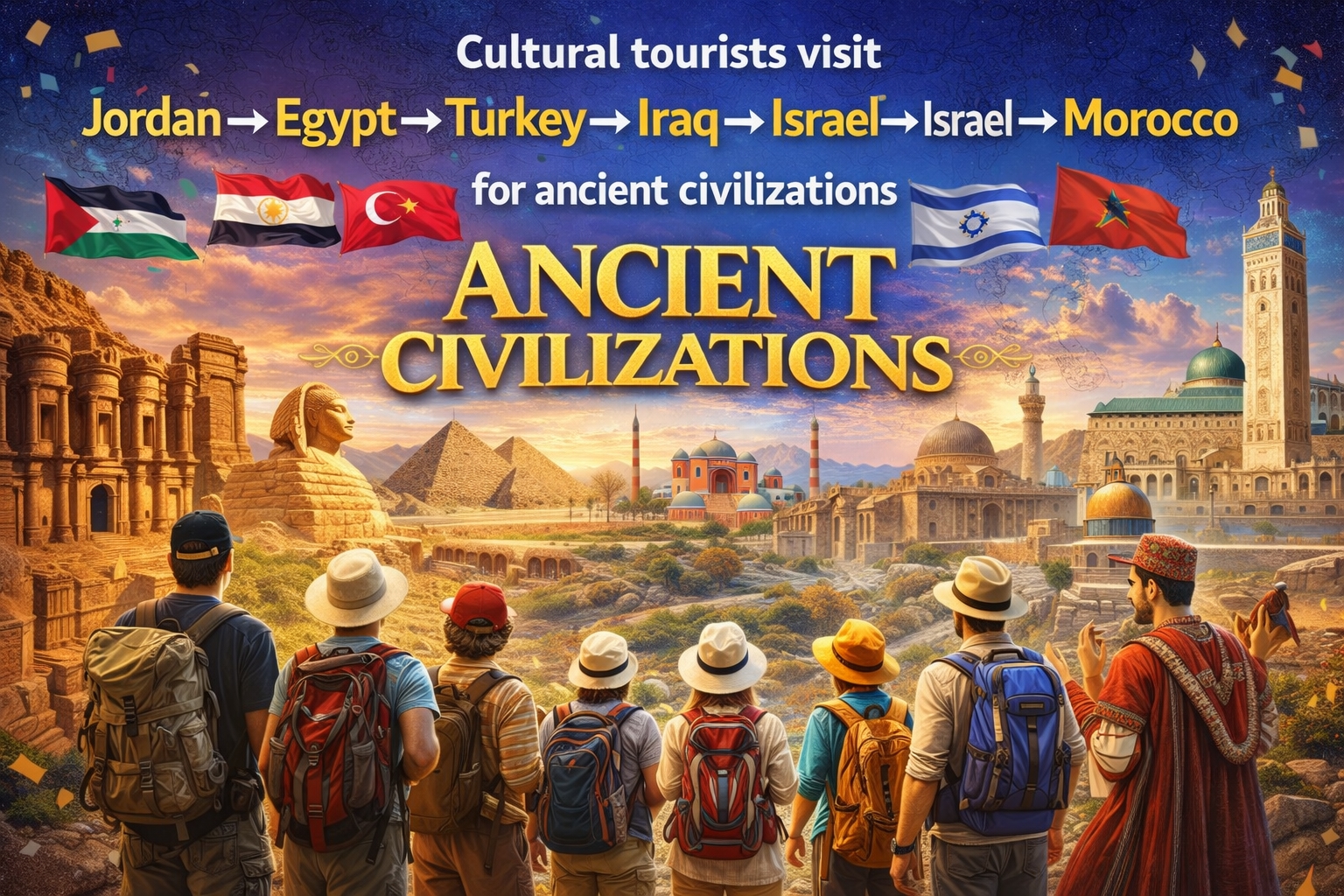
For many, travel is more than just a vacation; it is a pilgrimage to the roots of human history. The cradle of civilization isn't found in a single city, but across a vast, sun-drenched corridor that bridges the gap between Africa, Asia, and Europe. From the rock-cut facades of Jordan to the imperial medinas of Morocco, this journey through Jordan, Egypt, Turkey, Iraq, Israel, and Morocco offers an unparalleled look at the empires that shaped our modern world.
In this guide, we dive deep into the heart of these ancient lands, exploring the landmarks you cannot miss and the logistical tips to make your dream itinerary a reality.
1. What is the best itinerary for visiting ancient civilizations in the Middle East?
A logical route typically follows the historical timeline of the region. Most travelers start in Jordan to see the Nabataean wonders before moving to the Pharaonic heartland of Egypt. From there, a flight to Turkey reveals the Greco-Roman and Byzantine eras. To complete the circle, adventurers head to the Mesopotamian ruins of Iraq, the spiritual heritage of Israel, and finally, the Moorish architectural splendor of Morocco.
2. Walking Through the Rose-Red City: Why is Petra in Jordan a Must-See?
Jordan’s crown jewel, Petra, is more than just a photo opportunity at the Treasury (Al-Khazneh). It is a sprawling metropolis carved directly into sandstone cliffs by the Nabataeans over 2,000 years ago. Cultural tourists should also visit the Roman ruins of Jerash, often called the "Pompeii of the East," and the desert castles that tell stories of early Islamic history.
3. Decoding the Pharaohs: What are the top historical sites in Egypt?
No cultural tour is complete without the Giza Plateau, home to the Great Pyramids and the Sphinx. However, for a deeper dive, the Valley of the Kings in Luxor offers a glimpse into the opulent burials of Tutankhamun and Ramses II. Don’t miss the Temple of Philae in Aswan, which was painstakingly moved piece-by-piece to save it from the rising waters of the Nile.
4. Where East Meets West: How does Turkey showcase Byzantine and Ottoman history?
In Istanbul, the Hagia Sophia stands as a testament to two great religions and empires. Moving inland, the underground cities of Cappadocia and the sprawling ruins of Ephesus provide a tactile connection to early Christian and Roman life. Turkey is where you see the physical transition from Western classical antiquity to the vibrant Islamic art of the Ottomans.
5. The Cradle of Life: Is it possible to visit ancient Mesopotamia in Iraq?
Iraq is home to Babylon, the city of Hammurabi and Nebuchadnezzar II. While security has been a concern in the past, modern cultural tourism is returning to the Ziggurat of Ur and the spiral minaret of Samarra. These sites represent the very beginning of organized urban life, writing, and law.
6. A Journey Through Faith: What makes Israel’s historical sites unique?
Israel offers a layer-cake of history. In Jerusalem, you can stand at the Western Wall, visit the Church of the Holy Sepulchre, and view the Dome of the Rock all within a short walk. Beyond the religious significance, the fortress of Masada tells a harrowing story of Roman siege and Jewish resistance overlooking the Dead Sea.
7. Moorish Elegance: What are the cultural highlights of Morocco?
Morocco serves as the Western gateway to Islamic civilization. The ancient Roman ruins of Volubilis are surprisingly well-preserved, but the true draw is the living history in the Fes Medina. With its 9,000 alleys and centuries-old tanneries, Fes feels like a time capsule of the medieval Arab world.
8. How to get a travel visa for Egypt, Turkey, and Jordan?
Navigating the paperwork for a multi-country tour can be the most stressful part of the trip. Most of these nations now offer electronic entry permits. For instance, the Egypt eVisa online has streamlined the process for tourists, while the Turkey eVisa application allows travelers to bypass long airport queues. Similarly, completing a Jordan eVisa registration before arrival ensures a smoother transition through border control. Always ensure your passport is valid for at least six months from your entry date.
9. What is the best time of year for a cultural tour of the Middle East?
To avoid the blistering desert heat, the best window is from October to April. Spring (March and April) is particularly beautiful in Jordan and Turkey, as wildflowers bloom among the ruins. If you travel during Ramadan, be mindful of local customs regarding eating and drinking in public during daylight hours.
10. How to stay safe while traveling through Iraq and the Levant?
Cultural tourism in Iraq and parts of the Levant requires planning. It is highly recommended to travel with experienced guides who understand the local landscape. Always check your home country’s travel advisories and ensure you have comprehensive travel insurance that covers "off-the-beaten-path" destinations.
11. What should I pack for a history-focused trip in these regions?
Comfortable Footwear: You will be walking miles over uneven stone and sand.
Modest Clothing: Both men and women should carry light layers (linen or cotton) that cover shoulders and knees to respect local religious sites.
A Good Power Bank: E-visas and digital maps are essential, and you don't want your phone dying mid-tour.
12. Why Choose Us for Your Travel Visa Needs?
Planning a six-country expedition requires precision. We simplify the most complex part of your journey: the documentation.
Reliable Travel Visa Services: Our global approach has assisted numerous travelers in obtaining their documentation for ancient destinations. You can easily apply for an Iraq eVisa or secure a Morocco electronic visa through our dedicated systems.
Round-the-Clock Assistance: Reach out to us 24/7. Our experts understand the urgency of international travel and will respond to your queries within 72 hours.
Experienced Visa Consultants: Don’t leave your application to chance. Whether you are using the Israel eVisa portal or navigating other regional requirements, receive expert guidance to ensure your application meets all government standards.
Efficient Visa Application Process: Time is of the essence. Our simplified, user-friendly forms allow you to submit your details in just a few minutes, avoiding the bureaucratic hurdles of traditional embassies.
Final Thoughts
A journey through these six nations is more than a tour—it’s an education. By witnessing the scale of the Pyramids, the intricate carvings of Petra, and the spiritual energy of Jerusalem, you connect with the shared heritage of humanity. With the right preparation and a reliable partner to handle your travel documentation, the wonders of the ancient world are yours to discover.