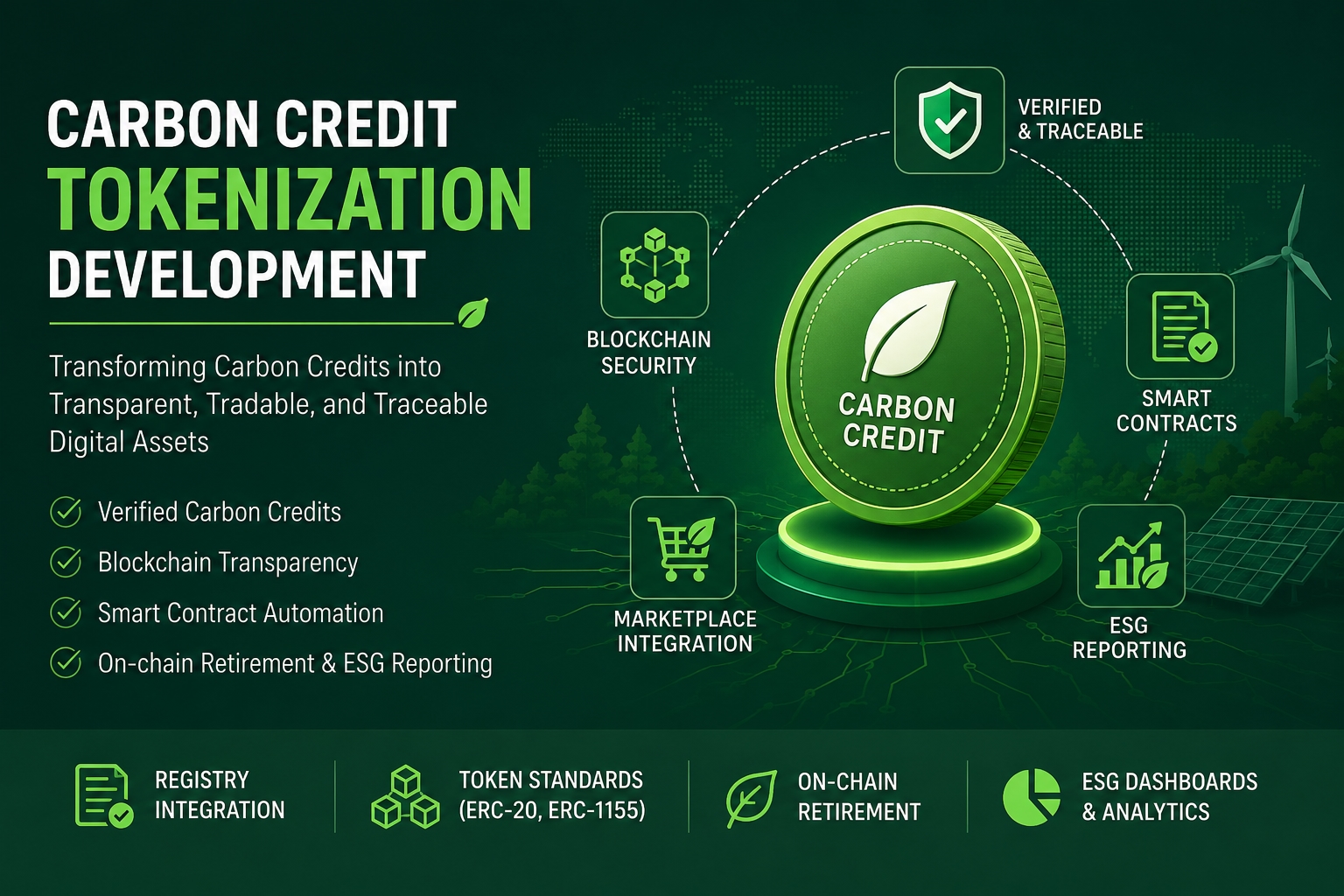
The transition toward a lower-carbon economy is creating new demand for reliable carbon markets. Businesses, investors, and sustainability-focused organizations increasingly need better ways to discover, purchase, track, and retire carbon credits.
At the same time, carbon markets can involve multiple registries, verification processes, project methodologies, ownership records, and retirement procedures. This complexity has created an opportunity for blockchain technology to provide a more transparent digital layer for carbon assets.
This is where Carbon Credits Tokenization Platform Development comes into focus.
By converting verified carbon credits into blockchain-based digital assets, businesses can create platforms designed to manage carbon credits across their lifecycle—from verification and token issuance to trading and retirement.
What Is Carbon Credit Tokenization?
A carbon credit generally represents a verified reduction, avoidance, or removal of greenhouse-gas emissions. In many carbon-market systems, a credit represents one metric tonne of carbon dioxide equivalent.
Carbon credit tokenization involves creating a blockchain-based digital representation of an eligible carbon credit.
The process can be viewed as:
Verified Carbon Credit → Registry Verification → Tokenization → Digital Ownership → Trading → Retirement
The blockchain token is not valuable simply because it exists on a blockchain. Its credibility depends on the underlying environmental asset, its provenance, verification status, registry relationship, and the mechanisms used to prevent double counting.
This distinction is important when designing a carbon tokenization platform.
Why Is Carbon Credit Tokenization Gaining Attention?
Traditional carbon-market infrastructure can involve fragmented databases and multiple intermediaries. Participants may need to check project details, certification information, credit vintages, ownership records, and retirement status.
Blockchain can provide a shared transaction layer where important events can be recorded in a way that is easier to audit.
A properly designed platform can potentially provide:
Transparent ownership records
Digital transfer of carbon assets
On-chain issuance and retirement
Automated smart-contract workflows
Registry integration
Fractionalization capabilities
Corporate ESG reporting
Digital marketplaces
The goal is not to replace the environmental verification process with blockchain. Instead, blockchain can complement existing carbon-market infrastructure by providing digital tools for managing verified assets.
How Does a Carbon Credits Tokenization Platform Work?
A complete platform usually involves several interconnected components.
1. Carbon Credit Assessment
Before tokenization begins, the platform needs to establish which carbon credits can be represented digitally.
Relevant information can include:
Carbon project details
Certification standard
Credit vintage
Quantity of credits
Project methodology
Registry information
Ownership status
Retirement status
The quality of this underlying information is fundamental. Tokenization cannot transform an unsuitable carbon credit into a high-quality environmental asset.
2. Registry Integration
Carbon markets rely on registries to maintain information about issued credits and their lifecycle.
A tokenization platform can integrate with registry systems to retrieve and synchronize relevant information. Clarisco's platform describes integration with registries and standards including Verra, Gold Standard, and ACR.
A multi-registry architecture can be particularly useful for businesses that want to support different types of carbon projects within one platform.
3. Smart Contract Development
Smart contracts provide the rules governing tokenized carbon assets.
Depending on the platform's requirements, developers may use standards such as ERC-20 or ERC-1155.
Smart contracts can be designed to support functions such as:
Token issuance
Token transfers
Batch management
Transfer controls
Credit retirement
Ownership tracking
Registry synchronization
Security should be a major consideration because errors in smart-contract logic can create financial and operational risks.
4. Token Issuance
After the underlying credits have been appropriately verified and mapped, the platform can issue digital tokens according to its tokenization model.
The token should maintain a clear relationship with the underlying carbon credit.
This can include metadata associated with the project, certification, vintage, quantity, and lifecycle status.
The stronger this connection is, the easier it becomes for users to understand what a token actually represents.
5. Marketplace and Trading
Once carbon credits are represented digitally, a platform can provide marketplace functionality for eligible users.
Depending on the business model, this may include:
Buy and sell functionality
Order management
Corporate purchasing
OTC trading
Portfolio management
Credit pricing
Secondary-market functionality
A marketplace can make carbon assets easier to discover and transact digitally, while compliance and eligibility rules determine who can participate.
6. Carbon Credit Retirement
Retirement is one of the most important parts of the carbon-credit lifecycle.
When a carbon credit is retired, it should no longer be available for another party to claim the same environmental benefit.
A tokenization platform can use on-chain retirement mechanisms to create a visible record of the retirement event. Clarisco specifically lists on-chain credit retirement and registry synchronization among its platform capabilities.
This can provide organizations with a digital trail for their carbon-credit activity.
Important Features of a Carbon Credits Tokenization Platform
A strong platform requires more than a token contract. It needs infrastructure connecting carbon-market data, blockchain technology, users, compliance, and reporting.
On-Chain Issuance and Retirement
Recording issuance and retirement events on-chain can improve traceability throughout the asset lifecycle.
Multi-Registry Integration
Connecting different registry systems can help platforms support carbon credits from multiple sources while maintaining relevant project information.
Fractional Tokenization
Fractionalization can divide eligible carbon-credit batches into smaller digital units. This can potentially make participation more accessible, depending on the platform's legal and commercial structure.
KYC and AML Workflows
Platforms serving investors or corporate buyers may require identity verification and compliance processes.
KYC and AML functionality can be integrated into the user-onboarding process.
ESG Dashboards
Corporate users may need tools to monitor purchased and retired credits and organize information for internal sustainability reporting.
A dedicated dashboard can bring these activities together in one interface.
Real-Time Monitoring
Carbon projects can involve data from different sources, including IoT devices and other monitoring systems.
Clarisco's platform describes real-time MRV integration and an AI-powered verification layer that can work with registry information, satellite data, and IoT inputs.
Such systems should be viewed as supporting verification and monitoring rather than replacing established environmental certification processes.
Carbon Credit Tokenization and the Toucan Protocol
Interoperability is another important consideration in blockchain-based carbon markets.
Clarisco describes compatibility with the Toucan Protocol and integration with blockchain-based carbon-market infrastructure as part of its tokenization solutions.
For businesses exploring this approach, interoperability can help connect tokenized environmental assets with broader blockchain ecosystems.
However, integration decisions should be based on the project's specific requirements, supported assets, target users, jurisdiction, and compliance model.
Green Energy Tokenization
Carbon credits are not the only environmental assets that can potentially be digitized.
Tokenization can also be applied to environmental and renewable-energy assets such as:
Renewable energy certificates
Solar energy assets
Wind energy-related environmental assets
Hydropower sustainability assets
Clarisco also lists green energy tokenization as part of its development services.
This creates an opportunity to build broader environmental-asset platforms rather than focusing exclusively on carbon credits.
Business Models for Carbon Tokenization Platforms
A carbon tokenization platform can generate revenue through different models depending on its target market.
Transaction Fees
The platform can charge a fee for eligible purchases, trades, or retirement transactions.
Asset Onboarding Fees
Project developers or asset providers may pay for onboarding and technical integration.
Subscription Plans
Corporate customers can potentially pay recurring fees for analytics, portfolio management, ESG dashboards, or reporting tools.
Marketplace Fees
A marketplace can charge fees for transactions executed through its trading infrastructure.
White-Label Solutions
Organizations that want to launch a branded platform can use a white-label architecture instead of developing every component from scratch.
The appropriate model depends on the target market, regulatory structure, asset type, and platform economics.
Challenges in Carbon Credit Tokenization
Tokenization offers opportunities, but it also introduces important challenges.
Avoiding Double Counting
One environmental benefit should not be claimed multiple times.
The platform therefore needs strong links between tokenized assets and their underlying registry records, along with reliable retirement procedures.
Maintaining Asset Quality
Blockchain does not automatically verify whether a carbon project delivers the environmental benefit it claims.
Project quality, methodology, additionality, permanence, verification, and registry status remain essential considerations.
Regulatory Compliance
Carbon credits and digital tokens can be treated differently depending on the jurisdiction and structure.
Businesses should obtain appropriate legal and regulatory advice before launching a platform, particularly when the platform involves investment, trading, retail participation, or cross-border transactions.
Smart Contract Security
Smart contracts should undergo rigorous testing and security review before handling valuable assets.
Access controls, contract permissions, upgrade mechanisms, and transaction logic should all be carefully designed.
Interoperability
Different registries and blockchain networks may use different data structures and technical standards.
A scalable platform therefore needs an architecture capable of handling these differences without compromising data consistency.
Why the Technology Architecture Matters
A carbon tokenization platform is not simply a blockchain application.
A typical architecture may contain:
Carbon Registries
↓
Verification & MRV Layer
↓
Tokenization Engine
↓
Smart Contracts
↓
Blockchain Network
↓
Marketplace & Wallet Infrastructure
↓
ESG Reporting & Retirement
Around these components, the platform may also require identity verification, compliance controls, analytics, monitoring, and administrative tools.
This is why choosing the right development architecture is one of the most important decisions when starting a carbon tokenization project.
The Future of Carbon Credit Tokenization
The carbon market is moving toward increasingly digital infrastructure.
Blockchain can provide a foundation for representing environmental assets digitally, while AI, IoT, satellite data, smart contracts, and automated reporting can add additional layers of functionality.
The long-term opportunity is therefore larger than simply creating a carbon token.
It is about creating an ecosystem where environmental assets can be:
Verified → Digitized → Tracked → Transferred → Retired → Reported
For businesses entering this market, the focus should remain on environmental integrity and transparency rather than tokenization alone.
Final Thoughts
Carbon Credits Tokenization Platform Development sits at the intersection of blockchain, climate technology, real-world asset tokenization, and digital marketplaces.
A well-designed platform can bring together registry integration, smart contracts, digital asset management, marketplace functionality, compliance workflows, and ESG reporting.
But successful tokenization requires more than blockchain development.
The underlying carbon credits need to be properly verified, their provenance must remain clear, double counting must be addressed, and the platform must be designed around applicable regulatory requirements.