
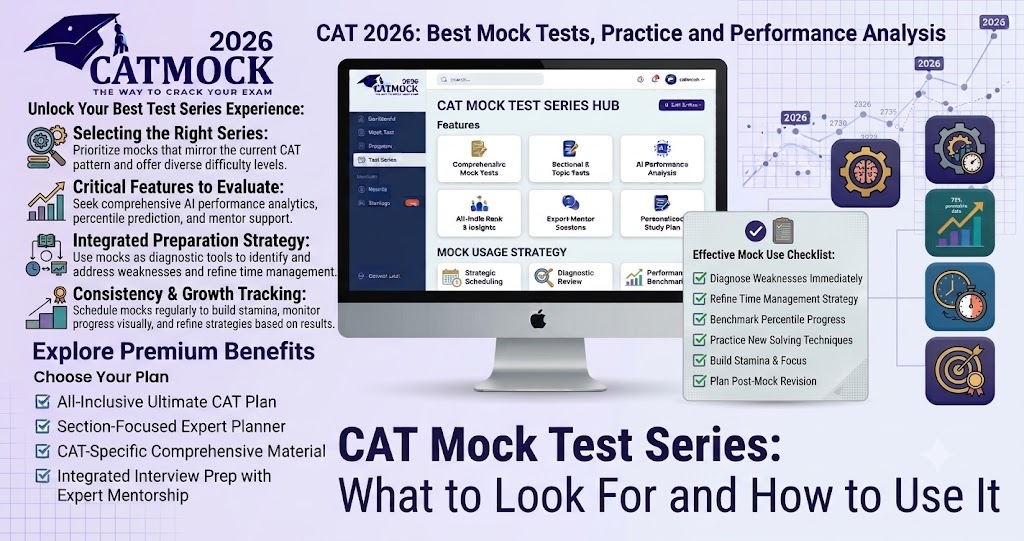
Preparing for CAT requires more than learning concepts and solving practice questions. Aspirants must also develop time management skills, improve accuracy, and learn to select questions strategically. A CAT mock test series provides an opportunity to practise under timed conditions and evaluate your readiness for the actual examination.
CAT has three sections: Verbal Ability and Reading Comprehension (VARC), Data Interpretation and Logical Reasoning (DILR), and Quantitative Ability (QA). Practising all three sections regularly helps you identify weaknesses and build a balanced preparation strategy.
Why Is a CAT Mock Test Series Important?
Mock tests help you understand how effectively you can apply your knowledge within a limited time. They also reveal mistakes that may not be obvious during regular practice.
Some key benefits include:
Time management: Learn to distribute time effectively across sections.
Accuracy improvement: Identify calculation errors and conceptual misunderstandings.
Better question selection: Recognise questions that are worth attempting and avoid spending too long on difficult ones.
Performance tracking: Monitor your scores and identify recurring weaknesses.
Exam confidence: Become familiar with timed tests and the examination format.
Remember that mock tests are most useful when you analyse your performance after every attempt.
Features to Look for in a CAT Mock Test Series
Before choosing a test series, consider the following features.
1. Full-Length Mock Tests
Full-length mocks simulate the complete examination experience. They help you practise all three sections under timed conditions and evaluate your overall strategy.
Choose tests that reflect the latest available CAT examination pattern.
2. Sectional Mock Tests
Sectional tests focus on VARC, DILR, or QA individually. They are helpful when you want to improve a particular section without attempting a complete mock.
For example, regular DILR practice can help you become more comfortable with arrangements, tables, charts, and logical puzzles.
3. Detailed Solutions and Performance Analytics
A useful test series should help you understand why an answer is correct and where your approach went wrong.
Performance analysis can help you identify accuracy issues, time-consuming questions, and topics that require revision. Use these findings to plan your next practice session.
4. Previous Year Questions
Previous year questions provide exposure to actual CAT questions and help you understand how concepts are tested. Combining them with mock tests creates a more comprehensive preparation routine.
5. Daily Practice Resources
Daily practice helps you maintain consistency between full-length mocks. Topic-wise questions, reading comprehension passages, and DILR sets can help strengthen your fundamentals.
Prepare with CATMOCK
CATMOCK is an online self-preparation platform designed to support CAT and other MBA entrance exam aspirants. It brings together mock tests, practice resources, and performance analysis to help students organise their preparation.
CATMOCK offers resources such as:
Full-length CAT mock tests for timed examination practice
Sectional tests for VARC, DILR, and QA
Previous year questions with solutions
Daily practice questions for consistent preparation
Bhandara question banks containing additional practice sets
Concept videos and free lectures for revision
Performance analytics to review strengths and weaknesses
CATMOCK also provides free practice resources, allowing aspirants to explore the platform before selecting a suitable test series package.
When choosing a package, consider your preparation level, budget, and the features you need. The objective is to find resources that help you practise consistently and learn from every attempt.
How to Use Your CAT Mock Test Series Effectively
Follow these steps to get more value from each mock test.
Step 1: Attempt the test under timed conditions. Avoid distractions and follow the prescribed time limit.
Step 2: Review incorrect answers. Identify conceptual mistakes, calculation errors, and incorrect assumptions.
Step 3: Analyse unanswered questions. Determine whether you skipped a question wisely or missed a manageable opportunity.
Step 4: Revise weak topics. Strengthen the concepts behind recurring mistakes before attempting similar questions again.
Step 5: Track your performance. Record your scores, accuracy, and section-wise progress to identify trends.
Avoid judging your preparation based on one mock score. Consistency and detailed analysis provide a clearer picture of your progress.
Frequently Asked Questions
1. What is a CAT mock test series?
A CAT mock test series is a collection of practice examinations designed to help aspirants understand the exam format, evaluate their preparation, and improve their test-taking strategy.
2. When should I start taking CAT mock tests?
Begin with sectional tests while developing your conceptual understanding. Introduce full-length mocks as your preparation progresses.
3. Are free CAT mock tests useful?
Yes. Free mocks help you understand the examination format, practise questions, and evaluate your preparation before purchasing a test series.
4. How many CAT mock tests should I attempt?
The ideal number depends on your preparation level and available time. Prioritise regular practice and thorough analysis rather than completing a fixed number of tests.
Conclusion
A CAT mock test series can help you practise under exam-like conditions, identify weaknesses, and improve your examination strategy. Look for full-length mocks, sectional tests, previous year questions, and useful performance analytics when choosing your preparation resources.
With CATMOCK, you can combine mock tests, daily practice, and concept revision in one self-preparation routine. Stay consistent, learn from your mistakes, and use every mock as an opportunity to improve.