
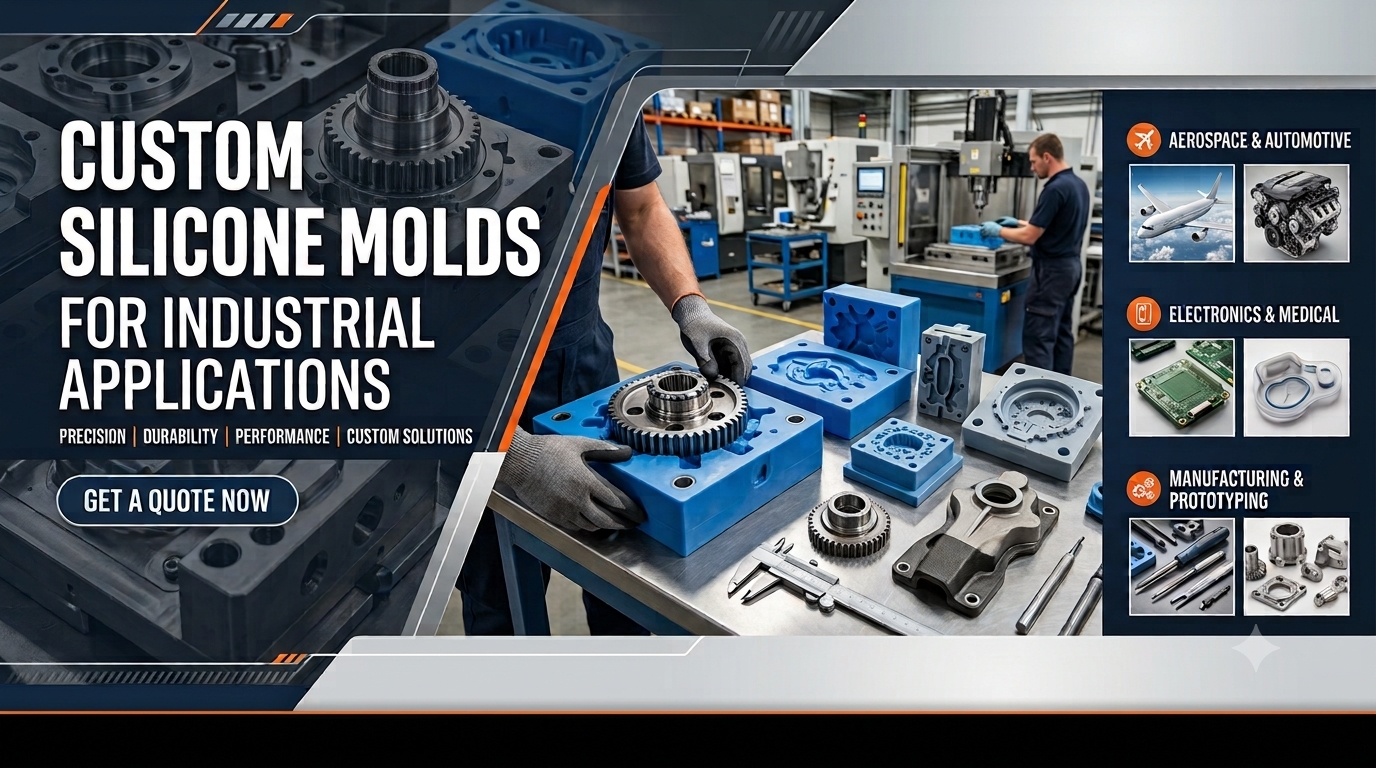
Standard molds often don't meet exact product requirements and can make complex shapes difficult to manufacture. That's why Custom Silicone Molds are used to give manufacturers greater control over geometry, tolerances, material properties, and repeatability to meet the final product's needs. Custom cavity geometry, parting lines, and ejection methods can accommodate intricate designs.
An experienced rubber mold maker always recommends custom tooling because engineering needs to revolve around the part itself, its silicone material, the molding process, tolerances, and the environment, not the other way around. In this guide, you can learn the custom mold requirements, engineering considerations, industrial applications and the silicone material selection process.
What are the Key Engineering Considerations for Silicone Mold Design
Before manufacturing any tools, the engineers from the manufacturing company always determine how the finished part will work, what it will do, and what manufacturing environment the mold must handle. Then, they determine the geometry, tolerances, surface finishes, and operating environment early, since each can affect the mold. The key consideration includes:
● Part Geometry and Dimensional Requirements: They study the form and complexity of the component itself. The complex form may influence the flow of material, its filling into the mold, ejection, and size precision. In addition, they determine the proper parting line.
● Tolerances and Surface Requirements: They decide on the accuracy required of the finished part. They take into account dimensions, surface finish, flash, edges, and cosmetics.These requirements can affect the design of the mold and the uniformity of the finished parts.
● Operating Environment: They analyze how and where the final silicone component will be applied. The factors include temperature, mechanical stress, chemical, moisture, and UV resistance, as well as electrical and sterilization properties. These conditions help us choose the right silicone material and mold design.
How Do We Choose the Right Silicone Grade for Industrial Applications
Choosing the right silicone depends on assessing the application environment, mechanical needs, processing techniques, and regulations before any tooling process. The material selection totally depends on the component’s performance rather than assuming one silicone type can meet all industrial requirements. The process includes:
● Selecting the Silicone Grade: Every manufacturer criteria differs but it usually includes temperature range, hardness, elasticity, compression set, tear resistance, chemical resistance, electrical characteristics, and regulatory compliance influence the material choice. Other factors include processing needs, where HTV is used in compression and transfer molding, LSR in injection molding, and RTV types in coating and sealing applications.
● Application-Specific Formulation: They select silicon properties depending on application needs. They specifically consider the working environment as well as functional requirements of the component.
● Over-Molding and Material Compatibility: They can decide if the silicone will have to adhere or bond with other substances such as plastic, metal or glass. Then they look at compatibility of the substrates and how the bonding can be done in the molding process.
Krishani follows a clear and practical process to select the final silicone grade for any industry such as automotive, medical, electronics etc. The engineering team makes sure the material meets the certain requirements for manufacturing the client's product.
What's the Process of Tooling Design for Production Repeatability?
Tooling design is basically designing every mold for consistent production, not just to make one successful sample. During reverse engineering, suppliers check DFM and engineering reviews to successfully find mold design problems before production begins. The steps include:
● Cavity Configuration: They choose multi-cavity or single-cavity tooling based on production volume, required cycle time, and part consistency. With multi-cavity tooling, they can make more parts while ensuring cavity balance for part consistency.
● Mold Layout: They always consider parting lines, gate locations, vents, runners (if necessary), demolding techniques along with cavity accessibility to support effective, reproducible production. With proper layout, they can always facilitate material flow, easy part removal, maintenance, and consistent dimensional performance.
● Flash and Defect Control: In this process, manufacturers usually notice that tooling design may affect flash formation, air trapping, incomplete fill, surface flaws, and dimensions. That's why they carefully design, and ensure sealing surfaces, material flow, and cavity design to control these problems during production cycles.
● Production Repeatability: They then finally check the mold design and validate repeatability before full consistent production. The expert team makes necessary tooling adjustments if results vary to manufacture consistent parts over repeated cycles.
How Custom Silicone Molding Supports Complex Production Requirements
Custom silicone molding offers solutions for demanding applications that require flexibility, heat resistance, sealing, and specific geometry. In automotive production, silicone is well-suited for seals, protection, flexible assemblies, and under-the-hood parts because it maintains performance under extreme temperatures and mechanical loads. In the medical field, silicone can be used for micro-parts and flexible devices.
In electronics, silicone is useful for insulation, protection devices, and environmental sealing, as it offers electrical protection while resisting moisture and environmental effects. Silicone can be used in industrial devices for gaskets, covers, damping elements, and protection interfaces where flexibility, sealing, and resistance to operating conditions are needed.
Get Custom Silicone Mold Solutions Today!
Looking for a reliable custom silicone molding service provider? Request a call from Krishani now to get expert guidance for your project. We aim to deliver silicon molds for consistent industrial production.
📞 Call us at: +1 (647) 294-5240
📧 Email: info@krishani.com
Frequently Asked Questions
1. How do manufacturers choose the right silicone grade?
They look at temperature, hardness, flexibility, compression set, chemical resistance, and other application conditions. All this will allow us to choose a type of silicone which would function well in the operating conditions.
2. What is the difference between HTV, LSR, and RTV silicone?
HTV silicones are usually molded using either compression molding or transfer molding techniques, whereas LSR is usually injection molded. RTV silicones cure at room temperature or under controlled heating conditions and are normally used in coating and sealing applications.
3. Which industries use custom silicone molding?
Silicone molding is used in the automotive, medical, electronic, and manufacturing industries. Silicone components are used in sealing, insulation, protection, flexibility, and heat resistance.







