Learn how data archiving improves data security, reduces storage complexity, supports cyber risk management, and enables secure long-term data access.
What Is Data Archiving?
Modern businesses generate enormous amounts of digital information every day. Customer records, financial documents, emails, application data, system logs, employee files, operational records, and machine-generated information all contribute to an organization’s growing data environment. Not all of this information needs to remain in active production systems, but that does not mean it should be deleted.
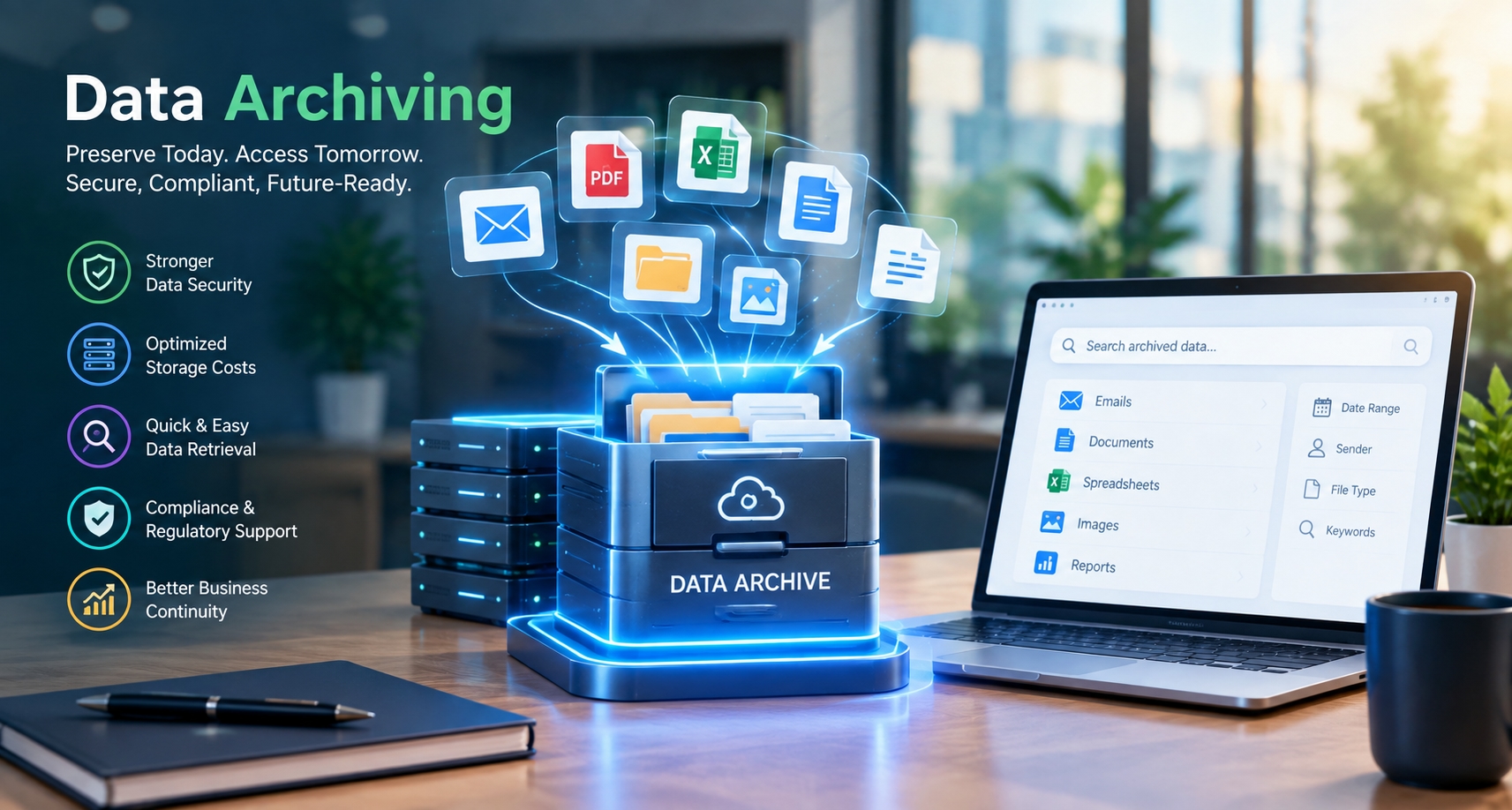
Data archiving is the process of moving information that is no longer actively used into a separate, secure, and organized storage environment for long-term retention and future access. Instead of keeping every historical file in expensive primary storage, organizations can move less frequently accessed information to an archive while keeping important active data readily available. The purpose of archiving is therefore more than simply creating additional storage space. A well-designed archive helps organizations manage the entire lifecycle of information, from active use and retention to retrieval and eventual disposal. It can also support business continuity, regulatory requirements, operational efficiency, and broader cyber risk management strategies.
As businesses increasingly adopt cloud applications, remote work, connected devices, and industrial technologies, the volume and variety of information continue to grow. In environments using industrial IoT solutions, for example, machines and sensors can continuously generate operational data that may be valuable for historical analysis even after it is no longer needed in the primary system.
Why Is Data Archiving Important for Modern Businesses?
The growing volume of business information creates a practical problem: keeping everything in primary storage can become expensive, difficult to manage, and unnecessarily complex. Organizations need to determine which information must remain immediately accessible and which information can be moved to a long-term storage environment. Data archiving provides a structured way to make that distinction.
Cost-Effective Storage Management
One of the most practical benefits of archiving is that it can help organizations manage storage costs more efficiently. Primary storage is generally optimized for workloads that require frequent access and high performance. Keeping years of rarely accessed information in the same environment may not be the most efficient approach. By moving older or infrequently accessed data to an appropriate archive tier, organizations can reduce pressure on primary storage and use their higher-performance resources for workloads that actually require them.
This is particularly useful for businesses experiencing continuous data growth. Instead of repeatedly expanding production storage whenever capacity becomes a concern, organizations can establish retention and archival policies that automatically move eligible information to a suitable long-term storage environment.
Better Backup and Recovery Performance
Archiving is not a replacement for backup, but it can complement a well-designed backup strategy.
When active systems contain unnecessary historical data, backup datasets can become larger and more difficult to manage. Separating active information from long-term archived information can help organizations focus backup operations on the data that requires frequent protection and recovery.
NIST emphasizes that effective data protection requires multiple controls, including secure storage, backups, integrity checking, audit logs, and appropriate recovery mechanisms. This distinction is important because an archive should preserve information for long-term access, while backups are primarily designed to support recovery following data loss, system failure, or cyber incidents.
Reduced Risk of Data Loss
Historical information can become difficult to recover when it is scattered across old servers, employee devices, disconnected storage systems, or obsolete applications. A centralized archiving strategy creates a more deliberate approach to retaining important information. Instead of relying on individual users or aging infrastructure, organizations can define where archived information belongs and how it should be protected.
This becomes particularly valuable when employees leave, applications are replaced, infrastructure is upgraded, or business systems are consolidated.
Stronger Data Security
Archived information can contain sensitive customer, financial, operational, or intellectual property data. Simply moving information into an archive does not automatically make it secure.
The archive should therefore be protected through appropriate authentication, authorization, encryption, monitoring, access controls, and retention policies.
NIST’s storage infrastructure guidance specifically identifies areas such as authentication and authorization, data protection, isolation, encryption, change management, and recovery assurance as important considerations for securing storage environments.
For organizations developing a broader cyber risk management program, data archiving should therefore be considered part of the overall data-protection architecture rather than an isolated storage activity.
Effective Data Archiving for Growing Data Environments
As organizations grow, their data infrastructure becomes increasingly complex. Different departments may use different applications, databases, file systems, cloud platforms, and operational technologies.
An effective archive provides a controlled destination for information that no longer needs to remain in active systems but still has business value.
Secure and Organized Data Retention
An archive should not become a digital dumping ground.
Organizations need policies that determine which information should be archived, when it should be archived, how long it should be retained, and when it should eventually be deleted or securely disposed of.
The retention period can depend on business requirements, contracts, regulatory obligations, industry practices, and the sensitivity of the information. There is no universal retention period that applies to every organization.
A structured retention policy can prevent two opposite problems: deleting valuable information too early and keeping unnecessary sensitive information indefinitely.
Data Should Be Easily Accessible
Archiving data is useful only when authorized users can retrieve it when necessary.
Imagine an organization needs a customer record from six years ago, a historical project document, or operational information from an older system. If retrieving that information requires searching multiple disconnected storage systems or restoring obsolete infrastructure, the archive may create as many problems as it solves.
Modern archiving strategies should therefore consider search, indexing, metadata, access controls, and retrieval processes as part of the original design.
Data Should Remain Protected
Archived information can remain valuable long after it stops being actively used.
In fact, historical information can sometimes become more difficult to monitor because it is accessed less frequently. Organizations should therefore apply appropriate security controls to archived data instead of assuming that old information is low-risk.
CISA recommends protecting stored business information through measures including encryption and secure backups, while also emphasizing the importance of maintaining appropriate cybersecurity practices across business environments.
Easy Retrieval of Historical Data
A successful archive should make historical information easier to find, not harder.
Organizations should define how users will search for archived information before selecting an archiving platform. Depending on the environment, useful search capabilities may include metadata, file type, creation date, department, application, owner, or other relevant attributes.
This becomes increasingly important as archive volumes grow into terabytes or petabytes. Without indexing and appropriate organization, even inexpensive storage can become difficult to use effectively.
What Are the Differences Between Data Archiving and Data Backup?
Data archiving and data backup are closely related but serve different purposes.
Data backup creates copies of information so that an organization can restore data after accidental deletion, hardware failure, ransomware, corruption, or another disruptive event. Backups are generally associated with recovery.
Data archiving, on the other hand, focuses on long-term preservation and management of information that may no longer be required in primary systems but still needs to be retained.
For example, a company may back up its active customer database every day because that information changes frequently. At the same time, older customer records that are rarely accessed may be moved into an archive according to the organization’s retention policy.
Both approaches can be important. NIST’s recent 2026 guidance for operational technology emphasizes regularly creating backups, testing them, integrating backup management with change processes, and reviewing recovery during exercises.
A strong data-management strategy should therefore avoid treating archiving and backup as interchangeable technologies.
Top Data Archiving Strategies for Businesses
There is no single archiving model that works for every organization. The right strategy depends on the type of data, access requirements, regulatory environment, infrastructure, budget, and security objectives.
1. Identify What Data Needs to Be Archived
The first step is understanding what information the organization actually holds.
Businesses should identify data sources across departments, applications, databases, file systems, cloud platforms, email environments, and connected technologies. This is especially important for organizations operating complex environments where information is distributed across multiple systems.
2. Classify Data According to Business Value
Not every file requires the same treatment.
Frequently used operational information may need high-performance storage, while historical records can often be moved to a lower-cost archival environment. Sensitive information may also require stronger access controls and encryption.
Data classification can help organizations determine how information should be stored, protected, retained, and eventually disposed of.
3. Define Retention Policies
Retention policies should clearly establish how long different categories of information should remain available.
The policy should also define what happens at the end of the retention period. Keeping every piece of information indefinitely increases storage requirements and can increase the amount of sensitive information exposed if an environment is compromised.
4. Automate Where Appropriate
Manual archiving can create inconsistent results.
Where possible, organizations should use policy-based automation to identify information that meets defined archival conditions. Automation can reduce administrative effort and help ensure that archiving occurs consistently.
5. Protect the Archive
Security controls should be applied throughout the data lifecycle.
Organizations should consider encryption, authentication, least-privilege access, monitoring, audit trails, secure configuration, and appropriate recovery capabilities. NIST’s data confidentiality guidance highlights the need to identify and protect information assets because data breaches can create financial, legal, and reputational consequences.
How Data Archiving Supports Cyber Risk Management
Data is one of the most important assets that organizations need to protect. Consequently, data archiving should be connected to the organization’s wider cyber risk management approach.
A cyber risk strategy is not limited to preventing unauthorized access. Organizations also need to consider what happens when data is corrupted, deleted, encrypted by ransomware, altered by an insider, or made unavailable during a system failure.
NIST’s data integrity guidance identifies ransomware, destructive malware, insider threats, and accidental data destruction as potential risks to organizational information and highlights the importance of backups, secure storage, integrity checking, audit logs, and related controls.
An archive can support this broader approach by providing a controlled environment for retaining information outside active production systems. However, organizations should not assume that an archive alone provides ransomware protection or disaster recovery. It needs to be incorporated into a complete security and recovery strategy.
For businesses reviewing their cybersecurity architecture, working with experienced cybersecurity companies in India can also help identify how storage, backup, archiving, identity, endpoint, and network security should work together.
Data Archiving in Industrial and IoT Environments
Industrial environments create a unique data-management challenge.
Connected machinery, sensors, industrial control systems, monitoring platforms, and other industrial IoT solutions can generate continuous streams of operational information. Some of this information may need immediate processing, while historical data can be valuable for maintenance analysis, performance comparison, troubleshooting, compliance, and long-term planning.
Keeping every piece of generated information in expensive high-performance storage may not be practical.
An archiving strategy can allow organizations to move older operational information into appropriate storage tiers while keeping recently generated information readily available for active analysis.
This approach can help organizations balance performance, cost, retention, and accessibility.
NIST’s 2026 OT Backup Quick Start Guide also reinforces the importance of reliable data protection in operational technology environments, where backup and recovery failures can contribute to prolonged operational disruption.
What Should You Look for in a Data Archiving Solution?
Selecting an archiving platform requires more than comparing storage capacity and price.
Scalability
The solution should accommodate current data volumes while providing a practical path for future growth. Businesses should consider not only today’s storage requirements but also the rate at which their data is increasing.
Security Controls
Encryption, authentication, authorization, role-based access, monitoring, and audit capabilities should be evaluated carefully. Archived data should not become an overlooked security boundary.
Search and Retrieval
Users should be able to locate historical information without unnecessary complexity. Search and retrieval capabilities become increasingly important as archive volumes grow.
Integration
The archive should fit into the organization’s existing technology environment. Integration with cloud applications, databases, file systems, operational platforms, and security infrastructure can reduce administrative complexity.
Retention and Lifecycle Management
The platform should support policies for retaining, moving, reviewing, and eventually deleting information according to organizational requirements.
Recovery and Resilience
Organizations should understand how archived information is protected against system failures, accidental deletion, ransomware, infrastructure outages, and other disruptions.
Why Organizations Need a Modern Data Archiving Strategy
Data growth is not slowing down. Businesses are generating information from traditional applications as well as cloud platforms, connected devices, analytics systems, collaboration tools, and industrial environments.
Simply purchasing more primary storage may solve a short-term capacity problem, but it does not necessarily create a sustainable data-management strategy.
Modern data archiving provides a way to separate active information from historical information while maintaining appropriate access and protection. This can help organizations control storage growth, simplify information management, improve retrieval, and support broader security objectives.
The most effective strategy is not necessarily the one that stores the most data. It is the one that gives the organization the right balance of accessibility, security, cost, performance, and retention.
Data Archiving Best Practices
Organizations implementing or reviewing their archival strategy should consider several practical principles.
Keep a clear data inventory
Before deciding what to archive, understand where important information exists and which systems generate it.
Establish documented retention policies
Retention decisions should be based on business, legal, contractual, regulatory, and security requirements rather than simply keeping everything forever.
Protect archived information
Use appropriate authentication, encryption, authorization, monitoring, and access controls.
Test retrieval regularly
An archive should be tested periodically to confirm that authorized users can locate and retrieve required information.
Separate archiving from backup
Maintain a dedicated recovery strategy for active systems instead of assuming that archived information can replace backups.
Review the strategy as the business changes
New applications, cloud migrations, acquisitions, regulatory requirements, and connected technologies can change what needs to be archived and how it should be protected.
Pros and Cons of Data Archiving
The primary advantage of data archiving is improved control over growing information. Instead of keeping every historical record in expensive primary storage, businesses can move less frequently accessed data into an environment designed for long-term retention. This can help manage storage costs, reduce pressure on production systems, simplify information organization, and make historical records easier to locate.
Archiving can also support business continuity and operational knowledge. Historical information can remain available even when applications are replaced or employees leave. For industries that rely on long-term operational records, archived information can provide valuable historical context for analysis and decision-making.
However, archiving also introduces responsibilities. An archive needs to be secured, monitored, maintained, and governed. Poorly defined retention policies can result in excessive data accumulation, while weak access controls can expose sensitive historical information. Organizations also need to consider migration, compatibility, retrieval performance, vendor dependency, and long-term costs before selecting an archival platform.
For this reason, data archiving should be treated as part of an organization’s information lifecycle and security strategy rather than simply as a low-cost storage option.
Frequently Asked Questions About Data Archiving
What is data archiving?
Data archiving is the process of moving information that is no longer actively required into a separate storage environment for long-term retention and future retrieval.
What is the main purpose of data archiving?
The main purpose is to preserve valuable historical information while reducing the amount of inactive data stored in primary production environments.
Is data archiving the same as backup?
No. Backup focuses primarily on restoring information after loss or disruption, while archiving focuses on long-term retention and access to historical information.
How does data archiving improve cybersecurity?
A properly designed archive can support data protection through controlled access, encryption, retention policies, monitoring, and secure storage. However, archiving should complement rather than replace backup, recovery, and other cybersecurity controls.
How is data archiving useful for industrial IoT?
Industrial environments can generate large volumes of sensor and operational information. Archiving can help organizations retain historical information for analysis, maintenance, troubleshooting, and other long-term requirements without keeping all historical data in high-performance production storage.
How long should data be archived?
The appropriate retention period depends on the organization’s business needs, regulatory obligations, contractual requirements, data type, and internal policies. There is no single retention period that applies to every organization.
Should archived data be encrypted?
Sensitive archived data should be protected using appropriate security controls, which may include encryption, authentication, authorization, monitoring, and secure key management depending on the organization’s risk profile.
Build a Smarter Data Archiving Strategy
The increasing volume of digital information has made data management a strategic business requirement rather than simply an IT storage concern. Organizations need to know what information they have, where it resides, how long it needs to be retained, who can access it, and how it can be recovered when required.
A well-planned data archiving strategy can help businesses move historical information away from expensive primary systems while keeping it organized, protected, and accessible. When combined with backup, security monitoring, access management, and appropriate recovery processes, archiving can contribute to a more resilient information environment. The key is to design the archive around the organization’s actual requirements. Data should be classified, retention policies should be documented, security controls should be applied, and retrieval should be tested regularly. This becomes even more important for organizations managing large-scale cloud, operational, and industrial IoT solutions.
For organizations evaluating their broader data-protection and cyber risk management strategy, Delphi Infotech can help assess how data archiving, backup, security, and recovery capabilities can work together.
Have questions about your current data archiving strategy? Connect with a cybersecurity professional to assess your storage environment, retention requirements, and data-protection needs.