Kali Yuga, the Collapse of Morality, and the Eternal Shelter of Bhakti
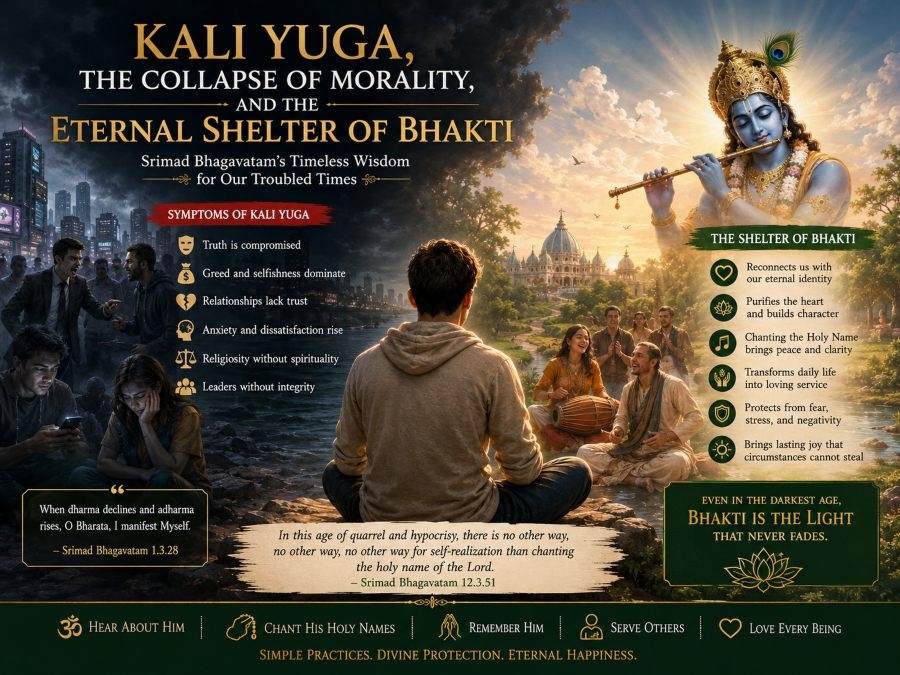
Have you ever looked around and wondered why honesty often seems weaker than deception, why anxiety keeps rising despite endless comforts, or why people feel more connected digitally yet more isolated emotionally? These questions are not unique to our generation. Thousands of years ago, the Srimad Bhagavatam & Bhakti described an age when moral values would steadily decline while material ambition would dominate human life. That age is known as Kali Yuga. Yet the Srimad Bhagavatam does not leave readers with fear or hopelessness. It offers a clear answer: even when society loses its moral compass, devotion to the Supreme Lord remains an unchanging shelter capable of restoring peace, purpose, and spiritual strength.
Kali Yuga Is More Than a Period of Time
Many people think Kali Yuga is simply the last age in the Vedic cycle of time. The Srimad Bhagavatam presents a richer picture. It describes Kali Yuga as an age where external progress often hides internal decline.
Technology may improve.
Cities may expand.
Knowledge may become easier to access.
Yet people still struggle with greed, anger, envy, loneliness, and confusion.
The scripture explains that morality weakens gradually because people begin identifying only with the temporary body instead of their eternal spiritual nature. Once that happens, success is measured almost entirely by wealth, influence, appearance, or power.
This shift affects every layer of society.
Families become divided by selfish interests.
Friendships become transactional.
Leadership loses integrity.
Even religion can become a matter of prestige rather than genuine devotion.
The Bhagavatam reminds us that moral collapse does not begin in governments or institutions. It begins in the human heart.
Why Moral Decline Feels So Familiar
The descriptions of Kali Yuga often sound surprisingly modern.
Truth becomes negotiable.
Promises become easier to break.
People judge others by possessions instead of character.
Patience becomes rare.
The desire for immediate gratification grows stronger than the willingness to develop discipline.
These are not merely social observations.
The Srimad Bhagavatam connects them to a deeper spiritual condition. When people forget their eternal identity, temporary pleasures naturally become life's highest priority.
That explains why material progress alone cannot solve every human problem.
A society may become richer while compassion grows weaker.
Education may increase while wisdom declines.
Communication becomes faster, yet meaningful conversations become less common.
The Bhagavatam encourages readers to recognize these symptoms without becoming discouraged.
Awareness is the beginning of transformation.
Bhakti Is Not an Escape—It Is a Return
When people hear the word bhakti, they sometimes imagine withdrawing from ordinary responsibilities.
The Bhagavatam teaches something very different.
Bhakti is not escaping life.
It is returning life to its original purpose.
A parent continues caring for children.
A professional continues working honestly.
A student continues learning.
A business owner continues serving customers.
The difference lies in motivation.
Actions performed only for personal gain often create endless dissatisfaction.
Actions performed with devotion gradually purify the heart.
This is why the Bhagavatam places such emphasis on hearing about the Supreme Lord, chanting His holy names, remembering His pastimes, and serving others with humility.
These practices reshape character from within.
The Strength That Bhakti Gives During Difficult Times
Every age brings uncertainty.
People lose loved ones.
Economies fluctuate.
Health changes unexpectedly.
Relationships face challenges.
The Bhagavatam never promises a life free from difficulty.
Instead, it promises an inner strength that circumstances cannot easily destroy.
A person grounded in bhakti develops qualities that remain valuable regardless of external conditions:
· Steady faith during uncertainty
· Compassion instead of resentment
· Humility instead of pride
· Gratitude instead of constant dissatisfaction
· Hope instead of despair
These qualities do not appear overnight.
They grow gradually through sincere spiritual practice.
The remarkable aspect of bhakti is that it transforms not only beliefs but also daily behavior.
Why the Holy Name Holds a Special Place in Kali Yuga
Among all spiritual practices, the Srimad Bhagavatam repeatedly glorifies the chanting and hearing of the holy names of the Lord.
Why?
Because Kali Yuga is marked by distraction.
The mind rarely stays still.
People are surrounded by endless information but very little inner silence.
Chanting brings the mind back to its spiritual center.
It reminds the soul of its eternal relationship with Krishna.
Unlike wealth or social status, this practice is available to everyone regardless of age, education, nationality, or background.
That universal accessibility is one reason bhakti is described as the most practical spiritual path for the present age.
Building Character Instead of Chasing Appearances
Modern culture often rewards appearance before substance.
The Bhagavatam reverses that order.
It teaches that genuine character naturally creates meaningful influence.
Instead of asking how successful someone appears, it encourages questions such as:
· Does this person live honestly?
· Do they inspire compassion?
· Are they humble despite their achievements?
· Do their actions benefit others?
These questions shift attention from image to integrity.
That shift is one of bhakti's greatest contributions.
As devotion deepens, the desire to impress others gradually gives way to the desire to serve them.
The Timeless Hope Hidden Within the Bhagavatam
Despite its detailed description of Kali Yuga, the Srimad Bhagavatam remains one of the most hopeful spiritual texts ever written.
It does not suggest that darkness has the final word.
Instead, it teaches that even a single sincere act of devotion possesses extraordinary spiritual power.
One person living honestly influences a family.
One devoted family influences a community.
One community devoted to spiritual values influences future generations.
Real transformation rarely begins with massive social movements.
It begins with individuals who decide to live according to eternal principles.
That message feels especially relevant today.
The world may continue changing, but devotion remains constant.
Moral confusion may increase, yet spiritual wisdom remains available.
Material success may come and go, but a heart connected with Krishna discovers a source of peace that does not depend upon changing circumstances.
The Srimad Bhagavatam ultimately reminds us that Kali Yuga is not merely an age of decline. It is also an age of extraordinary opportunity. Because confusion is widespread, sincere devotion shines even brighter. Bhakti becomes the shelter that protects the heart from fear, selfishness, and despair while guiding every aspect of life toward lasting spiritual fulfillment.