Srimad Bhagavatam Bengali 18 Volumes Set: What Makes It Special
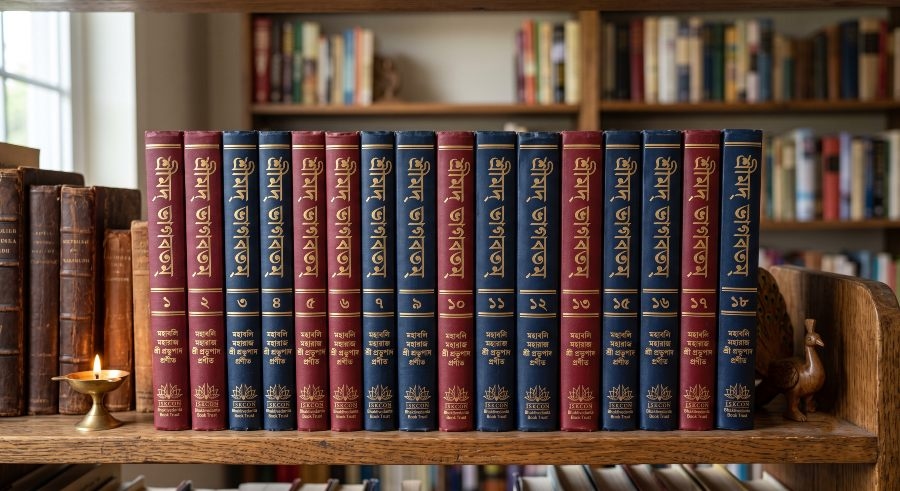
Walk into any Bengali bookstore's religious section and you'll find at least four or five different editions claiming to be "the" Bhagavatam translation. Some are thin single-volume summaries. Some are photocopied reprints from decades ago with faded typefaces. A few are genuinely careful scholarly attempts. So here's the real question nobody asks out loud before buying: what actually separates a Srimad Bhagavatam Bengali edition worth owning for life from one that'll sit half-read on a shelf within a year?
The honest answer isn't about marketing or packaging. It comes down to a handful of specific editorial and philosophical choices that most readers never notice until they've compared editions side by side. The ISKCON Srimad Bhagavatam Bengali 18 Volumes, set has become the reference point for exactly this reason — not because of tradition or brand loyalty, but because of decisions made at the translation level that quietly change the entire reading experience. Once you understand what those decisions are, you'll never look at a scripture set the same way again.
Why Most "Complete" Editions Aren't Actually Complete
Here's something the publishing world doesn't advertise loudly: a lot of "complete" Bhagavatam editions in regional languages are complete in name only. Publishers under pressure to keep costs down often quietly trim purports, skip verses considered "repetitive," or compress multiple chapters into summarized paragraphs. Nobody tells you this on the cover. You find out three cantos in, when a story feels rushed or a philosophical argument seems to skip a step.
The 18-volume structure exists specifically to prevent this kind of silent editing. Splitting the text across eighteen books isn't a marketing gimmick to sell more units — it's a practical response to a genuine problem. Each canto gets the physical space it needs. Nothing gets cut to fit a page count. When Kapila explains sankhya philosophy to his mother Devahuti across dozens of verses, every verse stays intact, because compressing that dialogue would gut its entire logical structure.
Think of it this way: if you shortened a legal contract to save paper, you wouldn't call it the same contract anymore. Scripture works the same way. Remove verses for convenience, and you're no longer reading the Bhagavatam — you're reading someone's abridged opinion of it.
The Translation Choice That Changes Everything
Most people assume translation is a fairly mechanical process — you take a Sanskrit word, find its Bengali equivalent, and move on. That assumption falls apart the moment you actually try translating devotional Sanskrit poetry.
Take a single word like bhakti. A rushed translator renders it simply as "devotion" every single time, and technically that's not wrong. But bhakti in different contexts carries different shades — sometimes it means loving service, sometimes surrender, sometimes a specific emotional mood toward Krishna that Bengali actually has better vocabulary for than a flat, repeated word ever could. A careless translation flattens all of that nuance into one generic term used mechanically five thousand times across eighteen books.
What makes this particular set stand apart is the discipline behind word choice. The translation doesn't chase literal word-for-word mechanical accuracy at the expense of meaning, and it doesn't drift into loose paraphrase either. It sits in the narrow, difficult middle ground — accurate enough that a Sanskrit scholar wouldn't object, natural enough that a Bengali reader never feels like they're reading a translated document rather than a story meant for them.
A few specific things worth noticing once you start reading:
Sanskrit verses are printed alongside the Bengali translation, not hidden away or dropped entirely, so nothing is lost between the original and the rendering
Purports explain context rather than just restating the verse in different words — you're told why something matters, not just what it says
Technical terms are introduced once and used consistently across all eighteen volumes, so a concept explained in Volume 2 isn't renamed or redefined by Volume 14
The Philosophical Backbone Most Editions Skip
Here's where a lot of popular retellings quietly lose something important. It's easy to tell the Bhagavatam as a series of entertaining stories — Krishna stealing butter, the Rasa dance, Dhruva's penance, the churning of the ocean. Those stories are genuinely captivating on their own, which is exactly why so many condensed versions lean entirely on narrative and quietly drop the philosophical sections that don't have obvious dramatic appeal.
But strip out Canto 3's cosmology, Canto 11's Uddhava Gita, or the metaphysical framework running underneath the Tenth Canto's stories, and you're left with something closer to mythology than scripture. The stories stop being illustrations of a philosophical system and start being just stories.
This 18-volume set refuses to make that trade. The philosophical cantos get the same careful treatment as the narrative-heavy ones. Canto 11, which many condensed retellings barely touch because it's dense and conversation-heavy rather than action-driven, is given full space here — and it happens to contain some of Krishna's most direct instructions on the nature of the self, delivered to Uddhava shortly before his departure from this world. Skipping that canto to keep things "readable" would mean skipping one of the most important conversations in the entire text.
What Bengali Readers Specifically Gain That Other Language Editions Don't
There's a reason this set isn't simply an English edition translated a second time into Bengali. That kind of double translation — Sanskrit to English to Bengali — tends to lose accuracy with each step, the way a message garbles slightly every time it passes through another person in a game of telephone.
This edition works directly from the Sanskrit, which matters more than it might initially seem. Bengali has certain grammatical tools — compound verb structures, layered honorifics, specific devotional vocabulary shaped by centuries of Gaudiya Vaishnava literature — that let a direct Sanskrit-to-Bengali translation capture emotional and philosophical nuance that an English intermediate step would have already smoothed away.
There's also a cultural layer here worth naming directly. Bengal isn't just another region that happens to speak a different language than Sanskrit. It's the birthplace of Sri Chaitanya Mahaprabhu, whose entire movement centered on public, ecstatic engagement with exactly the kind of devotional themes the Bhagavatam describes. Reading this text in Bengali connects a reader not just to the content of the scripture, but to five hundred years of a living regional tradition built directly around it.
Nine Details That Separate a Serious Edition From a Casual One
If you've never compared scripture editions closely, here's what actually distinguishes a set worth keeping for decades from one you'll replace in five years:
Verse numbering consistency — so a reference in a class or lecture matches exactly what's printed in your copy
Retention of Sanskrit transliteration, not just the Bengali rendering, so pronunciation during recitation stays accurate
Footnoted clarifications for names, places, and concepts a first-time reader wouldn't automatically know
A single translating vision across all eighteen books, rather than different translators handling different cantos with different styles
Physical durability built for daily handling over years, not a one-time decorative purchase
Chapter summaries that orient a reader without spoiling the philosophical build-up
Accurate genealogical tables in the cantos dealing with royal lineages, where errors are shockingly common in rushed editions
Cross-references between cantos where later sections assume earlier context
Institutional accountability — a publisher and lineage you can actually trace, rather than an anonymous reprint of unclear origin
Most readers won't consciously evaluate all nine points before buying. But they'll feel the absence of these things within the first few chapters, even if they can't name exactly what's missing.
A Story That Explains This Better Than Any Feature List Could
There's an account, shared often enough among devotees that it's become something of a teaching story, about a young man who owned a heavily abridged Bhagavatam for years and considered himself reasonably well-read in it. He later encountered a full unabridged edition and started again from Canto 1. What struck him wasn't new information exactly — it was realizing how many logical bridges between ideas had been silently removed from his earlier copy. Arguments that used to feel like isolated statements suddenly connected into a coherent chain of reasoning he'd never actually seen laid out before.
That's the real difference an unabridged, carefully translated edition makes. It's not that the shorter versions are lying to you. It's that they're handing you conclusions without the reasoning that got there, and reasoning is precisely what makes philosophy stick rather than fade.
Common Misunderstandings About This Set, Cleared Up
"Eighteen volumes must mean it's padded with extra commentary." Not quite. The length comes from preserving the complete Sanskrit text, complete Bengali translation, and purports for every single verse across twelve full cantos — roughly eighteen thousand verses in total. That's simply how much content the original scripture contains when nothing is trimmed.
"Isn't the philosophy too dense for someone without a Sanskrit background?" The purports are specifically written to bridge that gap. You don't need Sanskrit training to follow the reasoning — you need patience and a willingness to read a passage twice if the first pass doesn't fully land, which is true of any serious text in any language.
"Does buying the full set mean committing to reading it cover to cover in order?" Not at all. Plenty of readers start with whichever canto interests them most, often Canto 10, and circle back to the philosophical cantos once they're already invested in the narrative. Owning the complete set just means you're never stuck waiting to buy the next volume once you're ready for it.
Where This Set Fits in a Larger Reading Life
Scripture rarely gets read the way novels do — start to finish, once, then shelved. The Bhagavatam in particular tends to become something closer to a long-term companion. People return to the same chapter years apart and notice something they missed the first time, simply because they've lived more life in between readings.
That kind of long-term relationship with a text only works if the edition itself holds up — accurate, complete, and built to survive being opened thousands of times over decades rather than dozens. A set that quietly cuts corners on translation or completeness might satisfy a first read, but it won't reward a second or third pass the way a genuinely careful edition will.
The Institutional Weight Behind the Translation
It's worth naming plainly why this particular translation carries the authority it does. It traces back through the Bhaktivedanta Book Trust and the broader ISKCON publishing tradition established by Srila Prabhupada, whose original English translation and purports became the foundation for translations into dozens of other languages, Bengali included. That's not an incidental detail — it means the Bengali edition isn't an independent reinterpretation floating on its own. It's anchored to a consistent philosophical framework maintained across every language ISKCON has published in, which is exactly why a reader moving between an English purport and a Bengali one will find the same underlying explanation, just expressed in a different tongue.
Distribution through ISKCON Mayapur adds another layer of continuity here, given that Mayapur itself is the appearance place of Sri Chaitanya Mahaprabhu and functions as a living center of the exact devotional tradition the Bhagavatam describes. Buying this set through that channel isn't just a transaction — it's a direct link to the institution actively preserving and teaching from this text today.
What to Actually Check Before You Commit to a Set
A few final practical points worth confirming before you order, especially if you're comparing sellers or listings that look similar on the surface:
Confirm the set genuinely contains all twelve cantos across eighteen volumes, not a smaller "essential chapters" version marketed under a similar name
Look for Sanskrit verses printed alongside the Bengali text, not a Bengali-only rendering
Check that purports are included for every verse, not just selected ones
Verify the publisher and translation lineage, since unofficial reprints occasionally circulate with uneven quality control
Ask about binding and paper quality if this is meant for daily reading rather than a one-time decorative shelf item
How Editorial Choices Show Up in Actual Reading Sessions
It's one thing to talk about translation philosophy in the abstract. It's another to see what it actually looks like on a random Tuesday evening when someone sits down with a chapter after dinner.
Say you're reading the section describing Krishna lifting Govardhan Hill. A rushed, summarized edition gives you the event in three or four sentences — Krishna lifted the hill, the villagers were protected, Indra was humbled. Technically accurate, emotionally flat. A careful, unabridged edition instead walks through the villagers' confusion before the event, their gradual trust in a child they'd known since birth, the specific reasoning Krishna gives for why cow protection and land worship matter more than sky-worship rituals, and only then arrives at the hill-lifting itself as the culmination of an argument, not just a magic trick.
That difference isn't cosmetic. It changes what you actually take away from the chapter. One version gives you a memorable image. The other gives you a memorable image plus the reasoning that makes the image meaningful — which is exactly the kind of depth that turns a one-time read into something you return to.
The Quiet Cost of Choosing the Wrong Edition First
Here's something rarely discussed openly: a reader's first serious scripture edition tends to shape how they relate to the whole text for years afterward, sometimes permanently. If someone's introduction to the Bhagavatam is a heavily condensed, narrative-only version, they often walk away thinking of it purely as mythology — colorful stories with a vague moral attached. That impression is hard to undo later, even after encountering a fuller edition, because the first version sets the frame.
Starting with a genuinely complete translation avoids this problem entirely. You encounter the philosophy and the narrative together, in the proportion the original text actually intended, rather than absorbing an incomplete first impression you'll spend years correcting. This matters especially for anyone introducing children or newcomers to the text — the edition you hand someone on day one quietly determines whether they eventually see the Bhagavatam as literature to be studied or just stories to be remembered.
Comparing Notes: What Long-Term Readers Say Changes Over Time
Ask anyone who's kept the same Bhagavatam set for ten or fifteen years what's changed about their relationship with it, and you'll usually hear some version of the same thing: the verses stayed identical, but what they noticed in them kept shifting.
A younger reader might connect most strongly with Dhruva's determination or the drama of Krishna's childhood pastimes. Return to those same chapters a decade later, after marriage, after raising children, after facing real disappointment, and suddenly the philosophical undercurrents that seemed abstract before start reading like they were written with direct personal experience in mind. This kind of layered re-reading only works with a complete edition. An abridged version gives you the same surface story every time, because there's no philosophical depth underneath it left to discover on a second or third pass.
This is really the strongest argument for investing in a genuinely complete 18-volume set rather than a shorter alternative: you're not just buying content for right now. You're buying a text that can keep teaching you something different at every stage of your life, provided nothing important was cut out of it to begin with.
A Note on Consistency Across Twelve Cantos
One detail that separates a well-managed translation project from a rushed one is almost invisible until you go looking for it: does the Bengali vocabulary used for recurring philosophical terms stay stable from Canto 1 all the way through Canto 12?
This sounds like a small technical point, but it has real consequences. If a term like maya gets translated one way in an early canto and rendered slightly differently by the time Canto 9 rolls around, a careful reader either gets confused or, worse, assumes two different concepts are being discussed when it's actually the same one. Across eighteen volumes, produced and reviewed as a single coherent project rather than assembled from disconnected translators working independently, this kind of vocabulary drift gets caught and corrected before publication. That consistency is part of why serious students of the text — not just casual readers — specifically seek out editions known for maintaining it.
A Handful of Final Questions Worth Settling Before You Order
Does this set assume prior familiarity with Vaishnava philosophy? No. It's written to bring a first-time reader up to speed gradually, canto by canto, rather than assuming background knowledge from page one.
Is it appropriate for older readers who may find eighteen thick volumes physically unwieldy? Individual volumes are sized to be manageable for daily handling rather than as one oversized combined book, specifically so this isn't an issue.
Can it be used for formal study alongside a teacher or class, not just personal reading? Yes — the consistent verse numbering and terminology across all eighteen volumes make it well suited for structured study groups, where everyone needs to reference the exact same passage without confusion.
Bringing It All Together
What makes this 18-volume Bengali set special isn't any single feature you could point to in isolation. It's the accumulation of dozens of careful choices — preserving every verse, maintaining translation consistency across thousands of pages, keeping the Sanskrit alongside the Bengali, refusing to trim the philosophically dense cantos just because they're harder to market. Any one of those choices alone might seem minor. Together, they're the difference between owning a summary of the Bhagavatam and actually owning the Bhagavatam.
If you've been comparing editions and feeling like they all blur together after a while, that feeling usually means you haven't yet held a genuinely complete one. Once you have, the difference stops being something you have to be told about — you simply notice it, page after page, for as long as you keep reading.