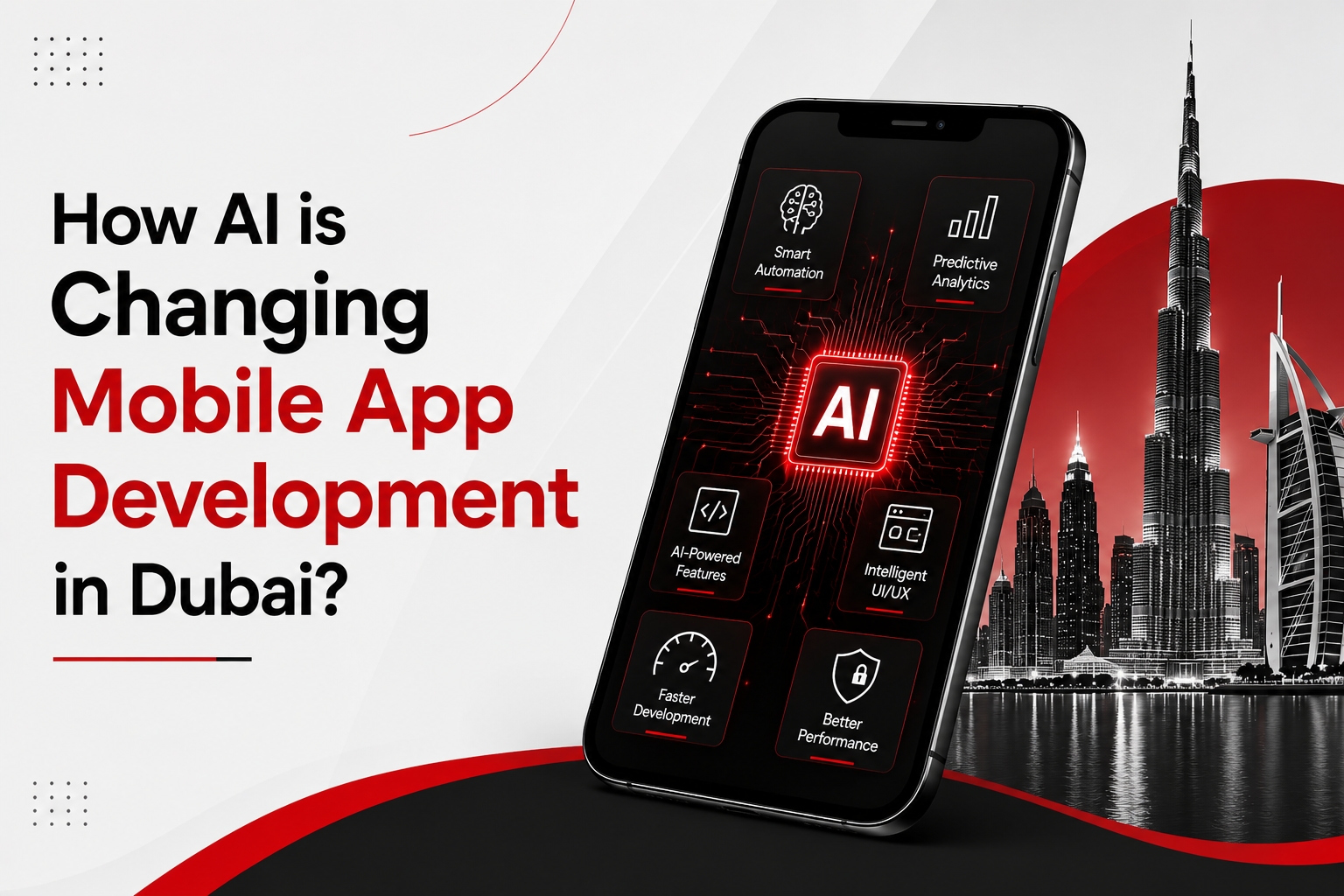
Artificial intelligence is transforming the way businesses build and deliver mobile applications. What once focused primarily on functionality now revolves around intelligence, automation, and personalized user experiences.
Dubai has emerged as a leader in this transformation, backed by ambitious government initiatives, a thriving startup ecosystem, and strong enterprise adoption of AI technologies.
Businesses across industries are embracing AI to accelerate development, improve application performance, and create solutions that adapt to changing customer expectations. As demand for smarter digital products grows, AI is becoming an integral part of the development process.
In this blog, we'll explore how AI is changing mobile app development in Dubai and why businesses should embrace this shift.
Dubai's AI Vision Is Reshaping Mobile Innovation
Dubai has established itself as one of the world's most progressive technology hubs. With continuous investments in artificial intelligence and digital transformation, the city is creating new opportunities for businesses to build innovative mobile applications.
This strong ecosystem is encouraging organizations to rethink how they design, develop, and scale digital products.
1. Government Policies Are Accelerating AI Adoption
Dubai's vision to become a global leader in artificial intelligence has created an environment where innovation thrives. Through initiatives such as the UAE AI Strategy 2031 and Smart Dubai, public and private organizations are encouraged to adopt intelligent technologies that improve operational efficiency and enhance customer services.
This long-term commitment has increased demand for AI-powered mobile applications across industries while strengthening Dubai's position as a preferred destination for technology investments.
2. Businesses Are Investing in Smarter Applications
Modern consumers expect applications that understand their preferences, respond instantly, and deliver personalized experiences. Traditional mobile apps often struggle to meet these expectations without intelligent automation.
Artificial intelligence helps businesses bridge this gap by enabling predictive recommendations, automated customer support, intelligent search, and real-time decision-making. These capabilities not only improve user satisfaction but also help organizations optimize internal operations and reduce manual effort.
3. Expertise Matters in AI App Development
Implementing artificial intelligence requires specialized technical knowledge, from selecting the right AI models to integrating cloud infrastructure and managing data effectively. Partnering with a mobile app development company in Dubai enables businesses to access local expertise while developing solutions aligned with regional market demands.
Experienced development teams also help organizations identify practical AI use cases that generate measurable business value instead of adding unnecessary complexity.
How Is AI Transforming the Mobile App Development Lifecycle?
Artificial intelligence is influencing every stage of mobile application development. From validating business ideas to maintaining applications after launch, AI enables development teams to work faster, improve software quality, and make better decisions using real-time insights.
A. Smarter Product Planning
Before development begins, AI analyzes customer behavior, market trends, and competitor activity to identify opportunities. These insights help businesses prioritize features that solve real user problems instead of relying solely on assumptions.
As a result, product roadmaps become more focused and development resources are allocated more effectively.
B. Faster Design and Development
AI-powered design tools assist teams in creating intuitive user interfaces by analyzing usability patterns and customer interactions. At the same time, coding assistants automate repetitive programming tasks, recommend optimized code, and improve overall developer productivity.
This combination shortens development cycles while allowing teams to focus on innovation rather than routine work.
C. Intelligent Testing and Deployment
Testing is no longer limited to manual quality assurance. AI-driven testing platforms automatically identify defects, generate test scenarios, and monitor application performance throughout development.
After deployment, AI continues tracking system health, detects unusual behavior, and recommends performance improvements before users experience disruptions.
D. Stronger Security Through AI
Cybersecurity has become increasingly important as mobile applications process sensitive customer information. AI strengthens security by identifying suspicious activities, detecting fraud patterns, and responding to potential threats in real time.
This proactive approach helps businesses protect user data while maintaining application reliability across growing user bases.
E. AI Is Influencing Development Budgets
Artificial intelligence can both reduce and increase development expenses depending on project requirements. Automation minimizes manual coding and testing efforts, while advanced AI capabilities require additional expertise, infrastructure, and model training.
Consequently, the cost to build a mobile app in Dubai depends largely on the complexity of AI features and the long-term business objectives they support.
AI Capabilities Powering Modern Mobile Apps
Artificial intelligence has transformed mobile applications from simple digital tools into intelligent platforms that learn, adapt, and improve over time.
Businesses across Dubai are leveraging AI to deliver more engaging user experiences, streamline operations, and gain valuable insights from customer data. The following capabilities are shaping the next generation of mobile applications.
► Personalized User Experiences
Every user interacts with an application differently. AI analyzes browsing patterns, purchase history, location, and preferences to deliver tailored content and recommendations.
Instead of providing a one-size-fits-all experience, applications adapt to individual users, increasing engagement, customer satisfaction, and long-term retention.
► Conversational AI
AI-powered chatbots and virtual assistants are becoming a standard feature in modern mobile applications.
They provide instant responses, assist users with routine tasks, and remain available around the clock. By handling common customer queries automatically, businesses can improve service quality while allowing support teams to focus on more complex issues.
► Predictive Analytics
Artificial intelligence helps businesses move beyond historical reporting by predicting future outcomes. Mobile applications can analyze user activity and operational data to forecast demand, identify customer preferences, and recommend the next best action.
These insights enable organizations to make faster decisions while improving customer engagement and business performance.
► Computer Vision
Computer vision allows applications to interpret images and videos captured through a mobile device. Businesses use this technology for facial authentication, document verification, product recognition, and augmented reality experiences.
As industries continue to digitize their services, visual intelligence is opening new possibilities for creating more interactive and secure mobile applications.
► Voice Intelligence
Voice recognition and Natural Language Processing (NLP) make applications easier to use by allowing customers to interact through spoken commands.
Whether searching for information, completing transactions, or controlling app functions, voice-enabled experiences improve accessibility while making everyday interactions more convenient and efficient.
► Generative AI and Intelligent Automation
Generative AI is expanding the capabilities of mobile applications by creating personalized content, summarizing information, and assisting users in real time.
Businesses are also adopting intelligent automation to streamline repetitive workflows, improve productivity, and deliver faster services without compromising quality.
Building AI-Powered Apps That Deliver Long-Term Value
Adding AI features alone does not guarantee success. Businesses need a well-defined strategy that aligns technology with customer needs and long-term objectives.
A thoughtful approach helps maximize the value of AI investments while ensuring applications remain scalable, secure, and relevant as technology continues to advance.
1. Begin With Clear Business Goals
Every AI initiative should solve a genuine business challenge. Defining objectives before development begins helps identify the right AI capabilities, prioritize essential features, and establish measurable outcomes that support long-term business growth.
2. Build on Reliable Data
Artificial intelligence is only as effective as the data it processes. Businesses should establish strong data collection practices, maintain data quality, and update datasets regularly to improve model accuracy and generate meaningful insights throughout the application's lifecycle.
3. Prioritize Security and Compliance
As AI applications handle increasing amounts of user information, protecting data becomes essential. Implementing encryption, secure authentication, and responsible data governance helps organizations safeguard sensitive information while meeting regulatory requirements and strengthening customer trust.
4. Design for Scalability
Business requirements continue to change as organizations grow. Building AI-powered applications on scalable cloud infrastructure allows new features, AI models, and services to be integrated without significant redevelopment, ensuring the application remains adaptable for future expansion.
5. Continuously Improve AI Performance
Artificial intelligence should evolve alongside user expectations. Monitoring application performance, collecting user feedback, and retraining AI models with updated data help maintain accuracy and ensure intelligent features continue delivering meaningful business value over time.
Conclusion
Artificial intelligence is redefining how businesses approach mobile application development in Dubai.
From streamlining development processes to delivering highly personalized user experiences, AI enables organizations to build smarter, more efficient digital solutions that keep pace with changing market demands.
As AI technologies continue to mature, businesses that embrace innovation today will be better positioned to improve customer engagement, enhance operational efficiency, and maintain a competitive advantage.
By combining a clear strategy with the right technical expertise, organizations can develop future-ready mobile applications that deliver lasting value in Dubai's rapidly evolving digital economy.