
Spreadsheets work fine until they don’t. Then you’ve got leads sitting in someone’s inbox, support staff asking customers to repeat themselves, and a sales pipeline nobody fully trusts. That’s usually when a CRM goes on the to-do list, and that’s also when the price question gets uncomfortable. Depending on the route you take, it can run from a few thousand dollars to well past $300,000.
So how do you budget for something with a gap that big? This guide walks through what CRM software development costs in the USA, what pushes the number up or down, and how to avoid overspending. Treat every figure here as a ballpark. Nobody can give you an honest fixed price without knowing what you actually need built.
Platform-Based CRM vs Custom CRM
Your first decision shapes most of the budget. You can start with an existing product like Salesforce, HubSpot, Zoho, Microsoft Dynamics 365 or Creatio, then configure it, tweak it and connect it to the rest of your tools. Or you can have a CRM built from scratch around the way you actually work.
Neither is the “right” answer for everyone. Platform-based setups are faster to launch and cheaper at the start, but the licence fees never stop, and sooner or later you’ll run into something the product just won’t do. Custom builds cost more upfront. In return you own the logic, the data model and the roadmap. This is usually the point where a crm software development company is useful, because it can map your workflows against both routes and tell you which one makes more sense before you commit any budget.
Average CRM Development Cost in the USA
Platform-based projects usually land between $8,000 and $60,000. That covers implementation, customization, data setup and integrations. It doesn’t cover the monthly per-user licences, and people forget that all the time.
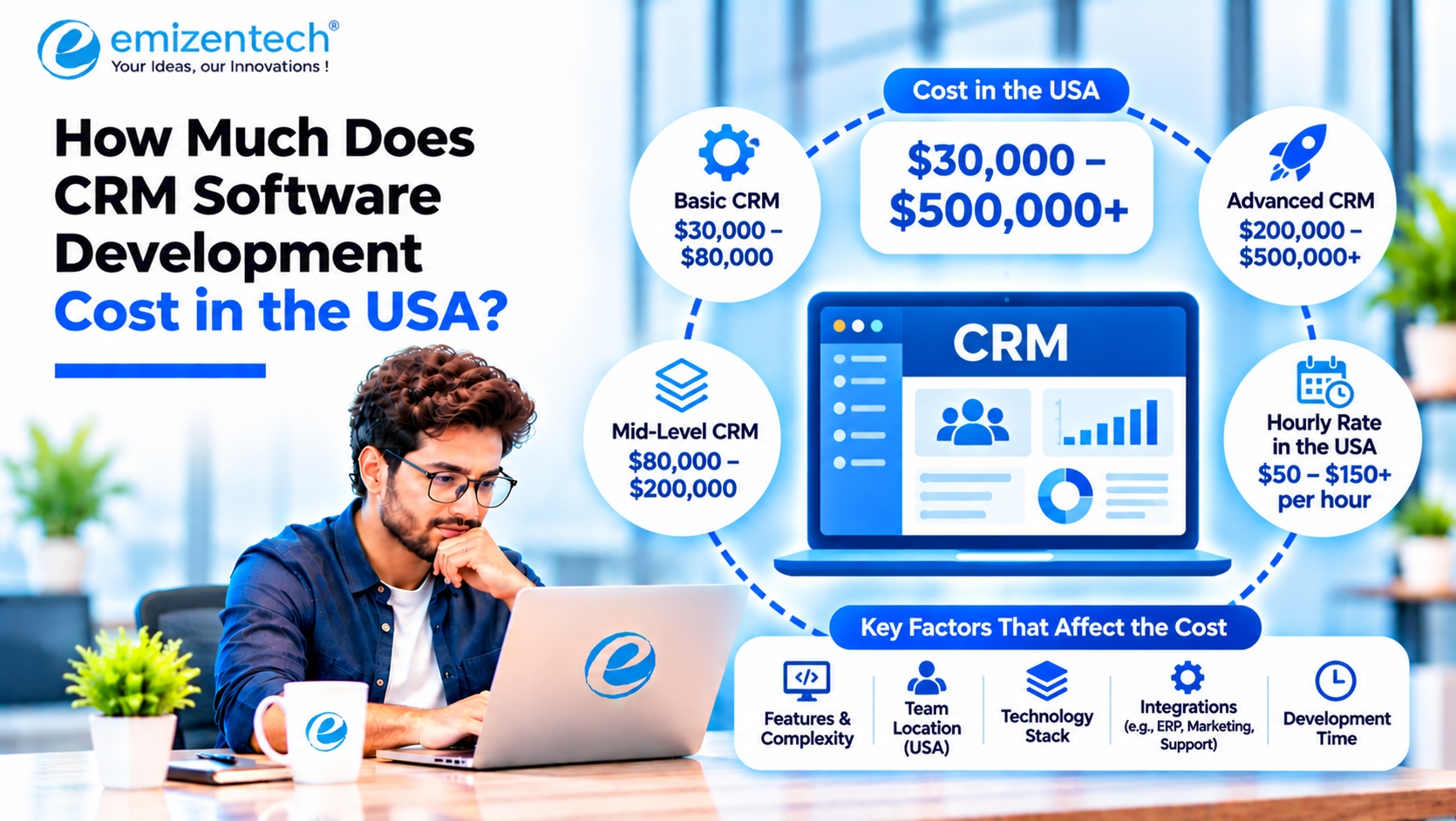
Custom CRM development is a different animal, running from roughly $40,000 up to $300,000 or more. Here’s a rough way to picture it:
Basic or MVP CRM ($40,000 to $80,000): contacts, lead tracking, a simple pipeline and a few standard reports.
Mid-range CRM ($80,000 to $150,000): workflow automation, dashboards by role, a handful of integrations and a mobile app.
Enterprise CRM ($150,000 to $300,000+): AI features, heavy integrations, tighter security and a big data migration.
I’d treat those tiers as a starting guess. A real quote might sit inside them or well outside, depending on what you ask for.
Key Factors That Affect CRM Development Cost
Two CRM projects can sound almost identical and still come back with very different quotes. The difference usually comes down to how much the system has to do, how many people use it, and how much old data needs to come along. Knowing these things before you talk to anyone makes quotes much easier to read. There are six that matter most.
Scope and modules
Every module means more design, building and testing. A CRM that only tracks leads costs far less than one that also runs marketing campaigns, support tickets, quotes and field service. Integrations count too, probably more than people expect. Each connection to another tool has to be built, secured and tested.
Users and roles
Five salespeople sharing one view is simple. Sales, support, finance and field staff all working in the same system, each seeing different things, is not. More roles mean more permissions, more dashboards and more testing.
AI features
Lead scoring, automated follow-ups and chat-style search can be handy. They also add work. Plugging an existing language model into your CRM is a lot cheaper than training a prediction model on your own customer data, so ask which one a vendor is actually quoting.
Data migration
Moving records out of an old CRM or a pile of spreadsheets means auditing, cleaning, removing duplicates, matching fields and checking the results afterwards. If your data is a mess, and honestly most of it is, expect that cleanup to show up on the bill.
Hosting
Cloud hosting is usually quicker and cheaper to get going because someone else runs the infrastructure. On-premises or hybrid setups, often picked for compliance reasons, need more configuration and security work.
Team and timeline
A tight deadline normally means more developers working at once, and that costs more. The way you engage the team (fixed scope, dedicated team or extra hands for your own staff) changes how the money gets spent too.
Features That Drive the Cost
Some features are cheap and some aren’t. Contact records, lead capture, deal stages and basic reports are well-trodden ground, so they don’t cost much. Things get pricey when a feature depends on complicated rules or other systems. Approval workflows, SLA tracking, technician scheduling, quotes with version history and e-signatures all take more time to design and test than they look like they should.
That’s why a clear feature list matters so much when you ask for an estimate. Most crm development services price by module and complexity, so a vague brief gets you a vague number. Sort your list into must-haves and nice-to-haves. If the budget comes in high, you’ll know what to cut without gutting the system.
How Team Choice and Timeline Change the Price
Who builds it matters nearly as much as what gets built. US-based developers often charge somewhere between $100 and $200 an hour, sometimes more. Offshore rates can start far lower, around $20 an hour for certain tech stacks. But the hourly rate isn’t the whole story. A cheap team that needs constant hand-holding or rewrites half its code can end up costing more than a pricier one that gets it right the first time.
Engagement models usually fall into three types. Fixed-scope delivery works when requirements are clear. A dedicated team suits longer builds where things will change along the way. Staff augmentation just adds specific skills to your own team.
Timelines follow the money. A platform-based rollout often goes live in 4 to 12 weeks. A focused custom MVP takes around 3 to 4 months, and a full enterprise system can run 6 to 12 months. If someone promises the enterprise version in a few weeks, ask what they’re leaving out.
Ongoing Costs After Launch
Launch day isn’t the end of the spending. Platform-based CRMs keep charging per user. Custom systems need hosting, monitoring and security upkeep. Then there’s maintenance, which covers bug fixes, updates, performance tuning and changes to integrations whenever another tool updates on its own schedule. A common rule of thumb is 15 to 20 percent of the original build cost each year, though it swings depending on how complex the system is.
Training gets skipped more often than anything else, and it shouldn’t. A CRM nobody uses properly is just an expensive database.
Practical Ways to Keep the Budget in Check
Start with an MVP. Launch the core features first and add modules once you see what people really use.
Clean your data first. Fixing duplicates and outdated records before migration saves paid developer hours.
Keep launch integrations short. Connect the two or three tools that matter most and push the rest to a later phase.
Ask for an itemized estimate. A breakdown by module, integration and phase makes quotes comparable and shows where costs are hiding.
Conclusion
CRM software development in the USA can cost as little as $8,000 for a lean platform setup or $300,000 and up for a fully custom enterprise build. Scope, user count, AI features, data migration, hosting and team structure decide where you land, and licences, maintenance and training keep adding to the total long after launch.
Before you ask anyone for a quote, write down the modules you can’t live without, how many people will use the system and which tools it has to connect to. EmizenTech works across the full CRM lifecycle, from consulting and custom development to mobile CRM apps, AI integration and long-term support. Starting with a discovery call helps you see which approach fits your needs and what it is likely to cost.
FAQs
How much does custom CRM development cost in the USA?
Usually between $40,000 and $300,000 or more. A focused MVP sits at the low end, while enterprise systems with AI, mobile apps and complicated integrations sit at the top.
Is a platform-based CRM cheaper than a custom CRM?
At the start, yes. Platform-based projects typically cost $8,000 to $60,000 for setup and customization. But licence fees keep coming every month, so compare the total over a few years, not just the first invoice.
How long does it take to develop a CRM?
Platform-based rollouts often take 4 to 12 weeks. A custom MVP takes around 3 to 4 months, and enterprise builds can take 6 to 12 months.
Can AI be added to an existing CRM?
Yes. Lead scoring, automated follow-ups and virtual assistants can be added through APIs, extensions or custom development. What it costs depends on the CRM you have and what you want the AI to do.
What ongoing costs should I plan for after launch?
Licence fees, hosting, maintenance, security updates, user training and future changes. Yearly maintenance is often estimated at 15 to 20 percent of the original build cost.


