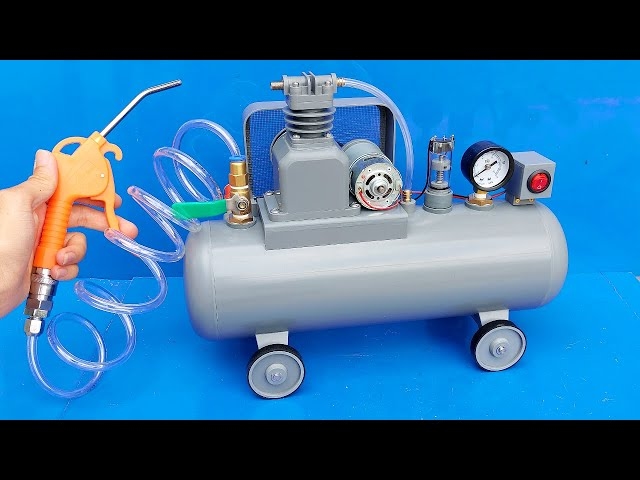
Look, if you are running a heavy-duty mechanical setup, a commercial deep-well drilling rig, or a high-capacity mobile blasting crew, low-pressure workshop air won't cut it. When your daily operations demand massive, continuous pressures pushing way past the standard 100 PSI ceiling, standard lightweight aluminum compressors will literally crack their casings or melt their internal seals within hours of turning the key. Managing extreme pneumatic forces requires a completely different breed of mechanical architecture built to survive intense heat cycles and brutal physical loads. Most procurement managers look at a basic machine spec sheet and assume every air pump handles high-pressure stress the same way, which is a massive gamble that ends in expensive job-site downtime. If your field crews are working in isolated environments without access to three-phase electrical utility grids and need a completely self-sustained, high-output setup that can hammer through extreme workloads all day long, sourcing a heavy-duty set of piston compressors diesel units is the ultimate way to lock down your site's mechanical baseline. But before you bolt one of these heavy iron machines to your service trailer, you need to look past the external sheet metal and understand the precise engineering mechanics that allow a reciprocating pump to tame extreme, high-pressure atmosphere.
The Multi-Stage Compression Ladder and Spatial Reduction Physics
You cannot safely force ambient air up to extreme pressures like 175 or 250 PSI in a single mechanical squeeze. If a single piston tries to crush outside air down to that density in one stroke, the laws of thermodynamics dictate that the air temperature will skyrocket instantly, cooking your internal oil film, warping the valve plates, and risking a violent pre-ignition explosion inside the cylinder head.
To bypass this physical barrier, high-pressure piston machines use an asymmetric multi-stage compression ladder.
The process doesn't happen all at once. The machine uses a massive low-pressure cylinder to take the first bite of outside air, compressing it down to a modest intermediate pressure. This pre-crushed air is then forced through a finned intercooler tube to drop its thermal signature before it enters a secondary, significantly smaller high-pressure cylinder. Because the air is already dense and cold, the smaller piston can easily crush it a second time, stepping the pressure up to its final extreme threshold without creating destructive, metal-warping heat spikes. This stepping method ensures maximum volumetric efficiency while keeping the internal mechanical components well within safe thermal boundaries.
Piston Ring Blowby and the Geometry of High-Pressure Sealing
When a piston is violently smashing air upward into a cylinder head at extreme pressures, that trapped air wants to find any possible escape route. The weakest point in the entire mechanical chamber is the tiny boundary gap between the moving cast-iron piston and the stationary cylinder wall.
If your machine uses cheap, standard commercial sealing rings, that high-pressure air will blow straight past the piston and leak down into the crankcase.
This destructive cycle, known in workshop yards as blowby, instantly destroys your air delivery volume, superheats your lubrication reservoir, and causes the engine oil to turn into a thin, useless sludge. High-pressure reciprocating pumps defeat this sealing challenge by deploying an advanced, multi-ring staggered geometry. The piston head features three or four distinct compression rings made of specialized high-tensile alloys or filled-fluoropolymer materials. Each ring is machined with an intentional gap, but during assembly, the engineering team offsets these gaps by 120 degrees, forcing the escaping air to face a tortuous, impossible maze. This geometric barrier traps the high-pressure air completely above the piston crown, keeping your air delivery flat out and preventing crankcase contamination.
Concentric Disc Valve Dynamics under Extreme Pneumatic Load
At standard workshop pressures, a compressor can get away with using thin, flexible spring-steel reed valves to handle the intake and exhaust flows. But when you step up into heavy industrial high-pressure applications, those thin metal reeds will rapidly fatigue, snap off, and drop straight into the cylinder, instantly destroying your entire piston assembly.
To survive the punishing slam of high-pressure air, rugged industrial pumps replace thin reeds with heavy-duty Concentric Disc Valves.
These heavy-duty components consist of precision-machined, spring-loaded stainless steel discs resting against flat, ground-metal valve seats. Instead of bending or flexing like a reed, the entire disc lifts uniformly off its seat when the pressure shifts, allowing massive volumes of air to pass through with minimum friction. The moment the piston reverses direction, heavy-duty internal springs snap the disc plate back down instantly, creating a positive, unyielding high-pressure seal that can handle millions of violent cycles without cracking or losing mechanical tightness.
The Constant-Run Unloader System vs. Continuous Cycling Shock
A hidden mechanical killer that completely ruins the lifespan of a high-pressure compressor is the constant stopping and starting of the heavy pump assembly. Pumping air up into a high-pressure storage tank requires an immense amount of startup torque. If your machine is forced to completely shut down and restart every single time your air tank pressure drops by a few PSI, the electrical or mechanical starter components will burn out within a matter of weeks.
High-pressure industrial systems manage this structural stress through an integrated Constant-Run Pneumatic Unloader System.
Instead of stopping the whole machine when the storage tank hits its maximum pressure limit, a smart pilot valve diverts a small stream of high-pressure air directly to an unloader mechanism mounted on the cylinder head. This air pressure physically forces the intake valves to stay wide open, allowing the piston to continue moving up and down freely without drawing any horsepower or compressing any air. The engine idles smoothly, shedding its internal thermal heat load under zero resistance, until the tank pressure drops below the minimum set threshold. The pilot valve then vents the unloader line, the intake valves drop back into action, and the machine instantly goes back to building high-pressure air without experiencing a single millisecond of brutal startup torque shock.
The Real Takeaway
At the end of the day, squeezing reliable high-pressure air out of a industrial reciprocating unit isn't about simply purchasing the largest iron block on the showroom floor and running it until it gets hot. It is a precise, calculated game of managing multi-stage scaling physics, locking down your cylinder rings against blowby, and protecting your valve plates from mechanical fatigue.
By prioritizing Multi-Stage Compression Ladders, securing Staggered Sealing Ring Geometry, deploying Concentric Disc Valves, and utilizing Constant-Run Unloader Loops, you turn a high-stress pneumatic demand into a highly stable, self-sustaining job-site asset. Stop treating your heavy-duty air supply like a simple workshop tool. Master the deep physical mechanics of your high-pressure load profile, eliminate your internal maintenance vulnerabilities, and let ruggedized, data-driven field engineering defend your company's operational uptime.