
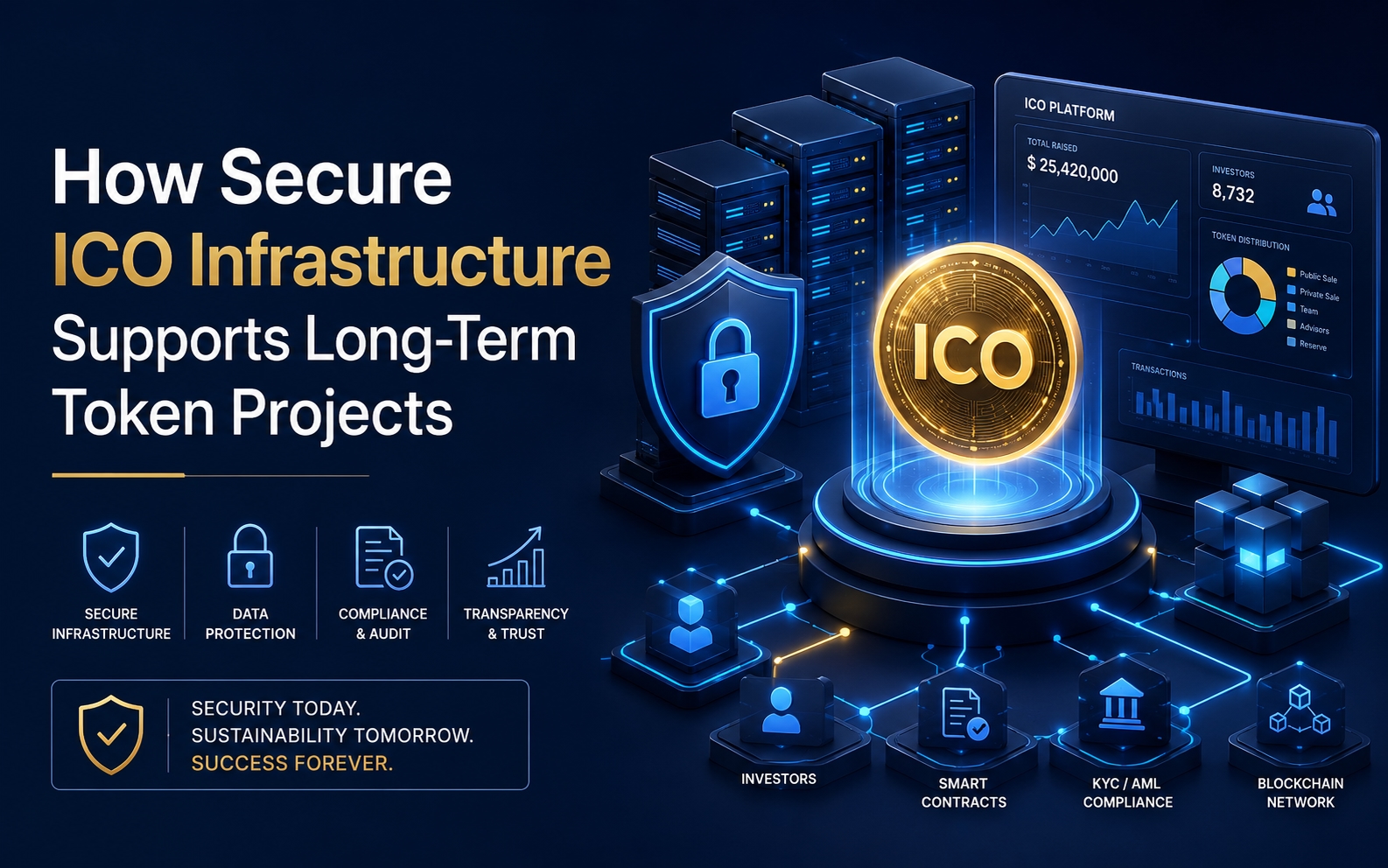
An ICO is often treated as a fundraising event with a defined beginning and end. A project launches its token sale, accepts contributions, distributes tokens, and moves toward its next phase. In practice, the technology built for the ICO can influence the project's security, credibility, scalability, and ability to support users long after fundraising ends.
A secure ICO infrastructure connects smart contracts, wallets, backend services, investor dashboards, payment systems, identity verification, access controls, and monitoring tools. When these components are designed as one system, the project has a stronger foundation for managing the token throughout its lifecycle.
Security is particularly important because crypto infrastructure remains a high-value target. Chainalysis reported that more than $3.4 billion in cryptocurrency was stolen during 2025, with the Bybit incident alone accounting for nearly $1.5 billion. These incidents show why security cannot be treated as a final development step.
Security Begins With ICO Architecture
A secure ICO starts with architecture rather than a security audit performed immediately before launch.
The platform can contain several interconnected layers. The frontend manages investor interactions. Backend services handle user records and transaction states. Smart contracts execute token-sale rules. Wallet integrations connect users to blockchain networks. Payment systems process contributions, while monitoring tools track suspicious or abnormal activity.
A weakness in one layer can affect others. For example, a compromised administrative account could potentially interact with privileged smart-contract functions. An insecure API could expose investor information even if the smart contract itself is secure.
For this reason, development teams need to map data flows, user permissions, blockchain interactions, and administrative operations before implementation begins. Threat modeling at the architecture stage helps identify high-risk components before they become expensive to redesign.
Smart Contract Security Protects the Token
Smart contracts are among the most important security components in an ICO because they can control token distribution, pricing, allocation, vesting, and other critical functions.
A coding error can produce consequences that cannot easily be reversed after deployment. Common risks include improper access control, flawed business logic, reentrancy vulnerabilities, arithmetic issues, and weaknesses in upgrade mechanisms.
OWASP's Smart Contract Security Testing Guide provides a structured approach covering architecture, business logic, access control, cryptographic practices, blockchain state management, and other security areas.
Access control deserves particular attention. Administrative functions such as minting, pausing transfers, changing parameters, or managing upgrades should not be available to arbitrary accounts. OWASP specifically recommends testing critical functions to verify that only authorized roles can perform sensitive operations.
A long-term token project should therefore treat the smart contract as core infrastructure rather than simply as code required to complete an ICO.
Auditing Is Only One Part of Security
A smart-contract audit can identify vulnerabilities, but security should not begin or end with an audit report.
Testing should occur throughout development. Unit tests can validate individual functions, while integration tests examine how contracts interact with wallets, backend services, and other components. Fuzzing and other automated techniques can test unexpected inputs and conditions.
Teams should also test economic and business-logic scenarios. A contract can be technically valid while still implementing an incorrect token-sale rule.
For example, consider a token with a fixed allocation for each fundraising phase. Testing should verify not only that purchases work but also that the allocation cannot be exceeded when multiple investors transact simultaneously.
Security testing should continue after deployment because contracts, infrastructure, dependencies, and attack methods evolve.
Access Control Protects Administrative Operations
Long-term token projects require administrative functions. Someone needs to manage operational settings, respond to emergencies, monitor infrastructure, and potentially execute approved upgrades.
These privileges create security risks if they are concentrated in one account.
Role-based access control can separate responsibilities. A deployment administrator, treasury operator, compliance administrator, and emergency operator can have different permissions based on their responsibilities.
Multisignature controls can also add another layer for high-value or high-impact operations. Instead of allowing one private key to authorize a critical transaction, multiple authorized parties can be required.
This reduces dependence on a single credential and creates stronger operational governance.
Wallet and Key Management Matter Beyond Launch
Private keys remain one of the most important security considerations in blockchain projects. Compromising an administrator's key can expose treasury assets or privileged contract functions.
Key management should therefore include secure storage, restricted access, backup procedures, rotation policies, and clear recovery processes.
The importance of this area is reflected in broader crypto security data. Chainalysis reported that private-key compromises represented the largest share of stolen crypto in 2024, accounting for 43.8% of stolen funds that year.
For a long-term project, key management should be treated as an operational process rather than a one-time technical setup.
Infrastructure Security Protects Investor Information
Smart contracts are only one part of an ICO platform.
Investor accounts, verification information, transaction records, APIs, databases, and administrative dashboards also require protection. A secure infrastructure should use appropriate authentication, authorization, encryption, logging, network controls, and monitoring.
API security deserves special attention because APIs often connect the frontend to backend services. Poor authorization controls can allow users to access information or functions they should not control.
For example, an investor should be able to view their own contribution history but should not be able to manipulate another investor's allocation by changing an identifier in an API request.
Security testing should therefore cover application behavior as well as blockchain code.
Compliance Can Strengthen Long-Term Infrastructure
Regulatory requirements can also influence the technical design of an ICO platform.
Under MiCA, applicable crypto-asset white papers need to present required information clearly and in a comprehensible manner. The regulation also addresses information about the issuer, crypto-asset, offering, rights and obligations, underlying technology, and risks.
This creates a need for systems that can maintain accurate disclosures, investor records, transaction information, and relevant access restrictions.
The exact requirements depend on the token, offering structure, jurisdictions, and applicable laws. Legal teams should determine these requirements before developers translate them into technical workflows.
A compliance-aware architecture can make future operational changes easier because important records and controls already exist within the platform.
Monitoring Helps Detect Problems Early
Security does not end when the ICO goes live.
Continuous monitoring can help identify unusual transactions, repeated failed login attempts, unexpected administrative activity, abnormal API requests, or unusual smart-contract interactions.
Monitoring also helps distinguish technical failures from potential security incidents. If a large number of transactions suddenly fail, the team can investigate whether the cause is blockchain congestion, a software issue, or malicious activity.
Logs and alerts should be designed around the project's highest-risk events. Recording everything without an incident-response process creates large amounts of data without necessarily improving security.
Secure Infrastructure Supports Scalability
Long-term token projects often experience significant changes in activity. Investor numbers can grow, transaction volumes can increase, and new products or blockchain integrations can be introduced.
Infrastructure that works during a small ICO may not perform well when the project gains a larger user base.
Scalable architecture should separate critical services where appropriate and allow resources to increase as demand grows. Load testing can identify bottlenecks before major campaigns or token events.
Blockchain conditions also need consideration. Network congestion can delay confirmations and increase transaction costs. The platform should communicate these conditions accurately rather than presenting delayed transactions as failures or encouraging users to submit duplicates.
Designing for the Full Token Lifecycle
One of the biggest mistakes in ICO infrastructure is designing exclusively for fundraising.
A token project can continue for years after its initial sale. Investors may need to claim tokens, follow vesting schedules, transfer assets, participate in governance, or interact with applications connected to the token.
The infrastructure should therefore support a broader lifecycle:
Launch → Distribution → Vesting → Trading → Utility → Governance → Long-Term Operations
This approach reduces the need to rebuild core systems as the project develops.
It also creates a more consistent experience for investors. The same account, transaction history, and security architecture can continue supporting users beyond the original token sale.
Security Builds Long-Term Investor Confidence
Security is not only a technical requirement. It is also part of how investors evaluate a token project.
Published contract addresses, transparent token allocations, clearly documented vesting schedules, appropriate audit information, secure administrative practices, and reliable investor dashboards can provide useful signals about project maturity.
The strongest signal is consistency. A project that communicates security clearly but operates with weak access controls creates a credibility gap.
Investors increasingly have more tools to examine blockchain activity themselves. Projects therefore benefit from treating transparency and security as ongoing responsibilities rather than marketing features.
Conclusion
Secure ICO infrastructure provides the technical foundation for a token project beyond its fundraising period. Smart-contract security protects core token logic. Access controls protect privileged functions. Key management safeguards critical accounts. Application security protects investor information, while monitoring helps teams respond to emerging threats.
The need for this approach is clear as crypto theft continues to generate substantial losses. At the same time, security practices are becoming more structured through frameworks such as the OWASP Smart Contract Security Testing Guide.
For businesses planning an ICO, the better approach is to build security into the architecture from the beginning. A well-designed ICO infrastructure can support not only a safer token launch but also the distribution, utility, governance, and long-term growth of the project.