Picture a hypothetical junior marketer hired a few years ago to write product descriptions and tidy page titles. Today, an AI tool drafts both in seconds. Her manager has stopped asking for more copy and instead asks why organic sign-ups fell after a site redesign. The job still exists, but its centre of gravity has moved from producing assets to interpreting evidence and making decisions.
Why digital marketing careers are changing
Two developments are well documented. A third remains a forecast.
The first is a change in search behaviour. A Pew Research Center analysis of 900 US adults' browsing in March 2025 found that people clicked a traditional result link in 8% of visits when Google showed an AI summary, against 15% when it did not. It is a US snapshot, but it suggests that visibility and traffic no longer move together as predictably as before.
The second is a change in what employers ask for. The World Economic Forum's Future of Jobs Report 2025, drawing on more than 1,000 employers across 55 economies, found analytical thinking to be the most sought-after core skill, rated essential by about seven in ten companies, while AI and big data topped its list of fastest-growing skills. LinkedIn's 2026 Skills on the Rise research adds that employers increasingly weigh skills above degrees and job titles. Separate LinkedIn research published in June 2026 found that marketing job postings requiring AI literacy had increased by 113% year-on-year.
The forecast concerns how much routine marketing work AI will absorb. Nobody can say reliably, so a sensible plan assumes change without betting on one outcome.
Which digital marketing skills create lasting professional value?
Interfaces change often, but the questions beneath them change slowly. Audience research reveals who is searching and what they need. Content strategy decides what deserves to exist, which matters more when producing text costs almost nothing. Analytics turns activity into evidence. Experimentation teaches how to run a fair test and when a result is too thin to trust.
Consider a hypothetical campaign that lowers cost per click while leads decline. Someone who knows only the ad platform sees a success. Someone who understands the funnel asks whether those clicks came from the right audience. Tools can produce the report, but they cannot decide which question is worth asking.
Why SEO remains a useful foundation
SEO is a compact education in how people look for things and how systems decide what to show them. It covers search intent, technical accessibility, content relevance and measurement, and each transfers to other channels.
AI-powered search has changed the interface more than the foundations. Google's guidance for site owners says a page must, at a minimum, be indexed and eligible to appear with a snippet to feature in AI Overviews and AI Mode, and that special files such as llms.txt or splitting content into small chunks are unnecessary for Google Search. It also warns that creating many pages mainly to capture query variations can breach its scaled content abuse policy.
Two limits apply. That guidance describes Google, while other AI assistants retrieve and cite sources in ways their makers do not fully disclose. Learning SEO well therefore means learning to diagnose problems, not to follow a checklist.
How to choose an SEO learning programme that develops practical skills
A syllabus lists topics but does not show whether a learner can use them. Useful programmes cover search intent, keyword research, on-page work, technical basics such as crawling, indexing and canonicalisation, and analytics through Search Console.
The more revealing questions concern process. Do students work on real or realistic sites? Does an experienced person review assignments and explain what was weak? Does assessment reward decisions rather than recalled definitions? Can the instructor show verifiable work? Treat promises of guaranteed jobs or rankings as a warning sign.
Looking at how different training providers organise their curricula can help learners establish their own evaluation criteria. For instance, this regional comparison of SEO training programmes in Kolkata, published by a training provider featured in the comparison, examines learning formats, curriculum coverage and practical training. Readers can apply similar criteria when assessing programmes in their own markets and independently verify current course details.
How to turn knowledge into professional experience
Finishing a course shows that someone has been taught. It does not show that they can handle an unclear brief, messy data or a stakeholder who wants answers by Friday.
A focused portfolio can help demonstrate that ability. Three useful starting projects are: an audit of a small site, used with permission or built by the learner, that ranks findings by likely impact; a keyword map explaining which query belongs on which page and why; and a content update documented with before and after notes. Label each honestly as a course exercise, test site or client work, and state what could not be known.
Internships, volunteering and modest freelance projects add something a course cannot, which is consequence.
What a realistic digital marketing career roadmap looks like
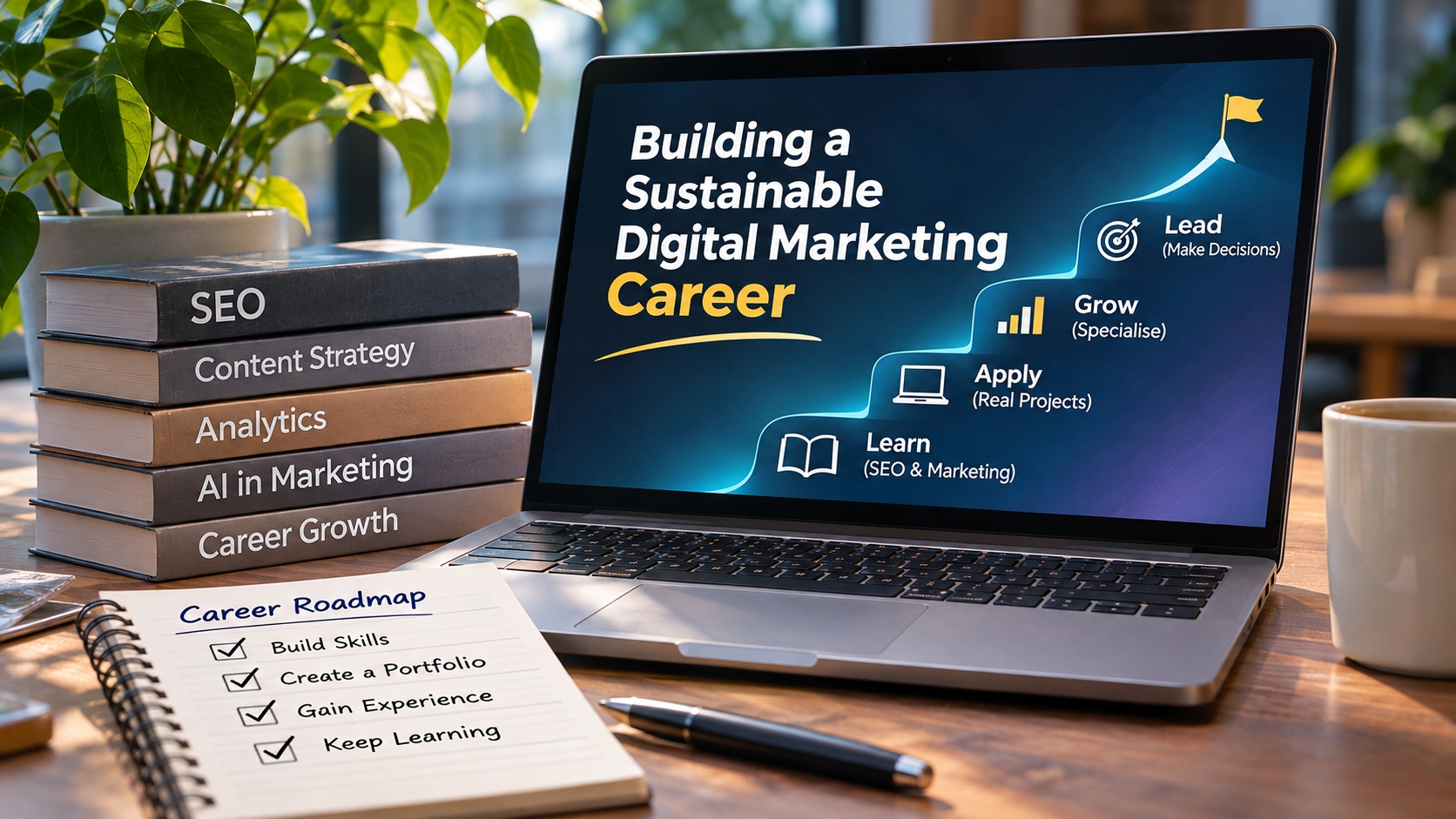
Pace varies by person, so this sequence is illustrative. It rests on no published timings and promises no job.
Foundations. Learn how search works, how audiences decide and how to read basic data in Search Console.
Application. Work on a real or test site, complete an audit, publish content and record what changed.
Depth. Choose one area, such as SEO, paid media or content, and learn enough about the others to see how they connect.
Judgement. Move from following instructions to making recommendations, with evidence and stated limits.
Career changers often move faster through the first stage because they bring domain knowledge. For a practical view of junior roles, this guide to building a career in digital marketing walks through typical entry-level tasks, a sample website diagnosis and ways to present early work without employment history.
How marketers can stay relevant as AI changes the work
When learning about search technologies, current official documentation is generally more reliable than tutorials based on outdated platform behaviour.
Responsible AI use rests on verification. AI tools can suggest keyword groupings and summarise data, and they can also be wrong. Google's guidance on generative AI content accepts it as a research aid but cautions that mass-produced pages with little added value may breach its spam policy. Check facts and keep a person accountable for the output.
Data interpretation needs particular care. A month of figures from a small site often cannot support firm conclusions, and saying so is part of professional credibility. Human judgement covers the rest, including deciding what is worth saying.
One habit is worth keeping. Once a month, pick a real question about a live site, investigate it end to end and write down what you concluded and what you could not know. After a year, that record shows judgement more convincingly than a certificate.