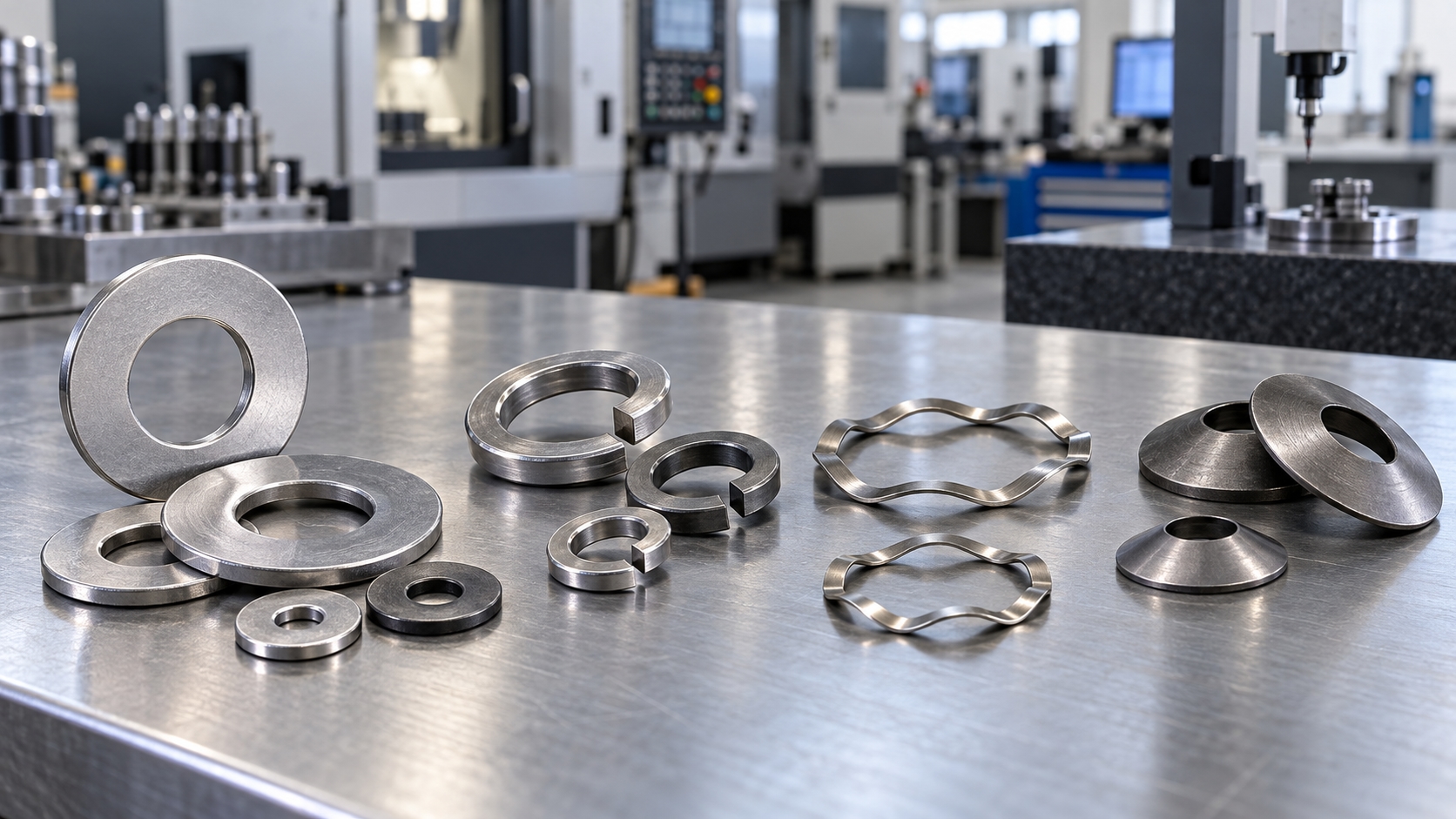
Washers may look like small, simple components, but they play an important role in the reliability of mechanical assemblies. From automotive manufacturing and industrial machinery to construction equipment and heavy engineering, selecting the correct washer can improve load distribution, protect contact surfaces, and support dependable fastening performance.
For procurement teams and engineers, choosing a washer involves more than finding the right diameter. Material, thickness, operating conditions, dimensional tolerances, and compatibility with the fastening system all matter.
Understanding these factors helps businesses make informed purchasing decisions and work with experienced manufacturers that understand industrial requirements.
Different Types of Washers Used in Industry
Different applications require different washer designs. Understanding their functions is the first step towards selecting a suitable product.
1. Plain Washers
Plain washers, also called flat washers, provide a bearing surface beneath a bolt head or nut. They help distribute the clamping load across a wider area and can reduce local surface damage.
These washers are commonly used in machinery, automotive assemblies, electrical equipment, and general industrial fastening applications. Their dimensions and material should be appropriate for the fastener and the surface being secured.
2. Spring Lock Washers
Spring lock washers are designed with a split or other spring-like geometry. They are used in certain fastening arrangements where their elastic characteristics are relevant to the joint design.
However, they should not be considered a universal solution to loosening caused by vibration. Joint stiffness, preload, surface conditions, and the selected locking method also influence fastening reliability.
3. Bearing Washers and Spacers
Bearing washers and spacer-type components help maintain spacing, support contact surfaces, and establish the required positioning within mechanical assemblies.
Dimensional consistency is particularly important in precision equipment, rotating machinery, and applications where alignment affects performance.
4. Disc Spring Washers
Disc spring washers have a conical shape that allows them to generate spring force under deflection. Depending on the application, they can help accommodate limited movement, maintain load, or compensate for dimensional changes.
Engineers should check the required load-deflection characteristics before selecting these components.
5. Wave Washers
Wave washers feature a wave-shaped profile that provides spring action along the axial direction. They are useful in selected compact assemblies where limited axial space and controlled spring force are important.
Their suitability depends on the available space, operating load, deflection requirements, and surrounding component geometry.
Key Factors to Consider When Selecting a Washer
Choosing the correct washer requires attention to the technical details of the application.
Material selection: Carbon steel, stainless steel, and other suitable materials offer different mechanical and environmental characteristics. Corrosion exposure, temperature, strength requirements, and contact with dissimilar metals should influence the choice.
Dimensions and tolerances: Inner diameter, outer diameter, thickness, and flatness should match the assembly requirements. Incorrect dimensions can affect fit, load distribution, and installation.
Surface finish: Zinc plating and other protective finishes may improve corrosion resistance in appropriate environments. The finish must also be compatible with the operating conditions and applicable specifications.
Load and application requirements: Consider the clamping force, contact area, vibration exposure, and whether the washer needs to provide spring action. A standard flat washer and a disc spring washer perform different functions.
Standards and quality documentation: Where required, verify dimensional standards, material specifications, inspection records, and traceability documentation. These details are particularly important for regulated or safety-critical applications.
Why Manufacturer Selection Matters
Industrial buyers need suppliers who can provide consistent product quality, reliable specifications, and clear communication. An unsuitable washer can create assembly difficulties and additional costs, particularly when components are purchased in large quantities.
When evaluating a Washer supplier, review the available product range, material options, dimensional capabilities, quality-control procedures, and ability to meet your purchasing requirements.
It is also useful to confirm minimum order quantities, delivery schedules, packaging arrangements, and the availability of technical assistance. For customised requirements, discuss drawings, tolerances, and inspection criteria before placing an order.
Businesses comparing the top Washer Manufacturers should focus on measurable quality factors rather than price alone. Consistent dimensions, suitable materials, transparent specifications, and dependable order fulfilment can contribute to lower procurement risks over time.
EASCO provides a range of industrial washer products for different fastening and mechanical assembly requirements. Buyers can review the available options on its washer product page and contact the company to discuss application-specific needs and product specifications.
Common Mistakes to Avoid When Purchasing Washers
Several avoidable mistakes can affect component performance and procurement efficiency.
One common issue is choosing a washer based only on its outside diameter while overlooking its thickness, inner diameter, or material grade. Another is selecting a spring washer without evaluating whether it suits the joint design.
Buyers should also avoid assuming that every stainless steel washer has the same corrosion resistance or that all protective coatings perform equally in every environment.
Finally, purchasing solely on the lowest quotation can overlook consistency, inspection requirements, and delivery reliability. A clear technical specification helps suppliers quote comparable products and reduces the likelihood of ordering errors.
Conclusion
Washers contribute to the performance and durability of industrial fastening systems by supporting load distribution, spacing, surface protection, and, in selected designs, spring action.
The right choice depends on the application, material, dimensions, operating environment, and engineering requirements. By defining these factors before purchasing and evaluating manufacturers on quality and consistency, businesses can make more reliable sourcing decisions.
For industrial buyers looking for different washer types, EASCO's Washer range is a useful starting point for reviewing available products and discussing specific requirements.
FAQs
What is the main purpose of a washer?
A washer can distribute the load beneath a nut or bolt head, protect contact surfaces, provide spacing, or deliver spring action, depending on its design.
What is the difference between a plain washer and a spring washer?
A plain washer primarily provides a bearing surface and helps distribute load. A spring washer has a spring-like geometry intended to provide elastic action in suitable applications.
How do I select the right washer material?
Consider the required strength, corrosion exposure, operating temperature, contact materials, and applicable technical standards before choosing a material.
Why are washer dimensions important?
Correct inner diameter, outer diameter, and thickness help ensure proper fit, suitable contact area, and compatibility with the fastening assembly.
What should I check before choosing a washer manufacturer?
Review product specifications, material options, dimensional consistency, quality documentation, order capacity, delivery commitments, and technical support.
Can one washer type be used for every industrial application?
No. Different washer designs serve different purposes. Selection should be based on the joint design, load requirements, environment, and required performance.