Publishing a useful article is only one part of building an online presence. After creating valuable content, the next challenge is finding appropriate places where that content can reach people who are actually interested in the subject.
This does not mean posting the same link everywhere. Effective content distribution is more selective. It involves understanding the audience, choosing relevant publishing environments, creating useful resources, and sharing them in ways that make sense for readers.
Whether you run a business website, manage a blog, work in digital marketing, or publish educational resources, a thoughtful distribution strategy can help your content reach audiences beyond your own website.
Start With the Audience
Before looking for websites where you can publish or share content, think about the people you want to reach.
A business owner may be interested in marketing guides, productivity resources, or technology solutions. A blogger may be looking for publishing communities and industry discussions. An SEO professional may be interested in research, technical guides, content marketing, and search-related resources.
Knowing the audience makes it easier to identify suitable platforms.
Instead of asking, “Where can I put my link?” ask:
“Where would someone interested in this subject naturally look for useful information?”
That small change in perspective can significantly improve the quality of your publishing decisions.
Look for Topical Relevance
Relevance should be one of the first things you evaluate when considering an external publishing opportunity.
A website can have a large audience, but that does not automatically make it suitable for every topic. A technology resource may be highly relevant for a software article but have little connection to a home-improvement guide.
Look at the subjects a platform regularly publishes.
Check:
The main categories
Recent articles
Typical readers
Editorial style
Contributor requirements
Types of external links allowed
Whether promotional content is restricted
A relevant environment gives your content a better chance of being useful rather than appearing out of place.
Create Something Worth Sharing
The quality of the destination content matters before you even begin outreach.
A short article created only to place a hyperlink gives readers little reason to continue reading. A detailed guide, original analysis, practical tutorial, checklist, or useful resource provides a much stronger foundation.
For example, an article about website promotion could explain different approaches to content distribution, common mistakes, platform selection, and ways to evaluate publishing opportunities.
The link can then support one specific part of the discussion.
The content should be valuable even if the reader never clicks the link.
Explore Different Publishing Opportunities
There is no single type of website where useful content can be published.
Depending on your subject and goals, you may find opportunities through:
Industry publications
Contributor websites
Blogging platforms
Online communities
Resource pages
Business publications
Educational platforms
Professional profiles
Content-sharing websites
Relevant newsletters
Each category serves a different purpose.
For example, an industry publication may provide editorial exposure, while a personal publishing platform may give you more control over formatting and presentation.
The right choice depends on the purpose of the content.
Use Natural Context for External Links
When you include a hyperlink, make sure it has a clear relationship with the surrounding sentence.
Suppose you are explaining how writers can find relevant publishing opportunities. You could naturally refer readers to a guide to places where website links can be posted if that resource provides additional information related to the discussion.
The important part is the context.
The reader should understand why the link is there before clicking it.
Avoid inserting a hyperlink into an unrelated sentence simply because you want another website mentioned. Contextual relevance creates a much smoother reading experience.
Don't Rely on Exact-Match Anchors
Anchor text should describe the destination naturally.
You do not need to repeat the same keyword every time you reference a website.
Depending on the sentence, useful anchor text might include:
detailed guide
additional resources
publishing opportunities
useful reference
link-sharing guide
more information
The best choice depends on what the destination page actually provides.
Natural wording also keeps the article readable for people rather than making every sentence sound like it was written around a search query.\
Evaluate the Website Before Publishing
A publishing opportunity should be evaluated beyond basic metrics.
Before contributing an article, examine the website itself.
Look at its recent content and ask:
Is this website genuinely active?
Check whether articles are being published regularly, whether topics are consistent, whether the site has an identifiable audience, and whether the content appears editorially maintained.
You can also examine the site's outbound links.
If almost every article contains numerous unrelated promotional links, that may be a reason to reconsider the opportunity.
On the other hand, a website with clear editorial standards and relevant content may provide a more appropriate environment for a genuinely useful contribution.
Don't Judge Opportunities by Metrics Alone
SEO tools provide useful measurements, but metrics should not be the only factor in your decision.
A website's authority score, domain rating, traffic estimate, or similar metric can help with research, but numbers do not tell the entire story.
Also consider:
Topic relevance
Audience quality
Content standards
Website activity
Editorial consistency
Search visibility
Referral potential
Overall credibility
A smaller but highly relevant publication may be more useful to a specific audience than a large website with no meaningful connection to your subject.
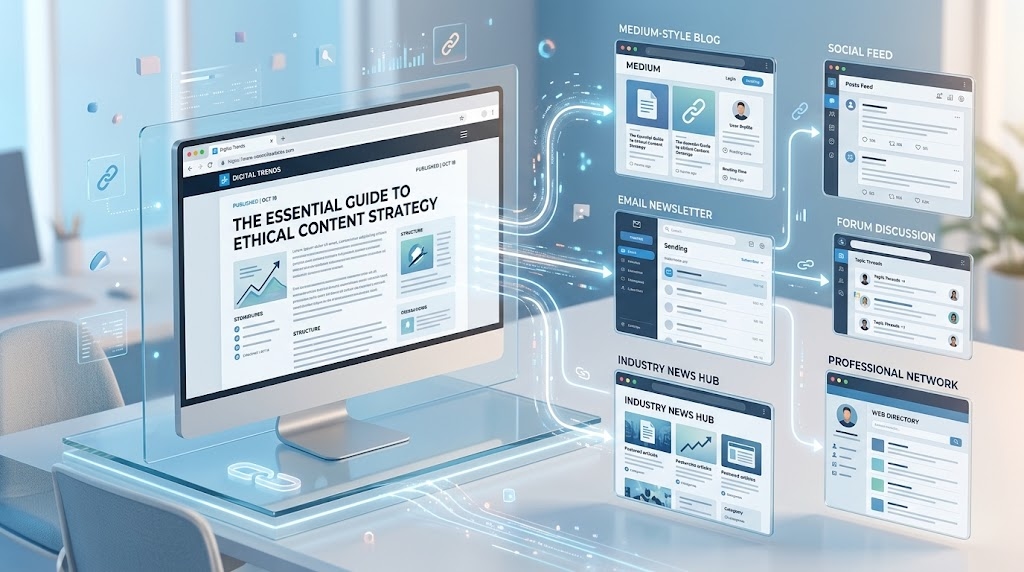
Create Different Content for Different Platforms
One of the easiest ways to reduce content quality is to publish the same article everywhere.
Instead, adapt your ideas to the platform.
For example, one topic can become:
A practical guide:
A detailed explanation of how to approach website content distribution.
A community post:
A short discussion about mistakes people make when sharing online resources.
An educational article:
A step-by-step explanation of evaluating publishing opportunities.
A case-based article:
An example of how a business could distribute one useful resource across relevant channels.
The central subject can remain similar while the article's purpose, structure, examples, and wording change.
This creates a more useful publishing ecosystem than repeatedly copying one article.
Think About the Reader's Next Step
A strong article should naturally lead readers toward additional information.
That next step could be another article, a research source, a tool, a tutorial, or a relevant website.
For example, if you are explaining content distribution, you might mention that marketers can research different platforms before deciding where to publish. A relevant resource for finding suitable link-sharing opportunities can then provide readers with additional context.
The link works because it follows the reader's interest rather than interrupting it.
Avoid Excessive Linking
More links do not automatically make an article more useful.
Too many external links can distract readers and make the content look promotional.
For a focused article, a small number of highly relevant references is often enough.
Before adding another link, ask whether it contributes something that the reader actually needs.
If the answer is no, leave it out.
Follow Platform Guidelines
Every publishing platform has its own rules.
Some websites welcome external references while others have restrictions on promotional content, commercial links, or self-promotion.
Read the publishing guidelines before submitting your article.
Also check whether links are permitted in the body of the article, whether contributor profiles can include websites, and whether the platform applies particular link attributes.
Following the rules is important because an article that violates editorial requirements can be rejected, edited, or removed.
Focus on Long-Term Content Value
Good content distribution is not simply about getting a URL published.
A useful article can introduce your ideas to a new audience, generate referral visits, support your reputation, and create opportunities for future relationships.
That is why the content itself should remain the priority.
Instead of creating dozens of thin posts, focus on producing fewer pieces that are genuinely informative and appropriate for the platforms where they appear.
Final Thoughts
Finding places to share website content is easier when you stop treating every platform as a backlink opportunity and start evaluating each one as a potential audience.
Look for topical relevance, understand the readers, create original material, use natural contextual references, and check the platform's publishing requirements before contributing.
Most importantly, make sure the article provides value independently of its links.
When the content is useful and the references genuinely support what you are explaining, website promotion becomes part of a broader content strategy rather than the entire purpose of the article.
That approach creates a better experience for readers and gives your published content a clearer reason to exist.