
India Construction Market Outlook
The market is expanding on record government capital expenditure, rapid urbanization, and policy initiatives that are modernizing the built environment. Investment in transport networks, smart cities, renewable energy, and industrial corridors is reshaping project pipelines, while prefabrication, sustainable building, and public-private partnership (PPP) frameworks raise efficiency.
Construction industry trends India 2026 point to a sector that is becoming more technology-led, more mixed-use, and more tied to clean energy and logistics. Contractors, developers, and allied industries such as cement, steel, and equipment benefit from a long, visible order pipeline.
Market Snapshot
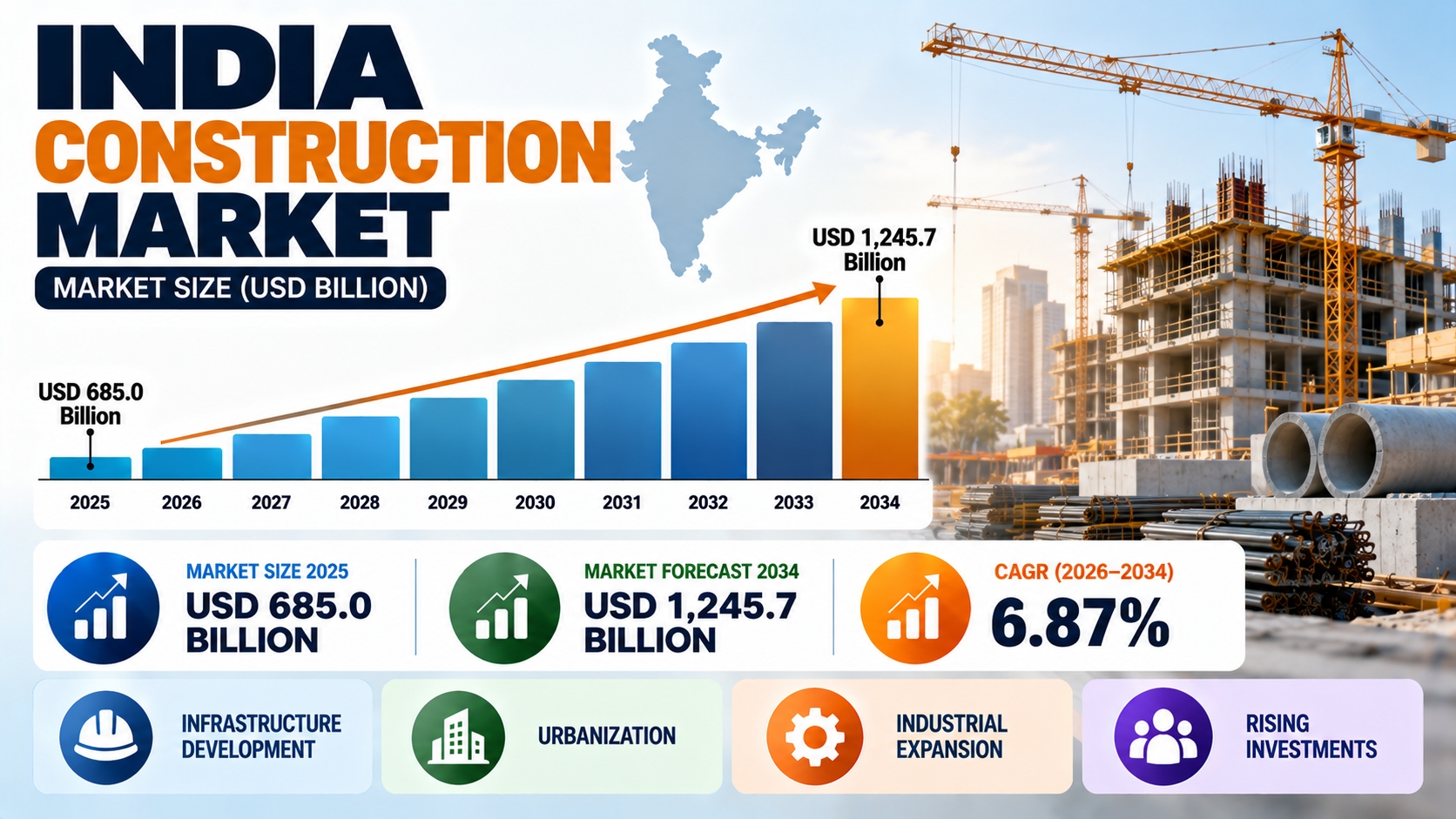
Market Size (2025): USD 685.0 Billion
Forecast Market Size (2034): USD 1,245.7 Billion
CAGR (2026-2034): 6.87%
Leading End Use Sector: Public, 56.8% share (2025)
Leading Type of Contractor: Large Contractor, 62.4% share (2025)
Leading Type of Construction: Buildings Construction, 44.9% share (2025)
Leading Region: West India, 31.6% share (2025)
Key Growth Drivers: Public infrastructure spending, urbanization, renewable energy, logistics, smart cities
Executive Summary
The market is projected to grow from USD 685.0 Billion in 2025 to USD 1,245.7 Billion by 2034 at a CAGR of 6.87%. This India construction sector growth projection rests on highway, railway, and metro programs, rising housing demand in metropolitan and tier-two cities, and investment in renewable energy and manufacturing corridors.
The public sector commands 56.8% of the market, and large contractors hold 62.4% thanks to their ability to execute complex, high-value projects. Buildings construction leads by type at 44.9%. Competition is intense, with diversified engineering conglomerates, specialized infrastructure developers, and regional contractors vying for public and private contracts.
India Construction Market Key Drivers
Expansion of Renewable Energy and Energy Infrastructure:
Solar parks, wind farms, transmission corridors, and storage systems require significant civil works and grid integration. In 2025, infrastructure projects worth ₹1.2 trillion were launched in Rajasthan, including the 4x700 MW Mahi Banswara Atomic Power Project, valued at about ₹42,000 crore, and the 925 MW Nokh Solar Park.
Growth of Logistics, Warehousing, and Supply Chains:
E-commerce is driving demand for distribution centers, cold storage, and logistics parks near consumption and manufacturing hubs. India’s e-commerce industry was valued at INR 10,82,875 Crore in 2024 and is projected to reach INR 29,88,735 Crore by 2030, a 15% CAGR.
Smart Cities and Urban Infrastructure:
Command centers, upgraded transit, waste management systems, and digital utilities generate sustained civil and engineering work. In 2025, Karnataka announced the Greater Bengaluru Integrated Township near Bidadi, an 8,400-acre AI-powered city expected to function as Bengaluru’s second central business district.
Rapid Urbanization and Housing Demand:
Migration to cities is increasing demand for housing, offices, retail centers, and integrated townships, supported by affordable housing initiatives and rising private participation.
Evaluate Market Opportunity with the Business Sample Report
India Construction Market Emerging Trends
Technology Adoption and Modern Construction Practices:
Building information modeling, prefabrication, modular methods, and automation are speeding up delivery. In 2024, EPACK Prefab constructed a 151,000 sq ft structure in Mambattu, Andhra Pradesh, in just 150 hours, earning a Golden Book of World Records mention.
Sustained Public Infrastructure Investment:
Multi-year capital expenditure gives contractors long-term visibility. In 2024, Afcons Infrastructure received a ₹1,007 crore Letter of Acceptance for Package BH-05 of the Bhopal Metro Rail Project, covering an elevated viaduct and 13 stations to be completed within 36 months.
Sustainable Mixed-Use Real Estate:
Investors favor projects combining residential, commercial, and retail space under green building standards. In 2025, Peerless announced Trayam, a ₹500 crore IGBC Gold pre-certified mixed-use project in New Town, Kolkata, due for completion by 2029.
Clean Energy Joint Ventures:
India construction sector growth 2026 is also shaped by clean energy partnerships. In 2026, NTPC Green Energy Limited and GAIL approved a 50:50 joint venture to develop renewable energy projects nationwide.
Government Initiatives Supporting the Market
National Infrastructure Pipeline: Provides a multi-year project pipeline across roads, rail, ports, and urban infrastructure.
PM Gati Shakti: Coordinates multimodal connectivity planning, reducing delays between agencies.
Smart Cities Mission: Drives technology-enabled urban infrastructure and civic works.
Pradhan Mantri Awas Yojana: Supports affordable housing construction across urban and rural areas.
PPP and Hybrid Annuity Models: Bring private capital and execution capability into public projects.
India Construction Market Challenges
Despite robust momentum, the India construction market faces persistent structural headwinds:
Rising prices of cement, steel, and bitumen pressure margins, and long-gestation projects are vulnerable to cost spikes, pushing contractors toward price-escalation clauses and hedging
Shortages of skilled workers for prefabricated installation, digital construction tools, and advanced engineering techniques constrain timelines and quality assurance
Complex approvals, multi-layered environmental clearances, and protracted land acquisition delay project execution
Inconsistent building codes and permit timelines across states create friction for contractors working on multi-state programs
Explore the Full Report with Charts, Table of Contents, and List of Figures
India Construction Market Segment Insights
By End Use Sector
Public: 56.8% (highways, railways, airports, metro systems, institutional facilities)
Private
By Type of Contractor
Large Contractor: 62.4% (complex projects, strong financing, preferred for major tenders)
Small Contractor
By Type of Construction
Buildings Construction: 44.9% (housing, offices, retail, townships)
Heavy and Civil Engineering Construction
Specialty Trade Contractors
Land Planning and Development
Regional Insights
West India: 31.6% (Maharashtra and Gujarat as industrial, commercial, and residential hubs)
North India
South India
East India
West India’s lead reflects concentrated urbanization, ports, industrial corridors, and corporate headquarters. In 2025, infrastructure projects worth INR 318.5 Billion were launched in Maharashtra, focused on aviation, airport expansion, and connectivity.
Competitive Landscape
The India construction market is highly competitive, with large diversified engineering and construction conglomerates, mid-sized regional contractors, and emerging specialty firms. Leaders are widening order books into renewable energy, metro rail, highway, and industrial construction while investing in prefabrication, building information modeling, and modular capabilities.
Larsen & Toubro (Buildings & Factories)
Core Strength: Large-scale commercial and mixed-use delivery with sustainability-certified projects
DLF
Core Strength: Luxury and ultra-premium residential development across major metros
Afcons Infrastructure
Core Strength: Metro rail and large public infrastructure execution
EPACK Prefab
Core Strength: Prefabrication and pre-engineered building technology for rapid delivery
Recent Developments
November 2025: DLF announced plans to launch multiple luxury and ultra-premium housing projects over the next 18 months in Goa, Mumbai, Gurugram, and Panchkula, including new phases of Privana and The Westpark
October 2025: L&T’s Buildings & Factories business won orders including a 5.9 million sq ft IT Park in Bengaluru designed to LEED Platinum standards, and a mixed-use development in Mumbai with a 45-month execution timeline
2026: AGI Infra Limited launched Urbana Square in Jalandhar, Punjab, with 142 commercial shops and 218 office spaces
2025: Andhra Pradesh confirmed that construction of the Visakhapatnam Metro Rail Project will commence by October, using a double-decker model
Investment Opportunities
High-Growth Segments: Renewable energy construction, logistics and warehousing parks, and sustainable mixed-use developments are expanding fastest as clean energy and e-commerce scale up.
Technology-Led Delivery: Prefabrication, modular construction, and building information modeling shorten timelines and reduce execution risk, rewarding firms that invest early.
Geographic Expansion: Metropolitan hubs in West India and fast-growing tier-two cities offer deep pipelines in housing, commercial space, and metro and highway projects.
Discuss Your Requirements With an Analyst and Get Your Customized Market Report
Frequently Asked Questions (FAQ)
How big is the India construction market?
The India construction market was valued at USD 685.0 Billion in 2025, driven by government infrastructure spending, urbanization, and private investment.
What is the projected market size by 2034?
The market is projected to reach USD 1,245.7 Billion by 2034, growing at a CAGR of 6.87% during 2026-2034.
Which end use sector leads?
Public leads with a 56.8% share in 2025, supported by capital expenditure on highways, railways, metro systems, and urban development.
Which region dominates?
West India leads with a 31.6% share in 2025, anchored by Maharashtra and Gujarat.
What are the main challenges?
Raw material cost volatility, skilled labor shortages, regulatory approvals, land acquisition delays, and inconsistent state building codes.
Conclusion
The India construction market offers one of the region’s most durable growth stories, anchored by public capital expenditure, urban housing needs, and the build-out of clean energy and logistics infrastructure.
Contractors and developers that invest in prefabrication and digital tools, build skilled workforces, and diversify into energy, metro, and mixed-use segments will be best positioned as the market moves toward USD 1,245.7 Billion by 2034.
Source: IMARC Group




