Introduction
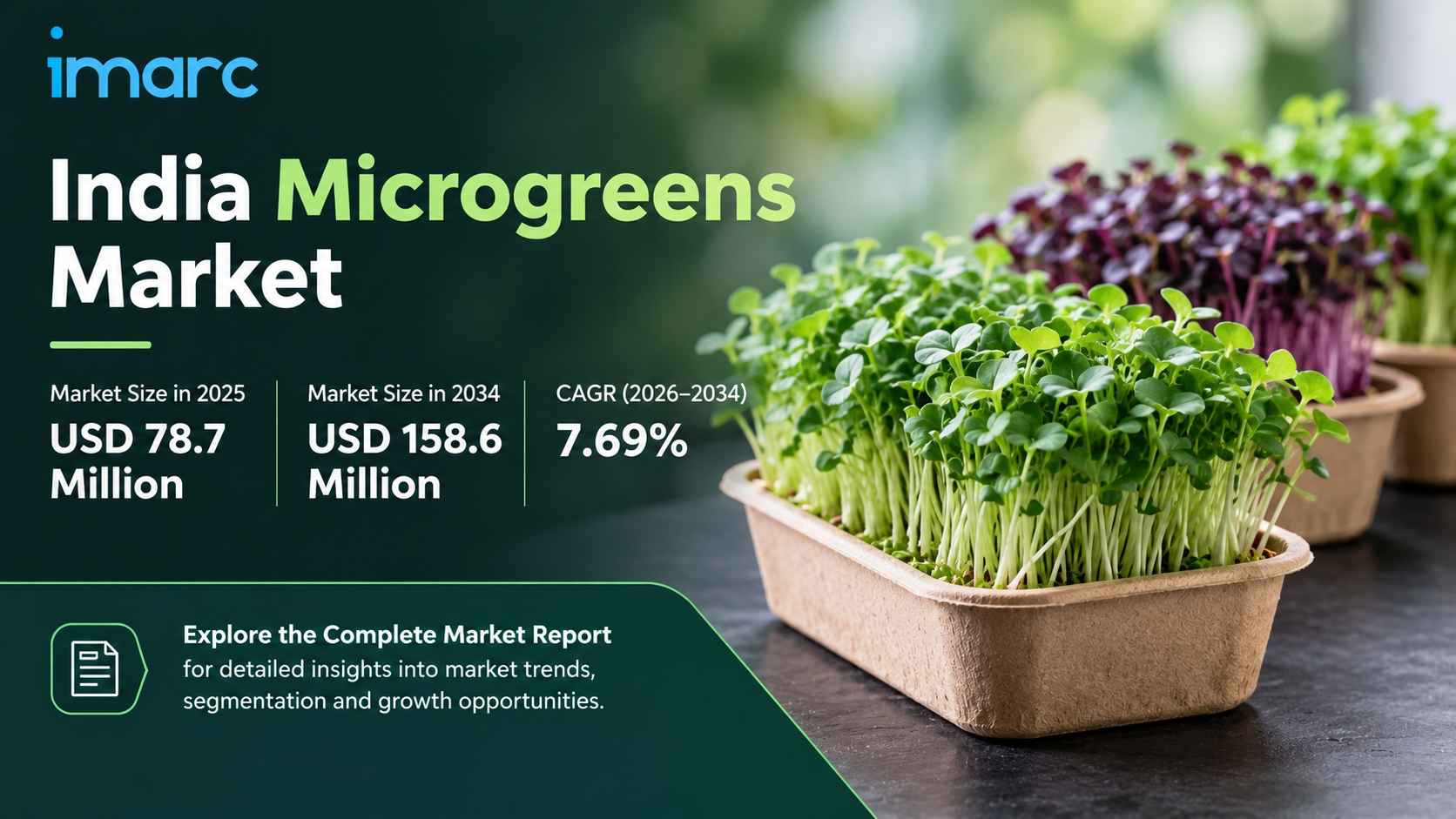
India’s microgreens market stands as one of South Asia’s most dynamic urban agriculture and functional food segments, encompassing Broccoli, Cabbage, Cauliflower, Arugula, Peas, Basil, Radish, and other microgreen types, across Indoor Vertical Farming, Commercial Greenhouses, and other farming methods, serving Residential and Commercial end uses through Supermarkets and Hypermarkets, Retail Stores, and other channels, spanning North India, West and Central India, South India, and East and Northeast India. The microgreens market size in India reached USD 78.71 Million in 2025 and is projected to reach USD 158.56 Million by 2034, exhibiting a growth rate (CAGR) of 7.69% during 2026-2034.
The market is growing due to rising awareness of nutrient-dense superfoods, expanding urban farming infrastructure, increasing adoption of plant-based diets, and growing institutional demand from hotels and restaurants. Microgreens are harvested within 7-14 days of germination and contain higher nutrient concentrations than mature vegetables, positioning them as premium functional foods. India’s urban population is projected to reach 600 million by 2036, and the urban farming sector is expected to grow 10% by 2026, creating scalable supply capacity. Demand for controlled-environment production, pesticide-free produce, and convenient microgreens-based nutrition is further accelerating adoption.
Market Snapshot
Current Market Size (2025): USD 78.71 Million
Projected Market Size (2034): USD 158.56 Million
CAGR: 7.69%
Indoor vertical farming leads the farming method segment with a 48.7% share in 2025, driven by year-round, pesticide-free production, consistent quality, and scalability for commercial growers targeting premium retail and institutional buyers. Commercial greenhouses follow with a 38.6% share.
Broccoli leads the type segment with an 18.6% share, backed by strong sulforaphane content and consumer recognition, followed by arugula at 14.7% and cabbage at 13.2%, which are favored for gourmet use and broad consumer appeal.
West and Central India lead with a 32.6% share, anchored by health-conscious urban consumers in Mumbai, Pune, and Ahmedabad and an active premium restaurant and hospitality ecosystem, followed by South India at 29.8% and North India at 24.1%.
Distribution is expanding across supermarkets and hypermarkets, retail stores, and online grocery platforms, as organized retail and e-commerce make fresh microgreens accessible beyond niche health food buyers.
What Growth Factors Are Driving India Microgreens Market?
Rising Health and Wellness Consciousness:
Urban Indian consumers are prioritizing nutrient-dense functional foods, and microgreens, which contain 4-40 times the nutrients of mature vegetables, are gaining mainstream acceptance. With the urban population projected to reach 600 million by 2036, microgreen demand in India is expected to broaden well beyond health food stores into mainstream grocery baskets. Fitness-oriented consumers value pea microgreens for their protein content, while broccoli microgreens appeal for their antioxidant profile. Growing awareness of preventive nutrition, plant-based diets, and clean-label produce is encouraging households to add microgreens to salads, smoothies, and everyday meals.
Expanding Urban Farming Infrastructure:
Growing availability of controlled environment agriculture equipment, hydroponic grow kits, and urban farming training programs is lowering barriers to entry for commercial producers. Indoor systems with spectrum-optimized LED lighting and automated climate control typically achieve 6-8 growing cycles per year per production unit. They improve capital efficiency compared with seasonal outdoor growing. Smart farm management platforms that track temperature, humidity, and nutrients in real time further reduce crop loss, improving supply reliability for institutional buyers and enabling producers to scale into mid-tier cities.
Growing Institutional and Foodservice Demand:
Hotels, specialty restaurants, and wellness cafes are sourcing microgreens for culinary differentiation and menu premiumization. Five-star hotels and wellness cafes use them as signature garnishes and salad bases, building consumer awareness that later converts into retail purchases. Corporate wellness programs and healthy canteen offerings are adding new B2B demand across technology and business hub cities. Together, these channels give producers premium pricing and long-term supply contracts, strengthening the commercial case for scaled production.
Government Policy Support
Mission for Integrated Development of Horticulture (MIDH): Provides financial assistance for protected cultivation, hydroponics, and post-harvest infrastructure, helping growers adopt controlled-environment farming systems for high-value crops such as microgreens.
Agriculture Infrastructure Fund: Offers concessional loans for cold storage and post-harvest facilities, addressing the short shelf life that limits microgreens distribution beyond local markets.
PM Kisan Sampada Yojana: Supports integrated cold chain, processing, and value-addition infrastructure, improving logistics and reducing losses for perishable fresh produce such as microgreens.
Startup India and Agri-Startup Support (RKVY-RAFTAAR): Funding, incubation, and mentorship programs help agri-tech and urban farming startups scale microgreens production and adopt new growing technologies.
FSSAI Food Safety and Organic Standards: Clear safety, labelling, and organic certification norms build consumer trust and support premium positioning of clean-label, pesticide-free microgreens.
Evaluate Market Opportunity with the Business Sample Report
What Are the Latest Emerging Trends in India Microgreens Market?
Rising Adoption of Urban and Sustainable Microgreens Farming:
Space-efficient indoor farming, organic cultivation, and controlled-environment agriculture are creating opportunities for startups, urban farmers, and local suppliers. Former pharma executive Mohit Nijhawan built Greenu into a ₹12 lakh-per-month organic microgreens business, cultivating over 75 varieties and training more than 300 farmers across India using sustainable methods. Hydroponic and aeroponic systems consume less water than soil-based cultivation and produce cleaner harvests, improving post-harvest shelf life. Sustainable and modified atmosphere packaging is also gaining traction as producers respond to retail and consumer demand.
Growth of Microgreens-Based Nutritional Products:
Health-conscious consumers are looking for easy ways to add nutrient-rich ingredients to their daily diets, and microgreens-based products are meeting that need. In September 2026, Keystone NeoGreens introduced Daily Greens in India, a powdered microgreens blend combining alfalfa, kale, broccoli, coriander, and sunflower, designed to support gut health and provide convenient daily nutrition. This format widens the addressable consumer base beyond fresh produce shoppers and creates new opportunities for packaged wellness brands to build on microgreens as a core ingredient.
Premium Retail and Hospitality Integration:
Organized retail supermarkets, specialty health food stores, and premium grocery chains are expanding fresh microgreens shelf sections in response to rising demand. At the same time, five-star hotels, specialty restaurants, and wellness cafes are using microgreens as signature garnishes and premium ingredients. Institutional adoption supports premium pricing for producers and builds consumer awareness through dining experiences, which then translates into retail purchasing and mainstream adoption across India’s major urban centers.
How will India Microgreens Market Evolve in the Coming Years?
The microgreens market in India is poised for sustained growth through 2034, driven by continued urbanization, rising health consciousness, and deeper institutional integration across hospitality, corporate catering, and organized retail. The market is projected to grow from USD 78.71 Million in 2025 to USD 158.56 Million by 2034 at a CAGR of 7.69%, reaching an intermediate milestone of approximately USD 113.99 Million by 2030.
Indoor vertical farming is expected to expand at around 9.3% CAGR, while arugula and broccoli grow at 8.7% and 7.9% respectively. Investment is concentrated in controlled environment agriculture technology, cold chain infrastructure, and organic certification, which together allow producers to serve wider geographies at premium price points. As technology lowers production costs, the market is expected to move from a niche premium category toward mainstream fresh produce status.
How Is India Microgreens Market Segmented?
➤ By Type
Broccoli
Cabbage
Cauliflower
Arugula
Peas
Basil
Radish
Others
➤ By Farming Method
Indoor Vertical Farming
Commercial Greenhouses
Others
➤ By End Use
Residential
Commercial
➤ By Distribution Channel
Supermarkets and Hypermarkets
Retail Stores
Others
➤ By Region
North India
West and Central India
South India
East and Northeast India
Request Customized Data Tailored to Your Interest
Note: If you require any specific information not covered within this report’s scope, we will provide it as part of the customization.
Competitive Landscape — By IMARC GROUP
The market research report has also provided a comprehensive analysis of the competitive landscape. Competitive analysis such as market structure, key player positioning, top winning strategies, competitive dashboard, and company evaluation quadrant has been covered in the report. Also, detailed profiles of all major companies have been provided.
The India microgreens market is highly fragmented, with a mix of specialized urban farming startups, established fresh produce companies, and commercial greenhouse operators. Key players include Greenu, NeoGreens, Waraah Green Technologies Private Limited, and Red Otter Farms, among others. Differentiation rests on production quality consistency, cold-chain reliability, organic certification, and the ability to supply institutional buyers at scale. As the market matures, consolidation is expected to accelerate, favoring producers with strong distribution reach, consistent quality, and institutional supply capabilities.
Frequently Asked Questions
How big is the microgreens market in India?
➤ The India microgreens market reached USD 78.71 Million in 2025 and USD 87.67 Million in 2026, driven by rising health consciousness, expanding urban farming infrastructure, growing demand from hotels, restaurants, and wellness cafes, and rising adoption of plant-based diets among health-conscious urban consumers.
What is the projected growth rate of the India microgreens market?
➤ The market is expected to exhibit a CAGR of 7.69% during 2026-2034 to reach USD 158.56 Million by 2034, supported by health-driven consumer demand, urban farming expansion, growing institutional and e-commerce distribution channels, and rising integration into organized retail and foodservice menus.
What are the key factors driving market growth?
➤ Key drivers include rising health and wellness consciousness, with urban India projected to reach 600 million people by 2036, expanding controlled-environment and urban farming infrastructure, growing institutional demand from hospitality and foodservice, and rising interest in microgreens-based nutritional products. Indoor vertical farming leads at 48.7% share, while broccoli leads types at 18.6%.
About Us:
IMARC Group is a global management consulting firm that helps ambitious changemakers create a lasting impact. The company offers comprehensive market assessment, feasibility studies, incorporation support, regulatory assistance, branding and strategy services, and procurement research.
IMARC Group
134 N 4th St. Brooklyn, NY 11249, USA
Email: sales@imarcgroup.com
Tel: (D) +91 120 433 0800
United States: +1-201-971-6302