
India Protective Coatings Market Outlook
The market is evolving from basic anti-corrosive coverage to performance-driven systems built for oil and gas, power, marine, and infrastructure assets. Steady infrastructure spending, growing industrial asset maintenance, and tighter corrosion management standards are encouraging asset owners to specify higher-grade coatings.
Environmental rules are also changing formulations. A shift toward water-based and powder technologies, along with sensor-assisted corrosion monitoring and automated application, is moving the industry toward longer-life systems and better lifecycle economics.
Market Snapshot
Market Size (2020): USD 392.0 Million
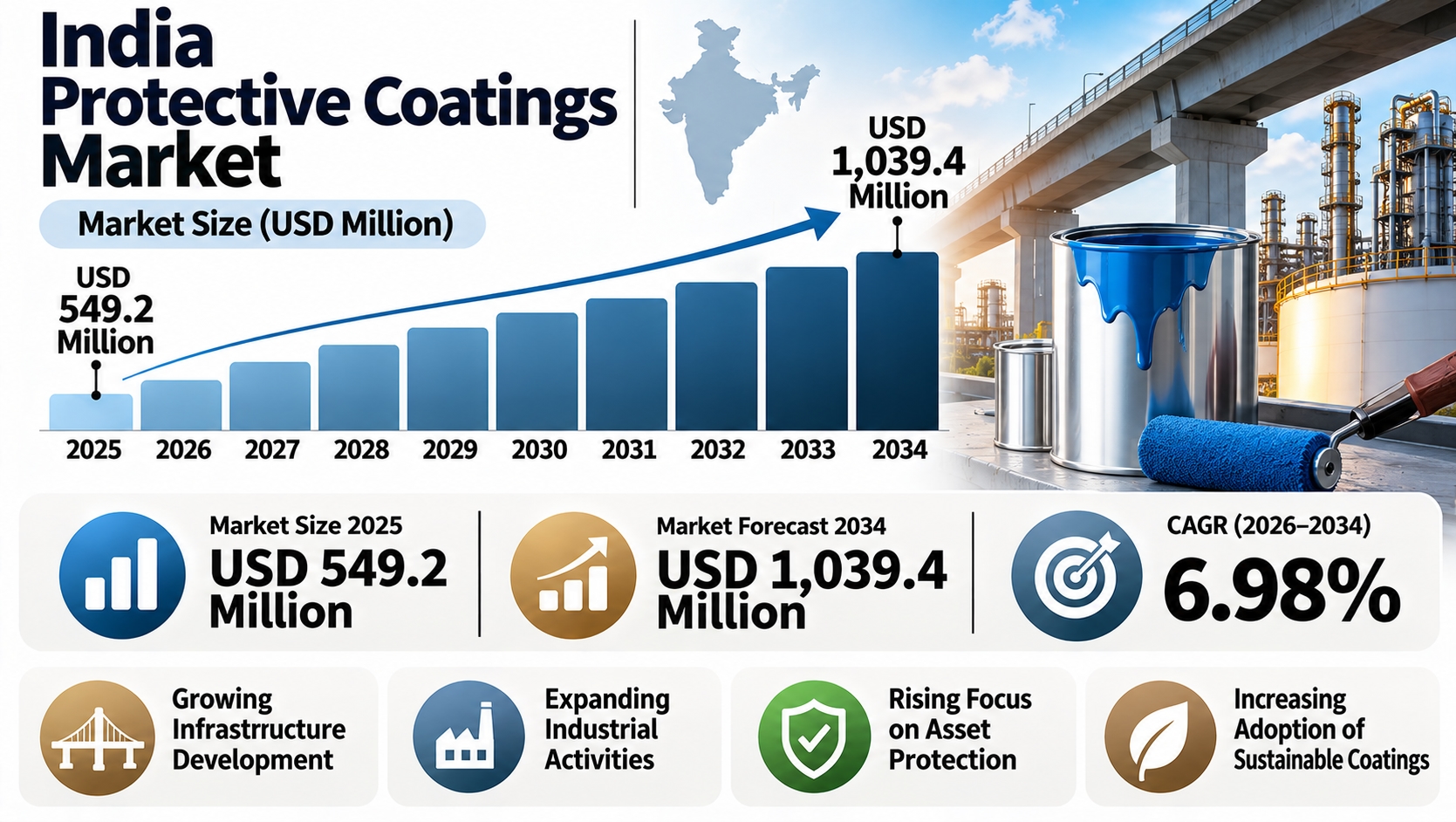
Market Size (2025): USD 549.2 Million
Market Size (2030): USD 769.5 Million
Forecast Market Size (2034): USD 1,039.4 Million
CAGR (2026-2034): 6.98%
Leading Technology: Solvent Based, 46.0% share (2025)
Leading Resin Type: Epoxy, 38.0% share (2025)
Leading Region: West India, 35.0% share (2025)
Fastest Growing Region: South India
Key Growth Drivers: Infrastructure investment, petrochemical capacity, marine demand, low-VOC shift
Executive Summary
The market is projected to grow from USD 549.2 Million in 2025 to USD 1,039.4 Million by 2034 at a CAGR of 6.98%, adding close to USD 490.2 Million in incremental value. Protective coatings market size in India expanded from USD 392.0 Million in 2020, and the forecast is supported by water-based adoption, marine coatings demand, and a more structured regulatory environment.
Solvent-based systems hold 46.0% on proven heavy-duty performance, with water-based at 34.0% and gaining as VOC norms tighten. Epoxy leads resin types at 38.0% for its adhesion and chemical resistance, followed by polyurethane at 27.0%. West India accounts for 35.0% of regional demand, anchored by refining, petrochemical, and port clusters. Competition is moderately consolidated around Asian Paints PPG Pvt. Ltd., Berger Paints India, Jotun, and Shalimar Paints.
India Protective Coatings Market Key Drivers
Infrastructure and Capital Expenditure Growth:
Public and private investment in roads, energy, and industrial assets is widening the base of steel and concrete structures needing long-term corrosion protection. The Union Budget for FY2026-27 raised public capital expenditure to about INR 12.2 Lakh Crore, up from INR 11.2 Lakh Crore a year earlier.
Oil, Gas, and Petrochemical Expansion:
Investment in refining, storage, and pipeline infrastructure drives demand for anti-corrosive and chemical-resistant systems across upstream and downstream facilities.
Marine and Shipbuilding Demand:
Port modernization and shipbuilding activity are raising consumption of specialized coatings for hulls, tanks, and offshore structures.
Shift Toward Water-Based and Powder Technologies:
Tightening environmental norms and preference for low-VOC formulations are accelerating adoption in general industrial applications, supporting overall India protective coatings market growth.
Evaluate Market Opportunity with the Business Sample Report
India Protective Coatings Market Emerging Trends
Water-Based and Low-VOC Formulations:
Manufacturers are cutting solvent content in heavy-duty coatings without losing corrosion resistance, which is driving investment in new resin chemistries and application equipment.
Smart Coatings and Corrosion Monitoring:
Asset owners are pairing coatings with sensor-based monitoring to plan maintenance proactively and extend recoating intervals on critical infrastructure.
Automation in Application:
Automated spray and robotic systems are gaining traction on large infrastructure and marine projects, improving consistency and reducing material wastage.
Multinational Technology Platforms:
Global coating majors are deepening India manufacturing and R&D through joint ventures and capacity expansion, bringing advanced formulation technology closer to domestic customers.
India Protective Coatings Market Challenges
Despite robust momentum, the market faces persistent structural headwinds:
Protective coatings rely heavily on imported titanium dioxide and specialty additives, exposing manufacturers to global price swings
Varying state-level environmental and safety norms for VOC emissions and hazardous materials create compliance complexity for firms operating across states
A shortage of trained surface preparation and application contractors constrains timelines and can affect coating quality and durability
Reliance on imported polyurethane and epoxy intermediates adds currency and supply disruption risk, while price-sensitive small contractors often favor lower-specification products
Government Initiatives Supporting the Market
Union Budget Capital Expenditure: Higher public capex for FY2026-27 supports roads, energy, and industrial infrastructure that require protective systems
Port Modernization Programs: Drive demand for marine and offshore coatings
National Green Hydrogen Mission: Early-stage hydrogen production and storage assets create opportunities for specialty coatings built for extreme service conditions
Environmental and VOC Norms: Encourage the move to water-based and powder technologies
Make in India: Supports domestic formulation, resin, and manufacturing investment
Explore the Full Report with Charts, Table of Contents, and List of Figures
India Protective Coatings Market Segment Insights
By Technology
Solvent Based: 46.0% (heavy-duty industrial and marine environments)
Water Based: 34.0% (growing as VOC norms tighten)
Powder Coatings
By Resin Type
Epoxy: 38.0% (primer and intermediate coat for tanks, pipelines, and structural steel)
Polyurethane: 27.0% (preferred topcoat for UV-exposed and marine assets)
Acrylic
Alkyd
Others
By End Use Industry
Oil and Gas
Building and Construction
Automotive
Marine
Others
Regional Insights
West India: 35.0% share (2025)
South India: 28.0% share (2025)
North India: 22.0% share (2025)
East India: 15.0% share (2025)
Competitive Landscape
The market is moderately consolidated. Multinational joint ventures and domestic majors lead on technology depth and distribution reach, while regional players compete on price and local service. Brand strength, resin technology, and applicator networks are the main competitive moats. India protective coatings market share is concentrated among organized players, with high barriers to entry from performance track records, applicator training, and multi-state distribution.
Asian Paints PPG Pvt. Ltd.: Leader; protective, floor, road marking, and powder coating systems; expanding capacity through technology collaboration and distribution reach
Berger Paints India: Leader; Berger Protecton range; growing share through expanded manufacturing and sector-focused development
Jotun: Challenger; protective and marine coatings; expanding regional manufacturing and applicator training
Shalimar Paints: Emerging; leveraging a century-long technical legacy for specialty industrial and infrastructure projects
Recent Developments
FY2026-27 Union Budget: Public capital expenditure raised to about INR 12.2 Lakh Crore from INR 11.2 Lakh Crore, reinforcing the infrastructure-led outlook
Asian Paints PPG: Continued enhancement of protective and powder coating offerings for industrial, infrastructure, and energy applications
Berger Paints India: Strengthening manufacturing footprint and distribution network for its protective coatings business
Jotun: Expanding its protective coatings presence in India in support of industrial and infrastructure projects
Investment Opportunities
High-Growth Segments: Water-based systems are expanding fastest among technologies, and polyurethane is the next-fastest resin type, supported by UV resistance and gloss retention for exposed infrastructure.
Geographic Expansion: South India is the fastest growing region, anchored by industrial parks, automotive and engineering clusters, and infrastructure investment, offering room for broader applicator and technical service networks.
Technology and Venture Investment: Capital is flowing into resin innovation, low-VOC formulation, applicator training, automated application equipment, and sensor-enabled corrosion monitoring.
Discuss Your Requirements With an Analyst and Get Your Customized Market Report
Frequently Asked Questions (FAQ)
What is the current size of the India protective coatings market?
The market was valued at USD 549.2 Million in 2025.
What is the forecast growth rate?
The market is projected to grow at a CAGR of 6.98% during 2026-2034, reaching USD 1,039.4 Million by 2034.
Which technology leads?
Solvent based leads at 46.0% in 2025, valued for long-term performance and cost efficiency in heavy-duty industrial and marine environments.
Which region dominates?
West India holds 35.0% in 2025, led by refining, petrochemical, and port infrastructure in Gujarat and Maharashtra.
Who are the key players?
Asian Paints PPG Pvt. Ltd., Berger Paints India, Jotun, and Shalimar Paints, among others.
Conclusion
The India protective coatings market is on a steady, infrastructure-led growth path. Four forces will shape it through 2034: sustained capital expenditure, the shift to water-based and powder technologies, deeper use of automated application and monitoring, and consolidation around technology-led platforms.
Companies that invest in low-VOC formulation, resin technology, and applicator networks will be best positioned as the market moves from USD 549.2 Million in 2025 toward USD 1,039.4 Million by 2034.
Source: IMARC Group




