
Indian Agricultural Implements Market Outlook
The market is undergoing structural change driven by large-scale farm mechanization, evolving cropping patterns, and supportive policy that makes modern equipment accessible. Over half of the population depends on farming for a livelihood, and tractors, rotavators, and power tillers are helping farmers raise productivity, lower input costs, and manage labor shortages.
Rural infrastructure investment, expanding custom-hiring networks, and improving rural credit are reinforcing demand. The agricultural implements market in India is shifting from manual and animal-drawn tools toward engine-powered, tractor-operated, and increasingly digital equipment.
Market Snapshot
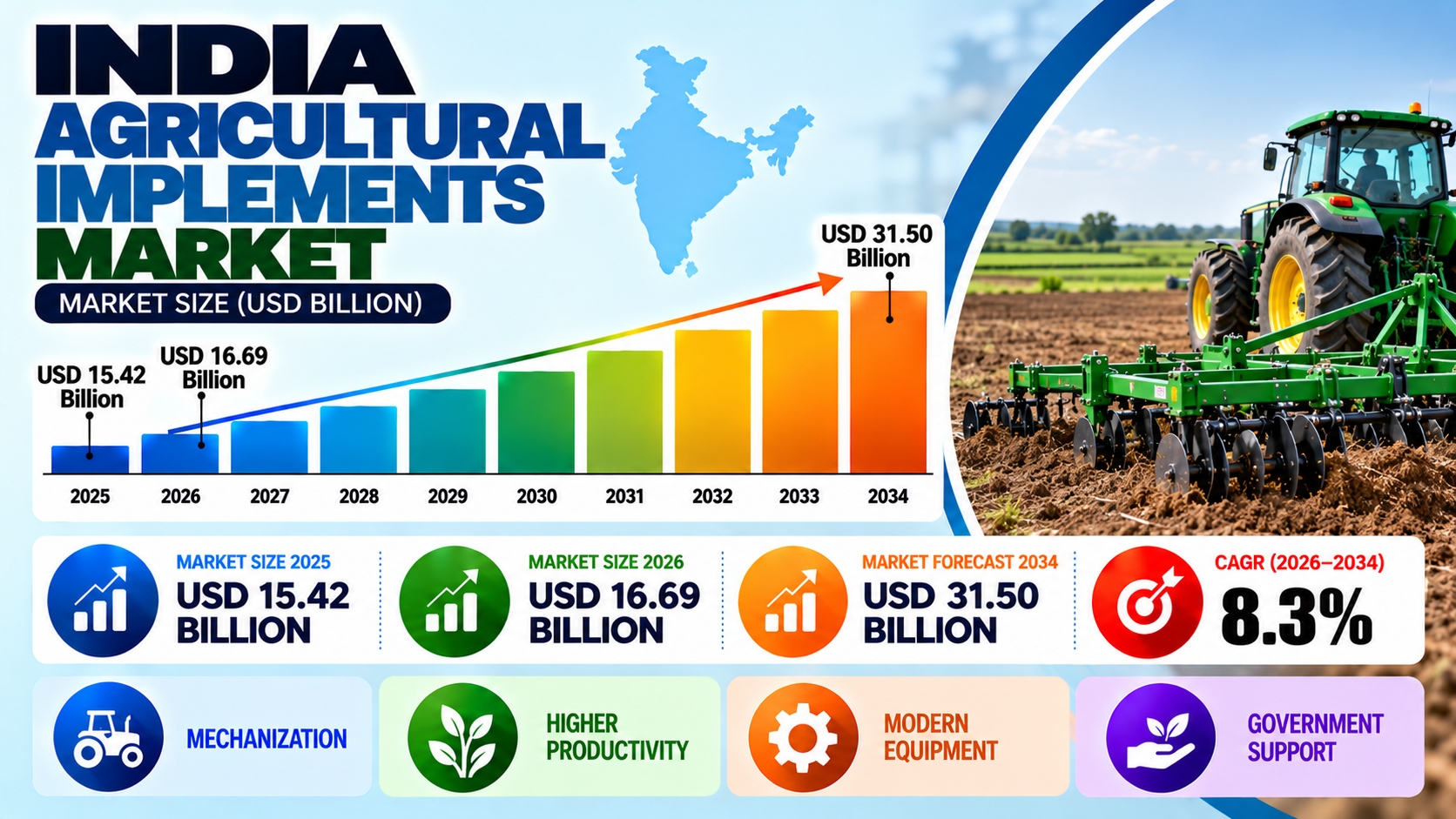
Market Size (2025): USD 15.42 Billion
Market Size (2026): USD 16.69 Billion
Forecast Market Size (2034): USD 31.50 Billion
CAGR (2026-2034): 8.3%
Leading Product Type: Tractors, 35% share (2025)
Leading Type: Mechanized, 70% share (2025)
Leading Distribution Channel: B2C, 68% share (2025)
Key Growth Drivers: Subsidy support, rural labor shortage, rising farm incomes, rural credit
Executive Summary
The Indian agricultural implements market size increased from USD 15.42 Billion in 2025 to USD 16.69 Billion in 2026, and is projected to reach USD 31.50 Billion by 2034 at a CAGR of 8.3%. Tractors serve as the primary power source for implements such as rotavators, seed drills, cultivators, and sprayers. IMARC also values the India tractor market at USD 9.4 Billion in 2025, projected to reach USD 15.9 Billion by 2034 at a CAGR of 6.05%.
Competition is intense among domestic and multinational manufacturers, led by Mahindra & Mahindra Limited, Tractors and Farm Equipment Limited, Sonalika International Tractors Limited, Escorts Group, and Deere & Company.
Evaluate Market Opportunity with the Business Sample Report
Indian Agricultural Implements Market Key Drivers
Policy Support for Mechanization:
Financial assistance for machinery purchases, with extra support for smallholders, women farmers, and socially disadvantaged groups, is lowering the cost of ownership. State-level schemes complement national programs by backing planters, transplanters, and harvesting equipment.
Intensifying Rural Labor Shortage:
Migration of rural youth to cities has reduced the availability of laborers during critical sowing and harvesting windows. Year-round rural employment under NREGA has also cut the seasonal inflow of migrant labor to states such as Punjab and Haryana, pushing demand for tractors, power tillers, and harvesters.
Rising Agricultural Incomes and Rural Credit:
Steady economic growth, periodic revisions in agricultural support pricing, and favorable weather strengthen farm cash flows. Cooperative banks, regional rural banks, and microfinance institutions now offer machinery-focused credit, often in tie-ups with manufacturers.
Indian Agricultural Implements Market Emerging Trends
Precision Farming and Smart Implements:
GPS-enabled tractors, sensor-based soil monitoring, and telematics are being built into new models. Mahindra Tractors launched its OJA platform with the MYOJA telematics pack and PROJA productivity automation system for real-time farm monitoring.
Alternate-Fuel and Sustainable Implements:
CNG, compressed biogas (CBG), and ethanol flex-fuel tractors are moving from prototypes to commercial products, aligned with India’s net-zero ambition for 2070. In November 2025, Mahindra & Mahindra showcased CNG/CBG dual-fuel models and an ethanol flex-fuel engine at Agrovision 2025 in Nagpur.
Custom Hiring Centres (CHCs):
Usage-based rental lets small and marginal farmers access modern machinery without large upfront capital, particularly in low-mechanization regions.
Explore the Full Report with Charts, Table of Contents, and List of Figures
Government Initiatives Supporting the Market
Sub-Mission on Agricultural Mechanization (SMAM): Provides financial assistance of 40-50% on machinery purchases, and its North-Eastern Region component offers up to 95% subsidized Farm Machinery Bank establishment
Custom Hiring Centres and Farm Machinery Banks: Thousands have been established across low-mechanization states to address the economics of small holdings
Digital Agriculture Mission: Aims to create a unified farmer registry and geotagged crop database that supports precision equipment deployment
Tax Relief: A recent GST reduction on tractors and agricultural equipment is improving affordability
Indian Agricultural Implements Market Challenges
Despite strong momentum, the market faces persistent structural headwinds:
Even with subsidies, high-value implements remain costly for farmers cultivating fewer than two hectares, and awareness of financing options is uneven
Fragmented landholdings and irregular field shapes reduce the productivity gains available from large machinery
Service technicians, genuine spare parts, and repair facilities are scarce in remote parts of East India, Jharkhand, Chhattisgarh, and the northeast, which prolongs downtime
The agricultural implements market size in India remains constrained by these access and service gaps in underpenetrated regions
Indian Agricultural Implements Market Segment Insights
By Product Type
Tractors, 35% (versatile across tillage, sowing, haulage, and tractor-mounted tools; 30-50 HP is the highest-volume range)
Rotavators
Threshers
Power Tillers
Others
By Type
Mechanized, 70% (combine harvesters, rotavators, seed drills, cultivators, power weeders)
Manual
By Distribution Channel
B2C, 68% (authorized dealers, tractor showrooms, and agri-equipment retailers that also provide servicing and spares)
B2B
Regional Insights
North India: Punjab, Haryana, and Uttar Pradesh, historically the most mechanized region with high demand for tractors, combines, and precision tillage
West and Central India: Soybean, cotton, and sugarcane drive demand for rotavators, seed drills, and sugarcane harvesters
South India: Growing adoption of compact tractors, paddy transplanters, and power weeders
East India: Underpenetrated, with low farm power availability, but targeted programs are unlocking demand
Competitive Landscape
The market is relatively concentrated yet highly competitive, with a few major manufacturers holding a significant share of tractor and power equipment. Leadership rests on extensive dealer networks, broad portfolios across horsepower categories, and brand recognition built over decades in rural markets. Manufacturers differentiate through technology, international collaborations, and expanded manufacturing capacity.
Recent Developments
August 2025: YEIDA allotted approximately 200 acres to Escorts Kubota Limited for a Rs 4,500 crore integrated tractor and commercial equipment plant, starting with a Rs 2,000 crore initial phase and expected to create employment for 4,000 people
October 2025: Gromax Agri Equipment Limited, a joint venture between Mahindra & Mahindra and the Government of Gujarat, launched eight new Trakstar tractor models in the 25-50 HP range, including India’s first sub-50 HP factory-fitted cabin tractor
Investment Opportunities
Smart and Alternate-Fuel Equipment: Telematics-ready and low-emission tractors align with sustainability goals.
Rental and Shared-Access Models: CHCs and machinery banks serve smallholders who cannot buy equipment outright.
Service Networks and Rural Financing: After-sales infrastructure and tailored credit remove two of the biggest barriers to adoption in underpenetrated regions.
Discuss Your Requirements With an Analyst and Get Your Customized Market Report
Frequently Asked Questions (FAQ)
How big is the Indian agricultural implements market?
The market was valued at USD 15.42 Billion in 2025 and reached USD 16.69 Billion in 2026.
What is the projected market size by 2034?
It is projected to reach USD 31.50 Billion by 2034, growing at a CAGR of 8.3% during 2026-2034.
Which product type leads?
Tractors lead with a 35% share in 2025, thanks to their versatility across farm operations.
Which type and channel dominate?
Mechanized implements hold a 70% share, and B2C distribution holds 68%.
Who are the leading companies?
Mahindra & Mahindra Limited, Tractors and Farm Equipment Limited, Sonalika International Tractors Limited, Escorts Group, and Deere & Company.
Conclusion
India’s agricultural implements market is set for sustained expansion, underpinned by mechanization policy, labor scarcity, and improving rural credit. Precision tools, alternate fuels, and rental models are making modern equipment accessible to far more farmers.
Manufacturers that strengthen rural service networks, broaden horsepower portfolios, and invest in cleaner, connected machinery will be best positioned as mechanization reaches regions that remain underserved today.
Source: IMARC Group