
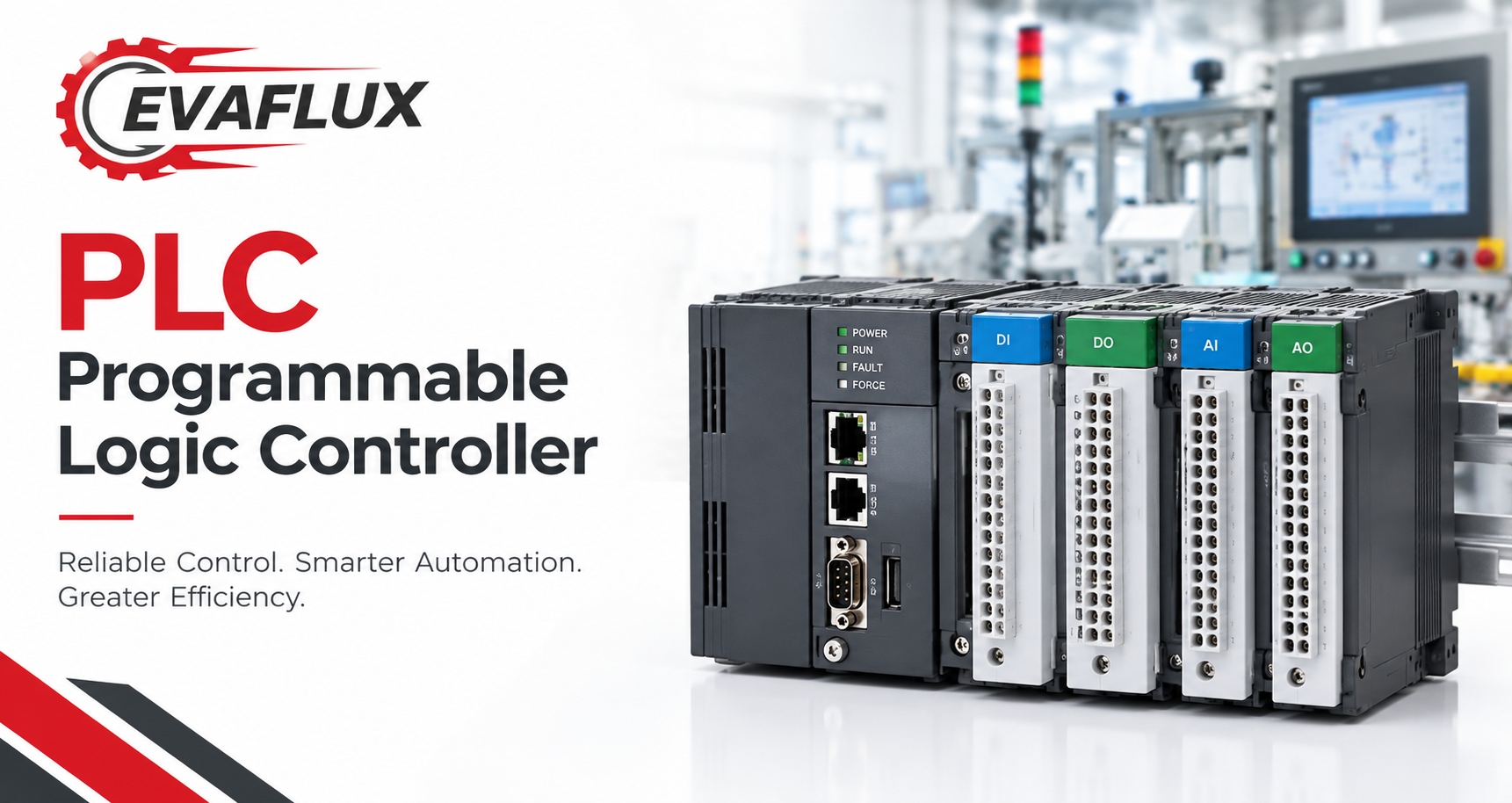
A Complete Product Overview for Industrial Buyers
A PLC programmable logic controller is the decision-making core of modern industrial automation. It reads signals from sensors and switches, runs a stored program, and drives motors, valves, drives and indicators in real time. Whether you are upgrading a legacy panel or specifying a new production line, understanding what a controller offers is the first step toward a reliable, maintainable system.
This overview covers the main technical characteristics, reliability and precision considerations, and typical applications, so that engineers, technicians and procurement managers can evaluate options with confidence.
What a PLC Does
Unlike a general-purpose computer, a PLC is purpose-built for deterministic control. It executes a repeating scan cycle: read inputs, solve the program logic, update outputs, and run diagnostics. This cycle repeats in milliseconds, so machines respond predictably, even under heavy electrical noise, vibration and temperature swings.
Programming follows the international IEC 61131-3 standard, which defines ladder diagram, function block diagram, structured text, instruction list and sequential function chart. This lets maintenance teams work in familiar formats and reduces training time.
Technical Specifications to Evaluate
A typical industrial PLC programmable logic controller is defined by several parameters. Always confirm exact values against the manufacturer's datasheet.
Parameter | Typical Range |
Supply voltage | 24 V DC or 100–240 V AC |
Digital inputs/outputs | 8 to several hundred (modular expansion) |
Analog inputs | 0–10 V, 4–20 mA, RTD, thermocouple |
Scan time | Sub-millisecond to a few milliseconds per 1K instructions |
Program memory | From tens of KB to several MB |
Communication | Ethernet, Modbus RTU/TCP, PROFINET, EtherNet/IP, RS-485, CAN |
Operating temperature | 0 °C to 55 °C standard; extended ranges available |
Protection | IP20 panel-mount; higher ratings via enclosures |
Key points when reading a datasheet:
Check the output type (relay, transistor or triac) against your load.
Verify analog resolution (12-bit, 14-bit or 16-bit), because it affects measurement quality.
Confirm that the available communication ports match your existing network.
Review expansion limits so the system can grow without replacing the base unit.
Reliability
Controllers are chosen for uptime. Industrial-grade units use components rated for continuous duty, conformal coating options, isolation between field and logic circuits, and watchdog timers that restart the processor after a fault. Many platforms offer battery-free retentive memory, hot-swappable I/O modules and built-in diagnostics that flag wiring faults before they cause downtime.
Look for compliance marks such as CE, UL/cULus and relevant EMC standards. These indicate the product has been tested for electrical safety and immunity to interference.
Precision
Precision depends on three factors: analog resolution, scan time and the quality of the input conditioning. High-resolution analog modules and fast counters allow accurate temperature control, flow regulation, positioning and speed measurement. High-speed counter inputs and pulse outputs support servo and stepper applications where timing consistency is critical.
Where a PLC Programmable Logic Controller Delivers Value
Typical use cases include:
Manufacturing and assembly: sequencing, interlocks, conveyors and robot cells.
Water and wastewater: pump control, level monitoring and chemical dosing.
HVAC and building systems: chillers, air handling units and energy optimization.
Packaging and food processing: filling, labelling, batching and traceability.
Oil, gas and utilities: skid control, metering and remote monitoring.
Material handling: warehouse automation and sorting systems.
Suitability for Hot, Dusty and Humid Regions
Many industrial regions combine high ambient temperatures, airborne sand or dust, and humidity. In these settings, the controller itself is only part of the solution. Specify extended-temperature variants where available, install in ventilated or air-conditioned IP54/IP65 enclosures, and use conformal-coated boards for humid sites. Proper panel thermal design often matters more than the controller's headline temperature rating.
How to Specify the Right Controller
Count current I/O points and add 20–30% spare capacity.
Define the communication architecture early.
Check the availability of local technical support and spare parts.
Confirm software licensing and programming tool costs.
Plan for cybersecurity features such as password protection and encrypted communication.
Frequently Asked Questions
What is the difference between a PLC and a PC-based controller?
A PLC is built for deterministic real-time control and harsh environments, while PC-based systems offer more computing flexibility but typically need more protection and maintenance.
Can a PLC be expanded later?
Yes. Most modular platforms accept additional I/O and communication modules, within the base unit's limits.
How long does a PLC last?
Properly installed controllers often operate for 10–20 years, depending on temperature, cleanliness and power quality.
Which programming language should we use?
The ladder diagram is the most widely understood on the plant floor. Structured text suits complex calculations.
Conclusion
Selecting the right PLC programmable logic controller means balancing I/O capacity, communication needs, environmental conditions and long-term support. Review the datasheet carefully, plan for growth, and consult a supplier who can confirm compatibility with your application. Browse the Evaflux category page to compare available options, or contact the team for technical guidance on the PLC programmable logic controller that fits your project.