
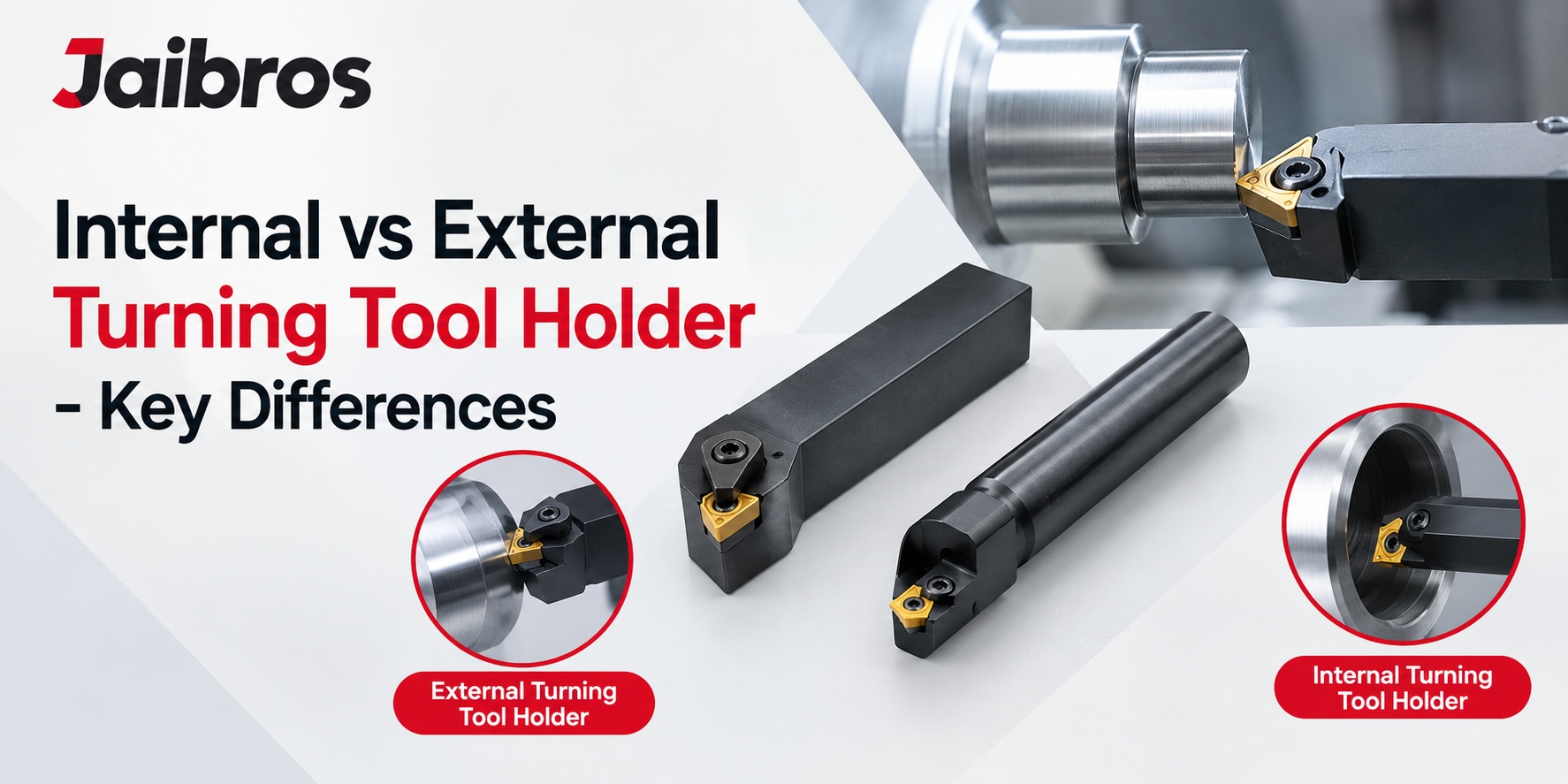
Choosing the correct tool holder is important for accurate and stable turning insert operations. In CNC machining, different holders are designed for different cutting positions, workpiece shapes, and machining requirements. Two common options are internal and external holders.
Although both support a cutting insert, their designs and applications are different. Understanding these differences helps machinists select suitable tooling, reduce vibration, improve surface finish, and maintain dimensional accuracy.
This guide explains how internal and external holders work, where they are used, and what to consider when selecting them.
What Is an External Turning Tool Holder?
An external holder is used to machine the outside surface of a rotating workpiece. It supports the cutting insert while the tool moves along the workpiece to remove unwanted material.
These holders are commonly used for straight turning, facing, taper turning, and external profiling. They are generally mounted on the lathe turret or tool post and are available in different shank sizes and geometries.
Because the tool usually works outside the component, the cutting area is easier to access and inspect. A short, rigid setup can also help control vibration during machining.
External holders are suitable for operations such as reducing shaft diameters, creating flat end faces, and producing external contours.
What Is an Internal Turning Tool Holder?
An internal holder is used to machine the inside surface of a component. It is commonly called a boring bar and enters an existing hole to enlarge it, improve its accuracy, or produce the required internal profile.
These tools are useful for machining bores, internal shoulders, and certain internal grooves. Their long and relatively narrow design allows them to reach surfaces that external tools cannot access.
However, internal machining presents a greater risk of tool deflection and vibration, especially when the boring bar extends far into the workpiece. Selecting the correct bar diameter, reducing overhang, and using suitable cutting conditions can improve stability.
For accurate results, the bar must also fit inside the existing hole and provide enough clearance for the cutting operation.
Internal vs External Turning Tool Holder: Key Differences
Feature | External Holder | Internal Holder |
Main purpose | Machines outside surfaces | Machines inside holes |
Common tool design | Usually a square shank | Usually a round boring bar |
Working position | Outside the workpiece | Inside an existing hole |
Rigidity | Generally higher with a short setup | More sensitive to overhang |
Common operations | Facing, straight turning, profiling | Boring and internal profiling |
Main challenge | Clearance and cutting stability | Vibration, deflection, and chip removal |
Selection factor | Shank size, insert geometry, and cutting direction | Bore diameter, bar diameter, overhang, and insert geometry |
The main difference is the surface being machined. External holders provide access to outer surfaces, while internal holders reach inside the component. Neither type can replace the other in every application.
Different Turning Tool Holder Types and Their Uses
Understanding turning tool holder types helps machinists choose equipment according to the operation.
1. External Turning Holders
These holders are designed for outside diameter turning, facing, and profiling. Their rigid mounting makes them suitable for many roughing and finishing applications.
2. Internal Boring Bars
Boring bars machine internal diameters and improve the size or finish of existing holes. Their dimensions must match the available bore and required machining depth.
3. Grooving Holders
Grooving holders create narrow grooves on external or internal surfaces, depending on their design. They require suitable insert width, tool alignment, and clearance.
4. Threading Holders
Threading holders support inserts designed to produce external or internal threads. The holder and insert must match the required thread profile and operation.
Each holder type has a specific purpose, so selecting it according to the part drawing and machining process is essential.
How to Choose the Right Holder for Your Application
Before choosing a holder, consider the following factors:
1. Identify the Machining Operation
Determine whether the job involves external turning, boring, grooving, or threading. The operation defines the required tool geometry and access.
2. Check Insert Compatibility
A turning insert must match the holder's insert shape, clearance angle, size, and clamping arrangement. Do not assume that inserts with similar appearances are interchangeable.
3. Consider Workpiece Material
Steel, stainless steel, aluminium, and cast iron may require different insert grades and cutting geometries. Choose the tooling according to the material and cutting conditions.
4. Reduce Tool Overhang
For internal operations, use the shortest practical boring bar overhang. A larger suitable bar diameter generally improves rigidity, provided there is enough clearance inside the bore.
5. Verify Machine Compatibility
Check the holder shank dimensions, turret or tool-post requirements, cutting direction, and available machining space before installation.
Common Mistakes to Avoid
Using an unsuitable holder can cause poor surface finish, vibration, insert damage, or dimensional errors. Common mistakes include selecting the wrong insert geometry, extending a boring bar too far, using incorrect cutting parameters, and failing to secure the holder properly.
Always clean the holder seat before installing an insert and inspect the clamping parts for wear or damage. Follow the tooling manufacturer's recommendations for installation, cutting conditions, and maintenance.
Conclusion
Internal and external holders serve different purposes in turning operations. External holders machine outside surfaces, while internal holders are designed for boring and other internal features. The correct selection depends on the component geometry, workpiece material, machining operation, insert compatibility, and required accuracy.
By understanding these differences and maintaining a rigid setup, machinists can improve cutting stability, achieve consistent surface quality, and reduce avoidable tool wear. Proper tool selection also helps make machining operations more predictable and efficient.Choosing the right turning tool holder and compatible turning inserts is essential for achieving accurate machining results and consistent surface quality. To explore suitable CNC machining tools and accessories for your requirements, visit Jaibros and find the right options for your machining applications.
Frequently Asked Questions
1. What is the main difference between internal and external turning holders?
External holders machine the outside surfaces of a workpiece, including its diameter and end face. Internal holders, commonly called boring bars, enter an existing hole to machine its inside surface. Their designs differ because they work in different spaces and face different cutting conditions. Internal holders require special attention to overhang, clearance, and vibration control.
2. Can an external turning holder be used for internal machining?
An ordinary external holder is generally unsuitable for machining inside a narrow bore because it may not fit or provide the necessary clearance. Internal machining normally requires a boring bar designed for the available hole diameter and cutting depth. Always check the holder's intended application, insert compatibility, and clearance before selecting tooling for an internal operation.
3. Why does a boring bar vibrate during machining?
A boring bar may vibrate because of excessive overhang, insufficient rigidity, incorrect cutting parameters, poor clamping, or a worn cutting edge. The problem can often be reduced by using a larger suitable bar, shortening its unsupported length, checking the insert, and adjusting cutting conditions according to the tooling manufacturer's guidance. Special anti-vibration bars may help with demanding deep-boring applications.
4. How do I select the correct turning insert for a holder?
Check the holder's specified insert shape, size, clearance angle, and clamping system before selecting an insert. Then consider the workpiece material, cutting depth, feed rate, and finishing requirements. The insert geometry and grade should suit the application. Always consult the holder and insert specifications to confirm compatibility instead of relying only on their appearance.
5. Which holder is better for achieving a smooth surface finish?
Neither holder type automatically produces a better finish. Surface quality depends on the machining operation, holder rigidity, insert geometry, cutting speed, feed rate, depth of cut, and workpiece material. External turning often allows a more rigid setup, while internal boring needs careful control of bar overhang and vibration. Correct tool selection and suitable cutting conditions are essential in both cases.



