
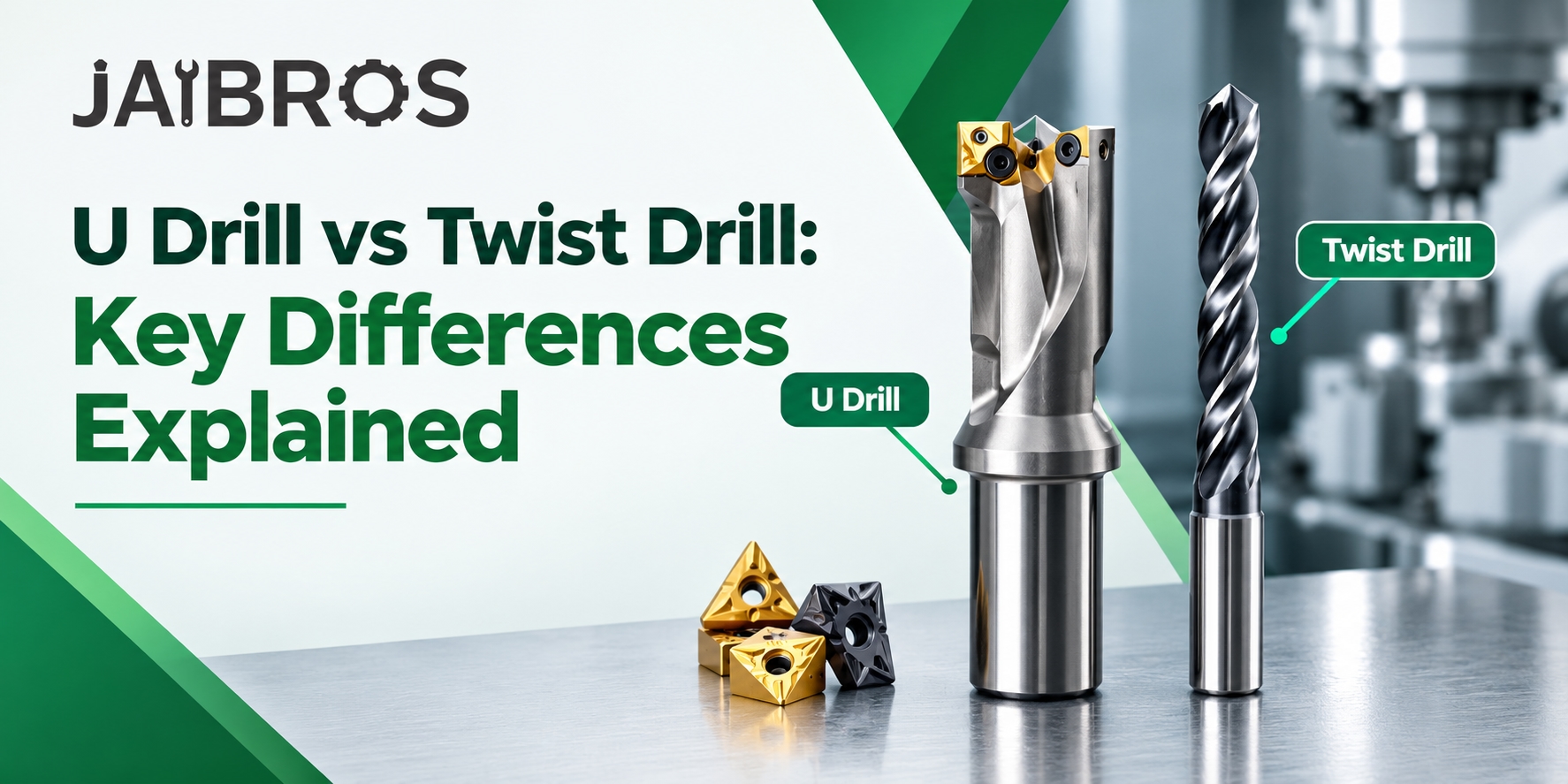
Choosing the right drilling tool is important for achieving accurate holes, maintaining surface quality, and improving machining efficiency. In CNC machining, indexable drills and conventional twist drills are commonly used for hole-making operations. However, they differ in design, cutting performance, tool maintenance, and suitable applications.
A U drill is generally used for production drilling where speed and repeatability are important. A twist drill, on the other hand, is widely used for general-purpose drilling across different materials and workshop applications. Understanding their differences helps machinists select the right tool according to hole diameter, material, production volume, and machine capability.
What Is a U Drill?
A U drill is an indexable drilling tool that uses replaceable carbide inserts mounted on a steel tool body. These inserts perform the cutting operation, while the flutes help remove chips from the hole. When a cutting edge becomes worn, the insert can be indexed to another usable edge or replaced without changing the entire drill body.
This design is particularly useful in CNC machining environments where repeated holes must be produced efficiently. Different body diameters, working lengths, insert geometries, and grades are available for different machining requirements.
Its performance depends on correct tool selection, suitable cutting parameters, stable clamping, and effective coolant delivery. Although this tool can offer high productivity, it generally requires a sufficiently rigid machine and a properly secured workpiece.
What Is a Twist Drill?
A twist drill is a conventional drilling tool with a pointed cutting end and spiral flutes along its body. These flutes help remove chips while the cutting edges create a hole in the workpiece.
Twist drills are commonly manufactured from high-speed steel (HSS), cobalt-alloyed HSS, or solid carbide. Each material offers different levels of hardness, heat resistance, durability, and cost.
HSS drills are useful for general workshop operations and can tolerate some variation in machining conditions. Solid carbide drills are often selected for higher cutting speeds and applications requiring good accuracy, provided the machine setup is suitable.
Unlike an indexable drill, a conventional twist drill generally requires sharpening, regrinding, or complete replacement when its cutting edges become worn.
U Drill vs Twist Drill: Key Differences
Both tools create holes, but their construction and operating requirements are different.
Feature | Indexable drill | Twist drill |
Cutting design | Uses replaceable carbide inserts | Uses integral cutting edges |
Tool maintenance | Inserts can be indexed or replaced | Often requires regrinding or replacement |
Productivity | Suitable for high-volume production | Suitable for general and production drilling |
Tool cost structure | Reusable body with replaceable inserts | Complete tool is purchased or reconditioned |
Machine requirements | Generally benefits from a rigid setup | Depends on drill material, size, and application |
Hole accuracy | Depends on setup, tool geometry, and operation | Depends on drill quality, setup, and application |
Typical applications | CNC production and repeated larger holes | General workshop and CNC drilling |
Neither option is automatically better for every job. The right choice depends on the machining conditions and the required result.
1. Cutting Speed and Productivity
An indexable drill can provide high productivity in repeated CNC drilling operations. Its geometry and replaceable cutting edges allow it to work effectively at manufacturer-recommended cutting speeds and feed rates.
Twist drills also offer good productivity, particularly solid carbide versions used with suitable machines. However, performance varies with drill material, workpiece hardness, hole depth, and chip evacuation.
For large batches of similar holes, an indexable system may reduce cycle time and tool-change interruptions. For occasional holes or varied workshop tasks, a conventional drill may be more practical.
2. Tool Cost and Maintenance
The initial cost of an indexable drilling system includes the tool body and compatible inserts. Over time, the body can be reused while worn cutting edges are replaced. This can reduce the cost per hole when production volume is sufficient.
A twist drill has a simpler cost structure because the complete cutting tool is generally purchased as one unit. HSS drills may be resharpened, depending on their condition and geometry, while solid carbide drills may require specialized reconditioning.
The most economical option should be evaluated using tool life, maintenance requirements, cycle time, scrap risk, and total cost per acceptable hole rather than purchase price alone.
3. Hole Diameter and Depth
Hole diameter is an important factor when selecting a drilling tool. A suitable diameter must be available, and the tool must have enough working length to reach the required depth safely.
An indexable drilling system is commonly considered for medium and larger production holes, although compact versions are also available. Twist drills cover a broad range of small and large diameters and are widely used for general-purpose drilling.
For deep holes, check the tool's recommended depth-to-diameter ratio, chip evacuation requirements, coolant arrangement, and machine specifications. A longer drill is not always the best choice because excessive overhang can increase deflection and vibration.
4. Understanding the Size Chart and Insert Selection
A drill size chart helps machinists compare available diameters, shank dimensions, and working lengths. Some indexable drill bodies are classified by depth ratios such as 2D, 3D, 4D, or 5D, where D represents the nominal drill diameter. These designations are commonly used to describe the intended drilling depth relative to the diameter, but the manufacturer's specifications should always be checked.
When reviewing a u drill size chart, confirm the following details:
Nominal hole diameter and required tolerance.
Tool body length and recommended drilling depth.
Shank size and compatible machine holder.
Suitable insert designation and cutting grade.
Recommended cutting speed, feed rate, and coolant conditions.
The correct u drill insert must match the tool body and the workpiece material. Insert geometry and grade affect cutting forces, wear resistance, chip formation, and tool life. Never assume that inserts with similar dimensions are interchangeable without checking compatibility.
5. Material Compatibility and Applications
Both tool types can drill materials such as mild steel, stainless steel, aluminium, and cast iron when the appropriate cutting tool and operating parameters are selected.
For stainless steel, chip control and heat management are important. Aluminium often requires suitable cutting geometry to reduce built-up material on the cutting edge. Cast iron can cause abrasive wear, so an appropriate tool grade is necessary.
An indexable drilling system is often suitable for repetitive CNC operations. Twist drills remain useful for maintenance work, small batches, general fabrication, and applications where flexibility is more important than maximum production speed.
How to Choose the Right Drilling Tool
Before selecting a tool, evaluate the workpiece material, hole diameter, hole depth, required tolerance, production quantity, and available machine rigidity.
Choose an indexable design when repeated drilling, insert replacement, and production efficiency are priorities. Consider a twist drill when the job involves smaller holes, varied operations, lower production volumes, or a machine setup that suits conventional drilling.
Always follow the tool manufacturer's recommendations for cutting speed, feed rate, coolant supply, and maximum drilling depth. Trial machining and inspection of the finished hole can help confirm whether the selected tool meets the required quality standards.
Conclusion
Indexable drilling tools and twist drills both play important roles in modern machining. The main differences involve cutting-edge design, maintenance, productivity, and the conditions in which each tool performs best. A careful comparison of machine capability, material, hole dimensions, and production requirements helps prevent unnecessary tool wear and inconsistent hole quality.
For more information about drilling tools and available specifications, explore the Jaibros U-drill collection to compare suitable options for your machining requirements. You can also visit Jaibros to explore a wider range of CNC tools and identify options that match your application.
Frequently Asked Questions
1. What is the main difference between an indexable drill and a twist drill?
An indexable drill uses replaceable carbide inserts, allowing the cutting edges to be indexed or replaced while retaining the tool body. A twist drill has cutting edges formed directly into its body. The best option depends on hole diameter, material, production volume, machine rigidity, and the required hole quality.
2. Is an indexable drill suitable for CNC machining?
Yes, indexable drills are widely used in CNC machining, especially for repeated hole-making operations. They can support productive machining when the tool body, inserts, cutting parameters, and coolant supply are correctly selected. A stable machine setup is important because excessive vibration or poor chip evacuation can reduce tool life and affect hole quality.
3. How do I select the correct drilling tool size?
Start with the required hole diameter, depth, and dimensional tolerance. Check the available tool sizes, shank dimensions, working length, and machine compatibility. For indexable systems, verify insert compatibility as well. Always consult the manufacturer's specifications because the recommended operating range can vary between tool designs and workpiece materials.
4. Can carbide inserts be replaced without changing the entire drill?
Yes. In an indexable drilling system, compatible carbide inserts can usually be indexed to another usable cutting edge or replaced when necessary. The tool body can continue to be used if it remains in suitable condition. Inspect the insert seats, clamping screws, and body for damage before installing new inserts.
5. Which drilling tool is better for high-volume production?
An indexable drilling system can be a strong choice for high-volume production because it allows cutting edges to be changed without replacing the entire tool. However, the actual benefit depends on cycle time, hole quality, tool life, and machine capability. A suitable solid carbide twist drill may also perform well in production applications, so comparisons should be based on the complete machining process.



