Technology is becoming an increasingly important part of children's education. From smartphones and games to websites, applications, robotics, and artificial intelligence, children interact with digital technology every day.
Learning how technology works can give children a valuable advantage. Instead of only using digital products, they can learn how to create them.
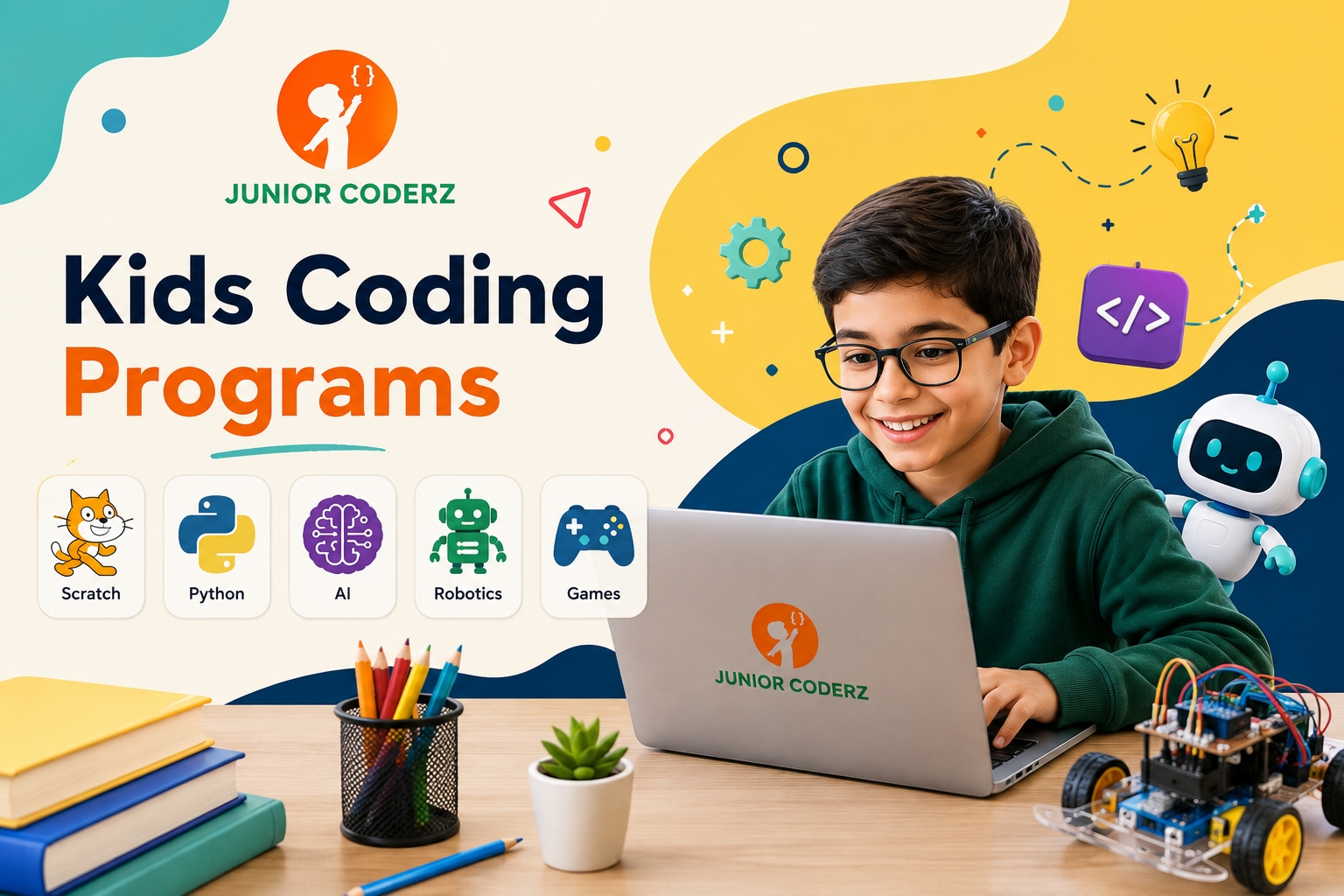
Kids coding programs provide an engaging way for young learners to develop programming knowledge while also improving logical thinking, creativity, problem-solving, and persistence. With age-appropriate lessons and hands-on projects, coding can become an exciting part of a child's education.
Why Should Children Learn Coding?
Coding is much more than memorizing programming commands. It teaches children how to think, experiment, identify problems, and create solutions.
Develops Problem-Solving Skills
Programming requires children to break a large challenge into smaller steps. If something does not work, they can analyze the problem, test different solutions, and improve their code.
Encourages Logical Thinking
Concepts such as sequences, loops, conditions, variables, and algorithms encourage children to think systematically.
Builds Creativity
Coding allows children to turn their ideas into digital creations. They can build games, animations, websites, applications, and other interactive projects.
Teaches Persistence
Debugging is an important part of programming. Children learn that mistakes are opportunities to investigate, improve, and try again.
Builds Technology Confidence
Completing a coding project can give children confidence in their ability to understand and create with technology.
What Can Kids Learn Through Coding Programs?
Modern coding education can cover much more than basic programming.
Scratch Coding
Scratch and other block-based programming tools can provide an accessible introduction to coding for younger learners.
Children can create:
Interactive stories
Animations
Simple games
Character-based projects
Digital experiments
Visual programming helps children understand coding logic without immediately dealing with complicated syntax.
Python Programming
As children become more experienced, Python can introduce them to text-based programming.
Students can learn concepts such as:
Variables
Loops
Functions
Conditions
Debugging
Algorithms
Object-oriented programming
Python can also provide a foundation for exploring AI, automation, and advanced software development.
Game Development
Game development is an excellent way to combine programming and creativity.
Children can learn how to create:
Characters
Game mechanics
Scoring systems
Levels
Interactive features
Game logic
Building a game allows students to see how programming concepts work together in a real project.
Web Development
Web development introduces children to the process of creating websites.
Depending on their level, students can explore:
HTML
CSS
JavaScript
Webpage structure
Interactive features
Basic web design
App Development
App development teaches children how digital applications are planned and created. They can explore user interaction, functionality, design, and programming while developing their own ideas.
Robotics and Electronics
Robotics combines programming with engineering concepts. Children can explore virtual robotics, electronics, sensors, circuits, and automation.
Artificial Intelligence
AI is another growing area of technology education. Older and intermediate learners can explore machine learning, generative AI, prompt engineering, automation, and AI-powered applications.
Why Age-Appropriate Coding Programs Matter
Every child learns differently. A beginner course for a six-year-old should not be the same as an expert-level program for a teenager.
Age-specific learning allows students to study concepts that match their current abilities while gradually progressing toward more advanced subjects.
Ages 6–7: Beginner Coding
Junior Coderz's Tiny Techies program is designed for children ages 6–7. It has a beginner difficulty level and covers basic coding, computer skills, logical thinking, typing, and beginner game development. The program includes 48 classes over six months.
This type of foundation can help younger children become comfortable with computers and basic programming concepts.
Ages 8–10: Exploring Multiple Technologies
The Junior Inventors program is designed for ages 8–10 and has an intermediate difficulty level.
Students can explore:
Python
Virtual robotics
AI
3D modeling
Game development
Electronics
Web development
App development
The program includes 144 classes over 18 months.
This broad curriculum gives children opportunities to discover which areas of technology interest them most.
Ages 11–14: Building Stronger Programming Skills
The Code Champions program is designed for ages 11–14. Students can continue developing their skills in Python, robotics, AI, 3D modeling, game development, electronics, web development, and app development.
The program focuses on strengthening problem-solving through coding logic and debugging.
Advanced Python Learning
For students interested specifically in Python, Junior Coderz offers Python Hybrid and Python Pioneers.
Python Hybrid is an advanced 18-month program covering advanced Python, AI, virtual robotics, game development, electronics, 3D modeling, web development, and app development.
Python Pioneers focuses more deeply on Python fundamentals, advanced Python, Python graphics, debugging, and object-oriented programming.
Ages 14+: Advanced Technology
Older students can progress into Algorithm Avengers, an expert-level program for ages 14+.
The curriculum includes:
Advanced Python
HTML
CSS
JavaScript
Blender
SolidWorks
Core game development
Advanced AI
The program is designed to help students develop more complex programming abilities and prepare for advanced STEM-related learning.
AI Coding Programs for the Next Generation
Artificial intelligence is rapidly becoming part of modern technology, making AI education increasingly relevant for young learners.
Junior Coderz also offers an AI Hybrid program for ages 8–16. The 12-month program covers generative AI, prompt engineering, machine learning fundamentals, Python programming, Cursor IDE, n8n automation, and app and web development.
Students can work toward creating practical projects involving automated workflows, intelligent applications, chatbots, AI models, and modern coding tools.
This type of learning can introduce children to technologies they may encounter in future academic and professional environments.
How Project-Based Learning Helps Kids
Children often learn more effectively when they can apply a concept immediately.
For example, instead of simply learning about programming loops, students can use loops to control an animation or game.
Instead of only studying web development concepts, they can build an actual webpage.
Projects can help children:
Apply programming concepts
Experiment with ideas
Practice debugging
Develop creativity
Improve logical thinking
Build confidence
Solve practical problems
Most importantly, children can see the direct results of their learning.
Choosing the Right Kids Coding Program
Parents have many options when selecting technology education for their children. A few factors can make the decision easier.
Consider Age and Experience
The program should match the child's current age and programming experience.
Look at the Curriculum
Check whether the course covers subjects that interest your child, such as Python, games, robotics, web development, or AI.
Choose Hands-On Learning
Children should have opportunities to create projects rather than simply memorize concepts.
Look for a Clear Learning Path
A structured progression can help students move from beginner concepts to intermediate and advanced skills.
Consider the Child's Interests
Some children enjoy games, while others may prefer robotics, websites, AI, or creative design. Finding the right area of interest can make learning more enjoyable.
Kids Coding Programs Can Build More Than Programming Skills
One of the biggest advantages of coding education is that children can develop skills that apply to many areas of life.
Critical Thinking
Children learn to analyze problems and consider different solutions.
Creativity
Programming gives students a way to transform ideas into digital projects.
Attention to Detail
Even a small error can affect a program, encouraging children to carefully review their work.
Organization
Large coding projects require students to divide tasks into smaller steps.
Persistence
Debugging teaches children that problems can be solved through experimentation and patience.
Why Online Coding Programs Can Be Convenient
Online coding education allows children to access technology learning from home.
For families, online programs can provide:
Convenient learning from home
Access to specialized instructors
Structured lessons
Digital project development
Age-specific education
Exposure to multiple technology fields
Children can learn programming in a familiar environment while developing skills that can support their academic and future technology interests.
Junior Coderz Kids Coding Programs
Junior Coderz provides a structured selection of kids coding programs designed around different ages and skill levels.
The current course catalog includes Tiny Techies, Junior Inventors, Code Champions, Python Hybrid, Python Pioneers, Algorithm Avengers, and AI Hybrid. These programs range from beginner coding for young children to advanced programming and AI for older learners.
The curriculum covers a broad selection of technology skills, including coding, Python, AI, virtual robotics, electronics, game development, 3D modeling, web development, app development, and advanced programming.
This progression allows students to continue building their technology knowledge as they grow older and become more experienced.
Preparing Children for a Digital Future
Technology will continue to evolve, but fundamental skills such as problem-solving, creativity, logical reasoning, adaptability, and persistence can remain valuable.
Coding can teach children how to approach unfamiliar problems and develop solutions step by step.
Whether a child eventually becomes a software developer, engineer, designer, scientist, entrepreneur, or works in another field, the thinking skills developed through programming can be useful.
The goal of children's coding education is not necessarily to turn every student into a professional programmer. Instead, it can help them become confident learners and creators who understand how technology works.
Final Thoughts
The right kids coding programs can give children an exciting introduction to programming and technology. From Scratch and beginner game development to Python, robotics, web development, app development, AI, and advanced programming, children can explore a wide range of digital skills.
Parents should consider their child's age, interests, current abilities, and learning goals when choosing a program.
With structured lessons and practical projects, coding can become more than another academic subject. It can give children the opportunity to create, experiment, solve problems, and turn their ideas into real digital projects.
Frequently Asked Questions
What are kids coding programs?
Kids coding programs are structured educational courses designed to teach children programming and technology skills through age-appropriate lessons, activities, and projects.
What age can children start coding?
Children can begin learning basic coding concepts at a young age. Junior Coderz offers its Tiny Techies program for ages 6–7.
What can children learn in coding programs?
Depending on their age and course level, children can learn Scratch, Python, game development, robotics, AI, web development, app development, electronics, 3D modeling, and advanced programming