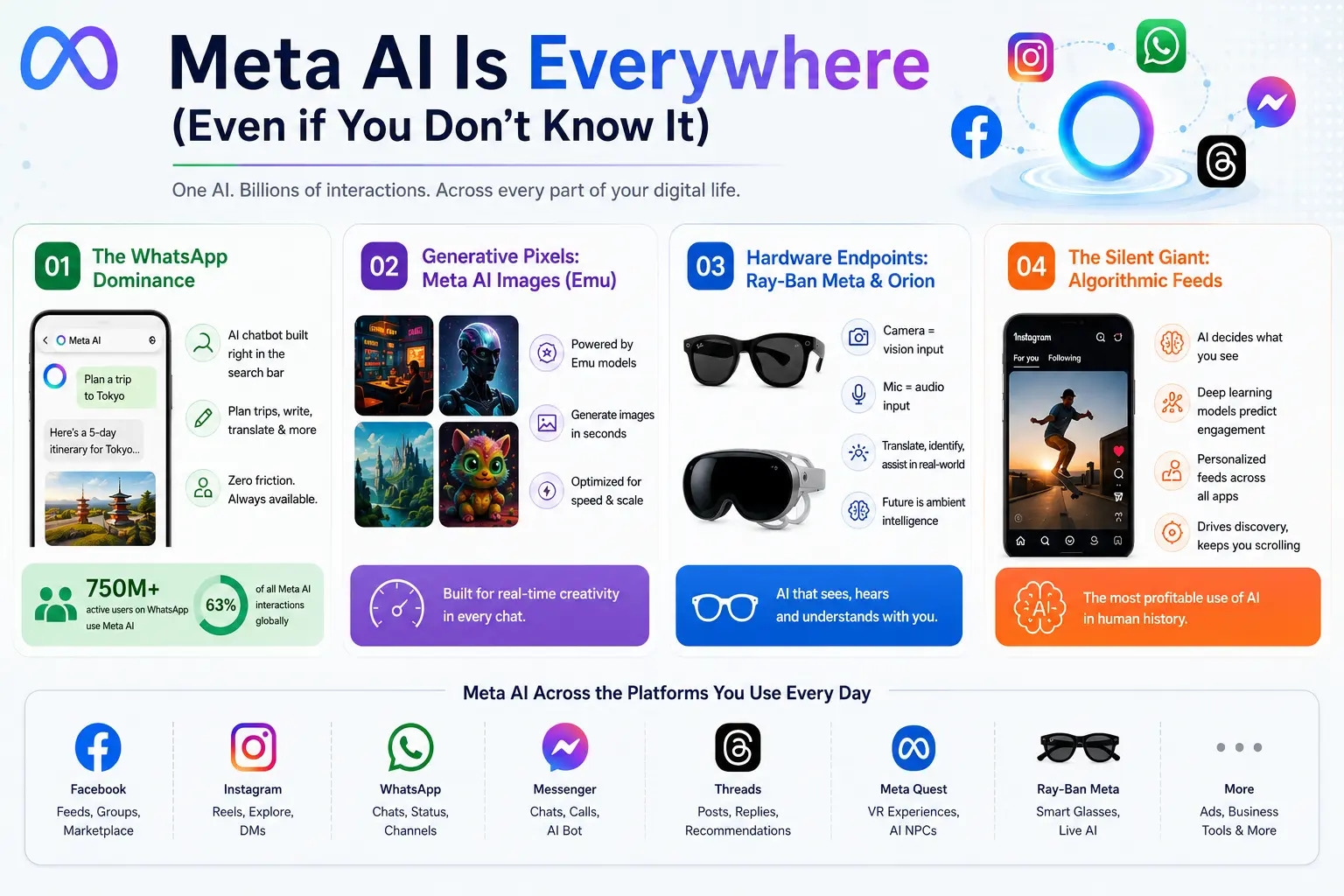
Modern AI adoption is no longer about experimentation—it’s about infrastructure decisions that affect cost, governance, and long-term flexibility. Many teams evaluating enterprise AI end up comparing open ecosystems with tightly controlled proprietary platforms. The differences go beyond pricing; they shape how data moves, how models evolve, and how much control organizations actually retain.
Before comparing these paths, it helps to understand how Meta’s approach fits into the broader AI landscape. A useful reference point is this breakdown of what is meta ai, which outlines how Meta’s system spans both consumer tools and open model development.
The Core Divide: Open vs Closed AI Systems
At a structural level, AI platforms fall into two categories. Closed systems are fully managed by a provider. Open systems expose model weights, deployment options, and sometimes training pathways.
This distinction changes how organizations operate in practice.
Closed AI models typically offer:
Fully hosted infrastructure with minimal setup
Predictable user experience across updates
Usage-based pricing tied to API consumption
Limited access to model internals or training data
Open AI models typically provide:
Self-hosting or private cloud deployment
Adjustable architecture for specific workloads
Greater visibility into model behavior
Responsibility for maintenance and scaling
For many engineering teams, the tradeoff is not simplicity versus complexity—it is control versus convenience.
Operational Control and Data Governance
One of the most significant differences appears in how data is handled. Enterprises working with sensitive or regulated information often need strict boundaries around processing environments.
Closed platforms require data to pass through external APIs, even if temporarily. This can raise concerns in sectors such as healthcare, finance, and legal services.
Open systems allow organizations to shift inference and training into controlled environments. That changes what is possible from a compliance standpoint.
Key governance considerations include:
Where data is stored and processed
Who can access model logs and outputs
How retention policies are enforced
Whether models can be audited internally
Organizations with strict regulatory obligations often find this layer of control essential rather than optional.
Cost Structure Over Time
Initial cost comparisons between open and closed AI systems can be misleading. Closed models appear inexpensive at low usage levels because they remove infrastructure overhead. However, cost behavior changes as usage scales.
Closed model economics:
Linear cost increase with every API call
Pricing controlled externally
Limited ability to optimize workload efficiency
Open model economics:
Higher upfront setup and infrastructure investment
Lower marginal cost at high request volumes
Ability to optimize inference pipelines
For workloads involving millions of daily interactions—customer support automation, internal assistants, or content pipelines—cost predictability becomes as important as raw pricing.
Flexibility and Customization Depth
Closed AI systems are designed for general use cases. They perform well across a broad range of tasks but offer limited adaptability beyond prompt engineering or fine-tuning layers.
Open models allow deeper modification.
Common customization advantages include:
Domain-specific fine-tuning on proprietary datasets
Integration into internal software stacks
Adjustments to latency, memory, and response behavior
Experimentation with alternative architectures
This flexibility is particularly relevant for organizations building long-term AI products rather than one-off tools.
Performance Tradeoffs and Engineering Reality
It is often assumed that closed models are always more advanced. In practice, performance depends on workload type, infrastructure quality, and optimization effort.
Closed systems:
Strong out-of-the-box performance
Rapid model iteration by provider teams
Less engineering overhead for scaling
Open systems:
Performance depends on deployment quality
Requires expertise in infrastructure tuning
Can outperform closed systems in specialized environments
In production environments, the engineering effort behind deployment can matter as much as the model itself.
Strategic Implications for Enterprises
Choosing between open and closed AI systems is rarely a purely technical decision. It reflects long-term strategy around ownership, risk, and operational independence.
Organizations evaluating both approaches often weigh:
Vendor dependency versus internal capability building
Speed of deployment versus long-term control
Standardization versus customization
Predictable costs versus scalable efficiency
Hybrid architectures are becoming more common, where closed APIs handle general tasks while open models support sensitive or high-volume workloads.
This blended approach reflects a broader shift: AI is moving from a single-service dependency model to a layered infrastructure strategy.
Closing Perspective
The gap between open and closed AI systems is narrowing in capability but widening in strategic importance. As model performance converges, the deciding factors increasingly revolve around governance, infrastructure ownership, and cost behavior at scale.
Enterprises that treat AI as a long-term operational layer—not just a feature—tend to evaluate these systems less as competing tools and more as complementary parts of a larger architecture.
For additional context on AI systems, research directions, and applied use cases, visit Jarvis Learn.


