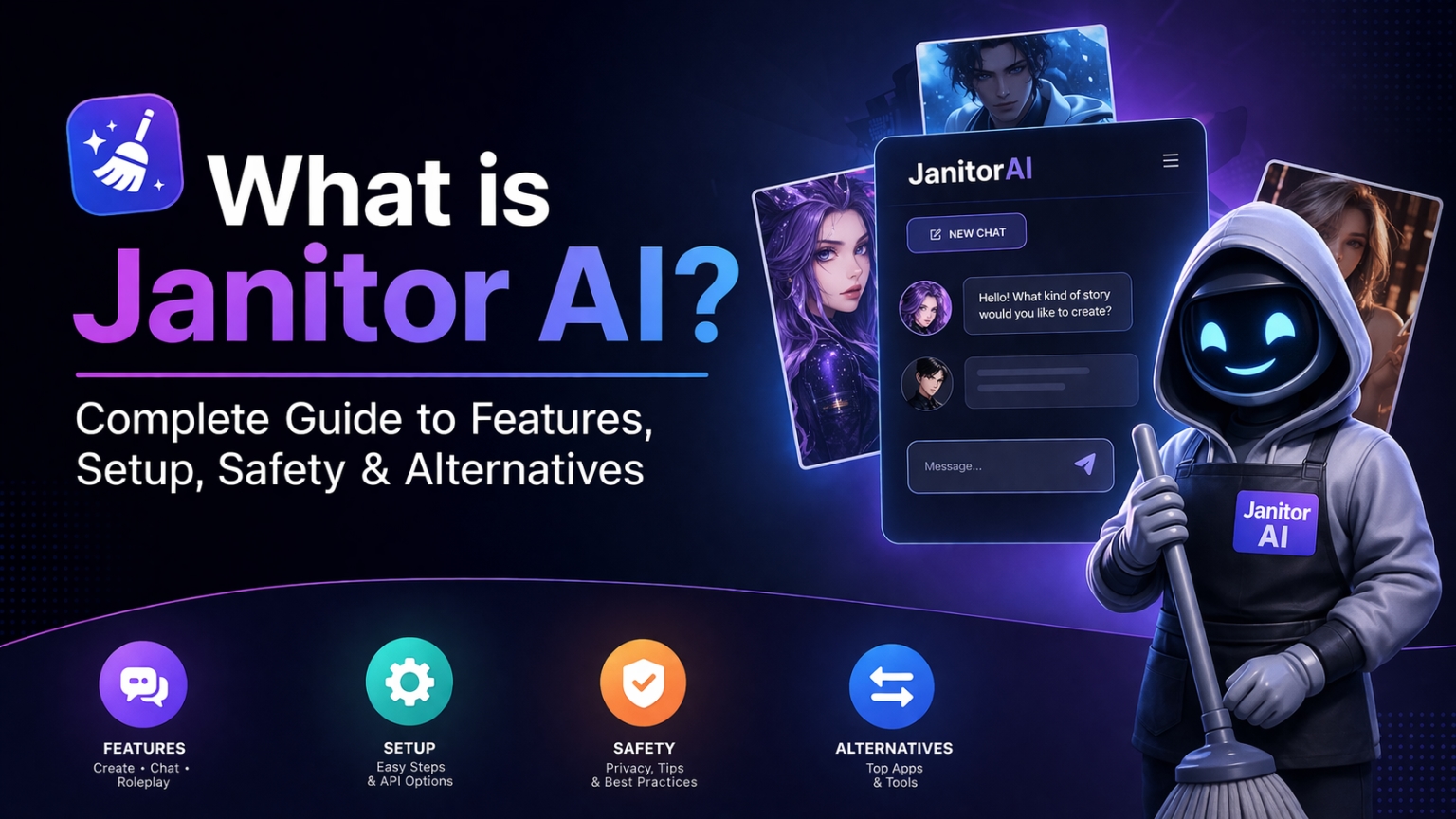
AI chat platforms have evolved far beyond simple question-and-answer tools. Users now expect immersive conversations, persistent personalities, and interactive storytelling experiences. That demand has fueled the rise of platforms like Janitor AI, which has attracted a large community of users interested in roleplay, creative writing, and character-driven interactions.
For readers looking for a detailed breakdown of what is Janitor AI, understanding the platform requires looking beyond its popularity and examining how it works, where it excels, and where its limitations become apparent.
Why Character-Based AI Has Gained Momentum
Traditional chatbots were designed to answer questions, complete tasks, or provide information. Character-focused AI platforms serve a different purpose: entertainment and storytelling.
Users are increasingly drawn to conversational experiences that feel personalized. Instead of interacting with a generic assistant, they engage with characters that have distinct personalities, backgrounds, and communication styles.
Several factors contribute to this trend:
Increased accessibility of large language models
Growing interest in interactive storytelling
Expansion of online fan communities
Demand for personalized digital experiences
Improved natural language generation capabilities
Janitor AI capitalized on these trends by creating an environment where users can build and share custom characters without requiring technical expertise.
The Technical Reality Behind the Experience
One common misconception is that Janitor AI itself generates all conversations.
In practice, the platform functions primarily as an interface that connects users to language models through external APIs or its own hosted models. The quality of conversations often depends less on the platform and more on the underlying AI model being used.
This architecture provides flexibility but introduces tradeoffs.
Advantages
Users can choose different AI models
Character customization remains highly flexible
Advanced users can experiment with alternative backends
Costs can be controlled depending on model selection
Challenges
Performance varies significantly between models
Response quality may fluctuate during peak usage periods
Technical setup can become complicated for new users
Long conversations may experience memory limitations
Understanding these tradeoffs helps explain why user experiences can vary dramatically even when using the same character.
The Ongoing Challenge of Context and Memory
One of the most discussed issues within AI roleplay communities involves long-term memory.
Most language models operate within a context window that limits how much information can be processed during a conversation. As chats grow longer, older details may gradually disappear from the model's active memory.
This creates several challenges:
Characters forgetting important story events
Personality inconsistencies
Plot continuity problems
Reduced immersion during extended roleplay sessions
Experienced users often compensate by creating detailed character definitions and storing critical information in memory settings rather than relying solely on chat history.
The issue is not unique to Janitor AI. It reflects a broader limitation affecting many modern language models.
Privacy Considerations Users Often Overlook
While entertainment remains the platform's primary purpose, privacy deserves attention.
Because conversations may be processed through third-party AI providers, users should carefully evaluate what information they share. The exact handling of conversation data can vary depending on the model provider, API configuration, and platform policies.
Practical precautions include:
Avoid sharing sensitive personal information
Avoid discussing confidential business data
Review provider documentation before connecting external APIs
Understand how conversation logs may be stored
These considerations become especially important when users experiment with alternative API configurations or proxy services.
Is Janitor AI Suitable for Professional Use?
The short answer is generally no.
The platform was designed around creative interaction rather than enterprise workflows. While it demonstrates the capabilities of conversational AI, it lacks many of the controls businesses typically require.
Organizations evaluating AI tools usually prioritize:
Data governance
Security controls
Compliance frameworks
Audit trails
Administrative oversight
Enterprise support
Janitor AI focuses on user-generated characters and entertainment experiences rather than meeting these operational requirements.
That distinction matters because consumer AI platforms and business AI platforms solve fundamentally different problems.
What the Future May Hold
The popularity of character-based AI suggests that conversational experiences will continue evolving beyond traditional chatbot interactions.
Future developments are likely to focus on:
Improved memory systems
Better character consistency
Enhanced personalization
Stronger privacy controls
More efficient local AI deployment
As AI models become more capable, the line between storytelling, simulation, and conversational assistance may continue to blur.
For users, the key is understanding both the possibilities and the limitations. Janitor AI offers an engaging example of how conversational AI can be applied to creative experiences, but it also highlights many of the technical, ethical, and practical questions that the broader AI industry is still working to solve.
For additional insights into AI platforms, emerging technologies, and practical AI applications, visit Jarvis Reach.



