
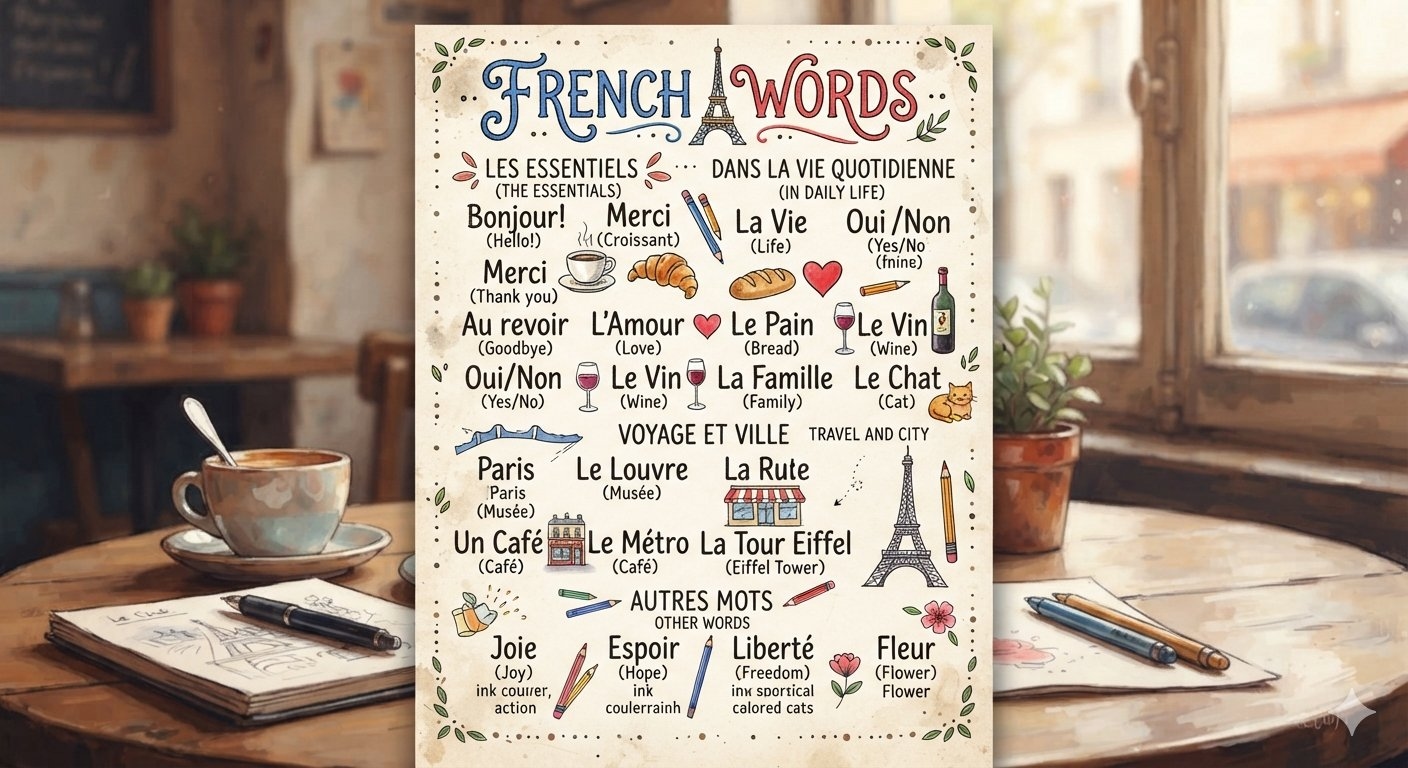
Learning French can feel overwhelming at first. Thousands of words, tricky pronunciation, and grammar rules can make a beginner wonder where to start. The good news is that you don’t need thousands of words to begin communicating. Research on language frequency shows that a small set of words covers a large share of everyday speech. Focusing on the highest French words, the ones used most often, is the fastest way to build confidence and real conversational ability.
Why Start with the Highest French Words?
Every language follows a pattern: a small group of words appears again and again. In French, the 100 most frequent words make up roughly half of what you read and hear in everyday life. Learning these first gives you an immediate return on your study time. Instead of memorizing rare vocabulary you may never use, you build a foundation that helps you understand real conversations, songs, shows, and articles.
Essential Greetings and Polite Phrases
Politeness matters in French culture, so begin here:
Bonjour: Hello / Good morning
Bonsoir: Good evening
Salut: Hi / Bye (informal)
Au revoir: Goodbye
Merci: Thank you
S’il vous plaît: Please (formal)
S’il te plaît: Please (informal)
De rien: You’re welcome
Excusez-moi: Excuse me
Pardon: Sorry
Using bonjour when entering a shop or merci when leaving is considered basic courtesy in France, and it makes a strong first impression.
The Most Common Small Words
The highest-frequency French words are often tiny grammar words. They are the glue of every sentence:
le / la / les: the
un / une: a, an
et: and
ou: or
mais: but
de: of, from
à: to, at
dans: in
pour: for
avec: with
sur: on
que: that, which
qui: who
Recognizing these words helps you break sentences into chunks, even when you don’t know every word.
Must-Know Verbs
Verbs drive communication. Start with these high-frequency ones:
être: to be
avoir: to have
aller: to go
faire: to do / make
pouvoir: to be able to
vouloir: to want
savoir: to know (a fact)
voir: to see
venir: to come
dire: to say
Learn être and avoir first. They appear constantly and are also used to form past tenses. For example, je suis (I am) and j’ai (I have) are among the first phrases any beginner should master.
Common Pronouns
Pronouns let you talk about yourself and others:
je: I
tu: you (informal)
vous: you (formal or plural)
il / elle: he / she
nous: we
ils / elles: they
Useful Question Words
Asking questions is essential when you’re learning:
Qui ? Who?
Quoi ? What?
Où ? Where?
Quand ? When?
Pourquoi ? Why?
Comment ? How?
Combien ? How much / how many?
A simple Où est la gare ? (Where is the train station?) can be incredibly useful for travelers.
Numbers and Everyday Nouns
Numbers come up daily: un, deux, trois, quatre, cinq, six, sept, huit, neuf, dix. Add practical nouns such as maison (house), eau (water), pain (bread), temps (time/weather), jour (day), personne (person), and ville (city), and you can already describe much of daily life.
Tips for Memorizing Common French Words
Use spaced repetition. Apps with flashcards review words just before you forget them.
Learn in phrases, not isolation. Memorize je voudrais un café rather than just café.
Practice aloud. French pronunciation, especially nasal vowels and silent letters, improves only through speaking.
Listen daily. Podcasts, music, and children’s shows repeat common words naturally.
Review a little every day. Fifteen minutes daily beats a two-hour session once a week.
Learning Is About Structure and Consistency
Whether you’re learning a language or a professional skill, the principle is the same: structured, prioritized learning beats random effort. The same logic applies to career training. A well-organized program such as an Ultimate SAP MM course (Materials Management) works because it teaches the most important concepts first, such as procurement, inventory, and vendor management, and builds toward advanced topics step by step. Language learners benefit from that same approach: master the core, then expand.




