
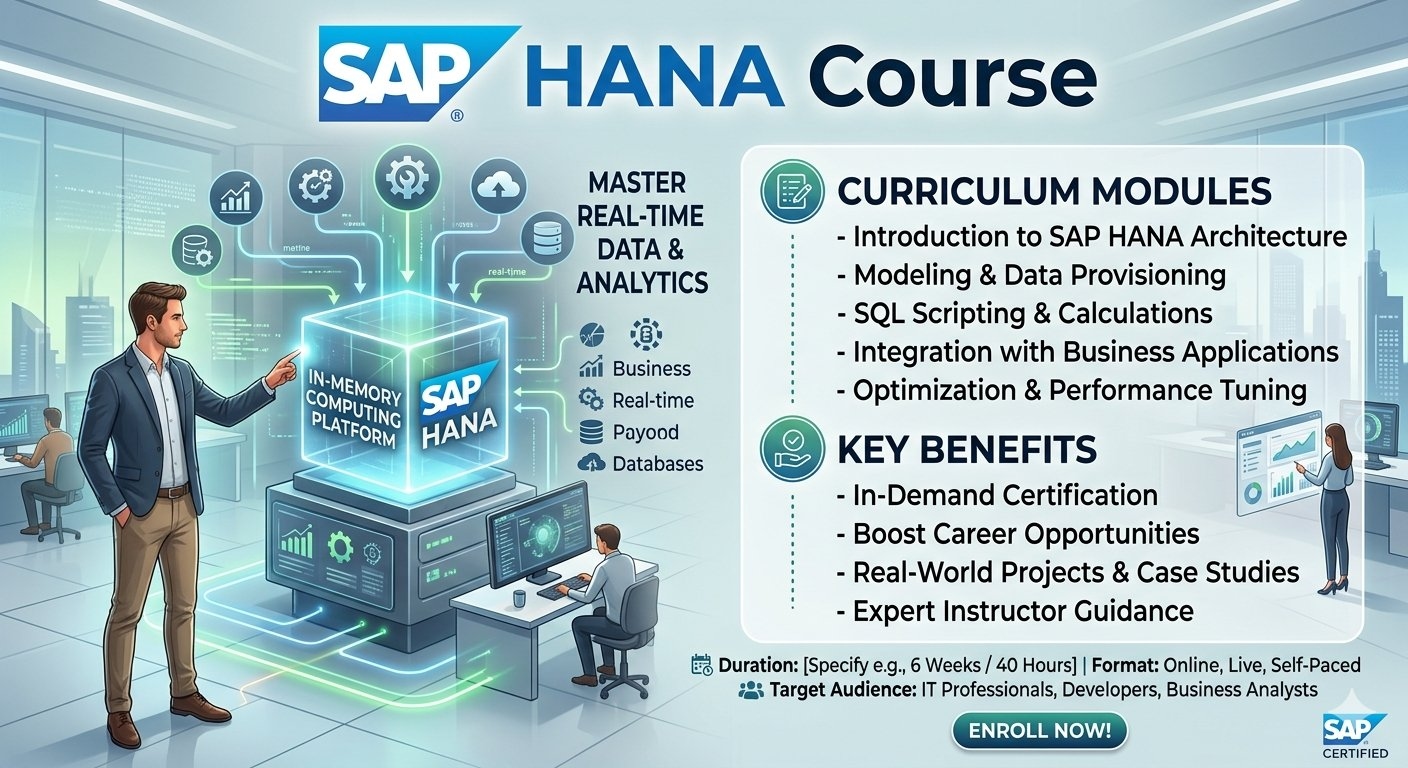
Explore an online SAP HANA course: what you learn, syllabus, fee factors, top SAP modules, and career paths. A practical guide for beginners and professionals.
An SAP HANA course teaches you to work with SAP’s in-memory database and platform, which powers S/4HANA and modern SAP analytics. A typical online SAP HANA course covers data modeling, SQL, calculation views, and integration with top SAP modules. It suits beginners, developers, and consultants aiming for SAP careers.
Understanding the Search Intent
Most people searching for an online SAP HANA course want to know four things: what they will learn, whether it is worth the money, how long it takes, and whether it leads to a job. This guide answers each one, and it is honest about what varies by provider and region.
What Is SAP HANA, in Plain Terms?
SAP HANA (High-Performance Analytic Appliance) is a database that keeps data in memory rather than reading it mainly from disk. It stores data in a columnar format, which speeds up reporting and analysis on large datasets.
It matters because SAP S/4HANA, SAP’s current ERP suite, runs on it. Companies migrating from older SAP ECC systems need people who understand both the database layer and the business modules on top of it.
Common use cases:
Real-time financial reporting
Supply chain and inventory analytics
Custom application development
Data warehousing with SAP BW/4HANA
Who Should Take an Online SAP HANA Course?
Fresh graduates who want a recognised enterprise-software skill
Database, SQL, or BI professionals moving into the SAP ecosystem
Existing SAP consultants (functional or technical) upgrading from ECC to S/4HANA
Developers interested in ABAP on HANA or SAP BTP
Career switchers with a business or finance background who want to join an ERP team
You do not need to be a programmer to start, but basic SQL and an understanding of business processes will help.
Typical SAP HANA Course Syllabus
Syllabi differ between institutes, so compare the outline before you enrol. Most solid programs include the following:
Core Modules
Introduction to SAP HANA architecture: in-memory computing, columnar vs. row storage, data compression
SAP HANA administration basics: installation concepts, users, roles, authorizations, backup and recovery
SQL and SQLScript: queries, stored procedures, functions, performance-aware coding
Data modeling: attribute, analytic, and calculation views using SAP HANA Studio or Web IDE / Business Application Studio
Data provisioning: loading data with SLT, SDI, and flat-file imports
Reporting and analytics: connecting models to SAP Analytics Cloud, BusinessObjects, or Excel
Security and performance tuning: analytic privileges, plan visualisation, query optimisation
Introduction to SAP HANA Cloud and SAP BTP: cloud-based deployment and extensions
Hands-On Components to Look For
A live or sandbox HANA system (not slides alone)
A capstone project, such as building a sales analytics model
Mock exams aligned to SAP certification topics
How SAP HANA Connects to the Top SAP Modules
HANA is the foundation, and the business modules sit on top. Understanding the top SAP modules helps you decide where to specialise.
SAP Module | What It Covers | How HANA Helps |
|---|---|---|
FI/CO (Finance & Controlling) | Accounting, reporting, cost management | Faster period-end close and real-time reporting |
MM (Materials Management) | Procurement, inventory | Live stock and purchasing analytics |
SD (Sales & Distribution) | Orders, pricing, billing | Quick order-to-cash insights |
PP (Production Planning) | Manufacturing planning | Better capacity and MRP analysis |
EWM / WM (Warehouse) | Warehouse operations | Real-time movement tracking |
HCM / SuccessFactors | HR and payroll | Workforce analytics |
BW/4HANA | Data warehousing | Large-scale, HANA-native reporting |
Practical example: A finance consultant who knows FI/CO and also understands how HANA calculation views feed financial dashboards is more useful to a migration team than someone who knows only one side.
Key Benefits of Learning SAP HANA
Relevance: S/4HANA is SAP’s strategic product, so HANA skills align with where the platform is heading.
Flexible career entry: you can move into technical, functional, analytics, or development tracks.
Cross-skill value: SQL, data modeling, and analytics transfer to other platforms.
Online accessibility: you can learn from anywhere, often at your own pace.
Clearer migration understanding: useful for ECC-to-S/4HANA projects.
No course guarantees a job. Outcomes depend on your effort, practice, communication skills, and the job market in your region.
Online vs. Classroom SAP HANA Training
Factor | Online | Classroom |
|---|---|---|
Flexibility | High, with recorded and live options | Fixed schedule |
Cost | Often lower | Usually higher |
System access | Cloud sandbox, if provided | Lab-based |
Interaction | Live Q&A, forums | Face-to-face |
Best for | Working professionals, remote learners | Those who prefer structure |
Choose an online SAP HANA course only if it includes live practice access and trainer support. Watching videos alone rarely builds job-ready skill.
SAP HANA Course Fees: What to Expect
Fees vary widely by country, provider, trainer experience, course depth, and whether certification prep is included. It would be misleading to quote a single figure, so use these factors to compare options:
Course type: self-paced videos, live instructor-led, or corporate training
Duration: short overviews versus full multi-week programs
Lab access: whether the system access is included or billed separately
Certification: exam fees are usually separate from training fees
Support: mentoring, resume help, and interview preparation
Tip: Ask for a free demo class, a detailed syllabus, and a clear refund policy before paying. Check current pricing directly with the provider and on the SAP Training and Certification Shop.
How to Choose the Right SAP HANA Course
Check trainer credentials: look for real project experience, not only teaching experience.
Verify the syllabus: it should include modeling, SQLScript, and a hands-on project.
Confirm system access: practice matters more than theory.
Review learner feedback: read independent reviews, not only testimonials on the provider’s own site.
Look for updated content: HANA, HANA Cloud, and BTP change regularly.
Ask about certification alignment: SAP updates its exam codes, so verify against SAP’s official listings.
Career Opportunities After an SAP HANA Course
Typical roles include:
SAP HANA Developer / Modeler
SAP HANA Administrator (Basis)
SAP BW/4HANA Consultant
SAP S/4HANA Functional Consultant (FI/CO, MM, SD, and others)
SAP Data Analyst / BI Consultant
SAP BTP / Cloud Developer
SAP Migration Specialist
Employers include IT services firms, consulting companies, and enterprises running SAP in manufacturing, retail, banking, and logistics. Salary ranges differ greatly by country, experience, and role, so check recent local job listings instead of relying on generic figures.
A Realistic Learning Path
Learn SQL fundamentals.
Understand basic ERP and business processes.
Complete a structured SAP HANA course with lab practice.
Build one or two portfolio projects, such as a sales dashboard or inventory model.
Pursue an SAP certification relevant to your target role.
Apply for junior roles, internships, or project support positions.
FAQ's
1. What is SAP HANA used for?
It is used for fast data processing, analytics, and as the database behind SAP S/4HANA and other SAP applications.
2. Is SAP HANA difficult to learn?
It is manageable if you know basic SQL and business processes. Modeling and SQLScript take consistent practice.
3. How long does an online SAP HANA course take?
It varies by provider and depth, from a few weeks for a focused course to a few months for comprehensive training. Confirm the schedule with the provider.
4. Do I need programming experience?
Not always. SQL knowledge helps, and developer tracks benefit from programming basics.
5. Which SAP modules are in highest demand?
Demand shifts by region and industry. Finance (FI/CO), supply chain (MM, SD), and S/4HANA migration skills are commonly sought. Check local job boards for current trends.
6. Is SAP HANA certification necessary?
It is not always required, but it can strengthen your profile. Confirm current exam details on SAP’s official site.
7. Can freshers get jobs with SAP HANA skills?
Entry-level roles exist, but employers generally look for hands-on proof, such as projects, internships, or strong fundamentals.
8. What is the difference between SAP HANA and S/4HANA?
SAP HANA is the database platform. S/4HANA is the ERP suite that runs on it.
9. Can I learn SAP HANA for free?
Yes, partly. SAP provides free learning content and trial options, though structured mentoring and lab environments may cost extra.
10. Is SAP HANA still worth learning?
Many organisations are migrating to or operating on S/4HANA, so the skills remain relevant. Pair HANA with a module specialisation for the best results.
Conclusion
An SAP HANA course can be a strong step if you want to work in enterprise software, analytics, or SAP consulting. The best programs combine theory, live system practice, and a real project, and they connect HANA to the top SAP modules that businesses actually use. Compare syllabi, ask about lab access, verify certification details, and set realistic expectations. Skill, practice, and persistence matter more than any certificate alone.







