
Learning German is a smart move. Germany offers great job opportunities, free or low-cost university education, and a strong economy. Millions of students and professionals around the world are now learning the language for study, work, or migration.
But before you start, you face a big question: should you join an online German course or an offline German class?
Both options work. The real question is which one works better for you. In this article, we will compare them in simple terms so you can make the right choice.
What Is an Online German Language Course?
An online German course is taught over the internet. You can join live classes on Zoom or Google Meet, or watch recorded lessons at your own pace. Many courses also include apps, worksheets, quizzes, and speaking practice with teachers.
What Is an Offline German Language Course?
An offline course is the classic classroom model. You go to a language institute, sit with a teacher and other students, and learn face to face. Classes follow a fixed timetable, and everything happens in one place.
1. Flexibility and Convenience
This is where online courses win easily.
With online learning, you can study from home, from your office, or even while traveling. You save time because there is no commute. If you live in a smaller city where good German teachers are hard to find, online classes give you access to top trainers anywhere in the country, or the world.
Offline classes need you to be at a fixed place at a fixed time. If traffic is bad or your schedule changes, you may miss a class. For students and working professionals with busy days, this can be stressful.
Winner: Online
2. Cost
Online courses are usually cheaper. The institute does not pay for a big building, electricity, or classroom space, so the savings often reach the student. You also save money on travel and sometimes on printed books.
Offline courses tend to cost more because of rent, staff, and infrastructure. However, some local institutes offer good deals, so it is worth comparing prices.
Winner: Online (in most cases)
3. Quality of Teaching and Personal Attention
A great teacher matters more than the mode of learning. A good online teacher can give you clear feedback, correct your pronunciation, and keep the class interesting. But with large online batches, it is easy to stay silent, switch off your camera, and slip through the cracks.
In an offline classroom, the teacher can see your face, notice when you are confused, and help you right away. Body language is a big part of teaching, and it is easier to read in person. Small offline batches often give more personal attention.
Winner: Offline (slightly), but a small online batch can match it
4. Speaking Practice
German is a language you must speak to learn. Many people understand grammar but freeze when they need to talk.
Offline classes give natural speaking practice. You talk to classmates during breaks, practice dialogues in pairs, and build confidence without screens in between.
Online classes can do this well too, especially with breakout rooms and one-on-one speaking sessions. The key is to pick a course that gives real speaking time, not just lectures.
Winner: Offline, unless the online course has strong speaking sessions
5. Discipline and Motivation
Be honest with yourself here. Do you stay focused without someone watching you?
Online learning needs self-discipline. It is easy to skip a class, get distracted by your phone, or say “I will watch the recording later” and never do it. Self-paced courses are the hardest to finish for this reason.
Offline classes build a routine. When you pay for a seat, travel to class, and see your classmates, you are more likely to show up. The group energy also keeps you motivated.
Winner: Offline
6. Learning Resources and Technology
Online courses often have a big advantage here. You get recorded classes to revise, digital notes, apps, online tests, and mock exams. If you forget a grammar rule like the German cases (Nominativ, Akkusativ, Dativ), you can rewatch the lesson in minutes.
Offline classes depend mostly on books, notes, and what the teacher says in the room. Many good institutes now add digital tools, but it is not guaranteed.
Winner: Online
7. Exam Preparation (Goethe, TestDaF, telc)
If you plan to take a Goethe-Zertifikat, TestDaF, or telc exam, you need structured practice for reading, writing, listening, and speaking.
Both formats can prepare you well. Online courses give plenty of mock tests and recorded listening practice. Offline classes give a real exam-like atmosphere, which can reduce nervousness on exam day. What matters most is whether the teacher knows the exam pattern well.
Winner: Tie
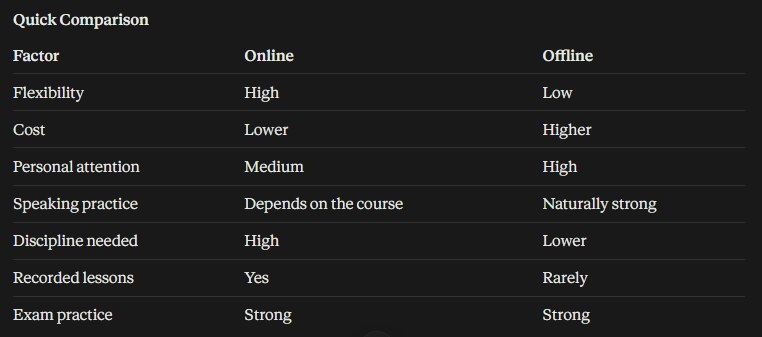
Quick Comparison
Who Should Choose an Online German Course?
Online learning is best for you if:
You are a working professional with a tight schedule
You live in a city without good German institutes
You want to save money and travel time
You are self-motivated and good at managing your time
You like to revise lessons again and again
Who Should Choose an Offline German Course?
Offline learning is better for you if:
You get distracted easily at home
You learn best by talking to people in person
You want a fixed routine and a classroom feel
You are a beginner who needs a lot of guidance
You enjoy studying with a group of friends
What About a Mix of Both?
Many learners now choose a hybrid approach. For example, you can attend offline classes for the basics and add online speaking sessions or apps for extra practice. Or you can take an online course and join a local German meetup or language exchange to speak with real people.
You do not have to pick only one. The best way to learn German is the one that fits your life and that you can stick with for months.
Tips for Choosing the Right Course
Whatever you pick, check these things first:
Teacher quality: Look for trained, experienced teachers, ideally with Goethe-Institut or similar certification.
Batch size: Smaller batches (8 to 12 students) give you more speaking time.
Demo class: Try a free trial class before paying.
Course structure: Make sure it follows the CEFR Levels of German language(A1, A2, B1, B2).
Reviews and results: Read student feedback and ask about exam pass rates.
Support: Good courses offer doubt-solving, extra practice, and regular tests.
Final Verdict: Which Is Better?
There is no single winner. Online German Language courses are better for flexibility, cost, and digital resources. Offline German classes are better for discipline, personal attention, and natural speaking practice.
If you are disciplined and short on time, go online. If you need structure and love learning with people around you, go offline. And if you want the best of both, mix them.
In the end, the best German course is the one you actually attend, practice with, and finish. Pick the format that suits your goals, your budget, and your personality, then start today. Viel Erfolg! (Good luck!)



