
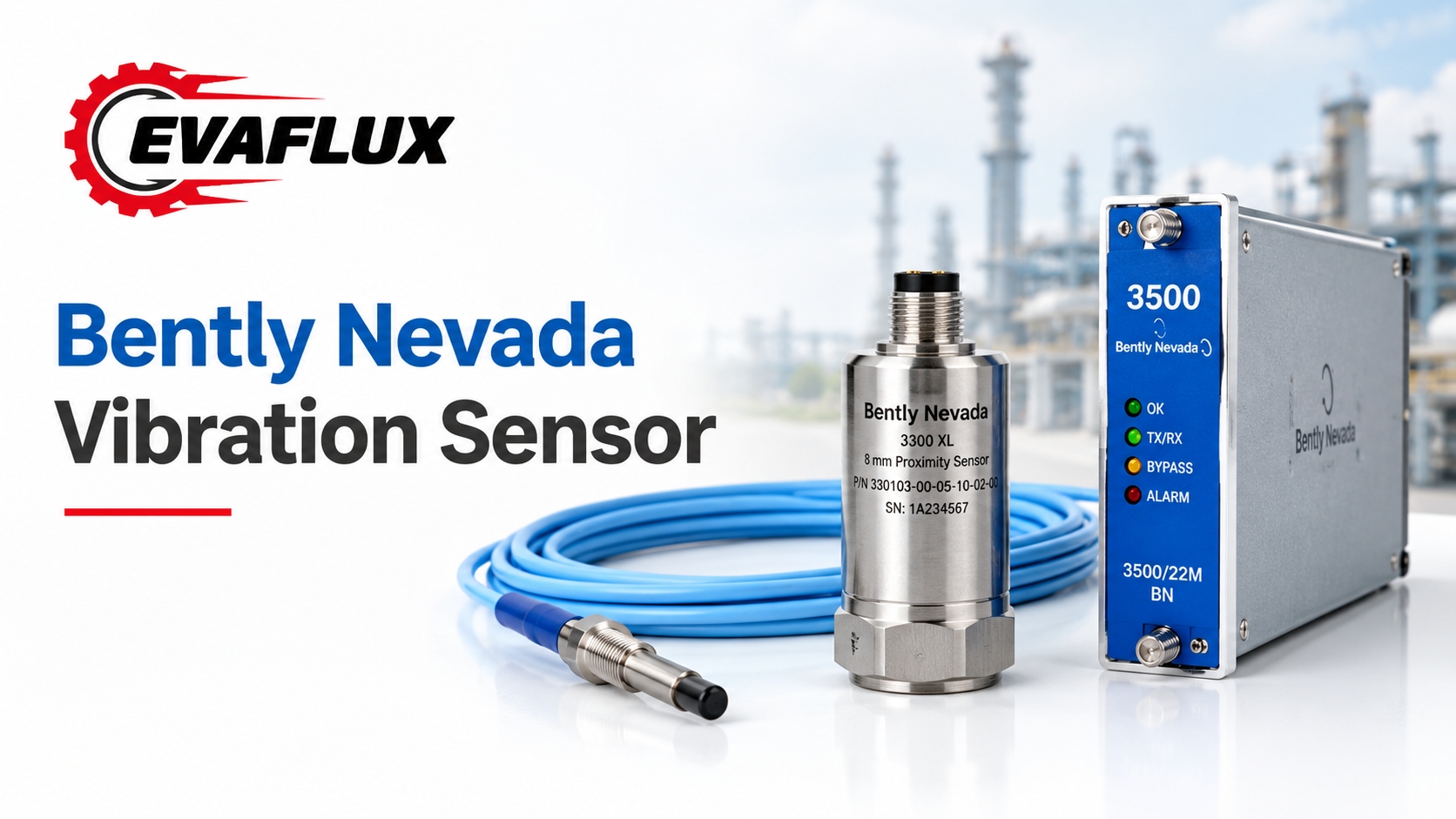
Unplanned downtime on a single turbine or compressor can cost a facility far more than the entire instrumentation budget. Maintenance leaders know this, which is why machinery protection is treated as a core engineering discipline rather than an optional extra. At the centre of many protection systems is the Bently Nevada vibration sensor, trusted for its stability and its fit with widely used monitoring platforms.
This article explains how these transducers contribute to uptime, what makes them reliable, and what buyers should check before purchase.
Protection Versus Condition Monitoring
Two goals are often confused. Protection means detecting dangerous conditions fast enough to trip a machine before damage occurs. Condition monitoring means trending data over time to plan maintenance and avoid surprises.
The same transducer can serve both goals. The real-time signal feeds a monitor with alarm and danger setpoints. The same data, sent to diagnostic software, supports trend analysis, orbit plots, and spectrum review.
What Makes the Sensors Reliable
Non-contact measurement. Proximity probes never touch the rotating shaft, so there is no mechanical wear on the sensing surface. That removes a common failure mode of contact sensors.
Robust construction. Probe tips are typically made of durable engineered plastic, with cables built to resist oil, heat, and abrasion. Connectors are designed with locking and sealing features to hold up under vibration.
Wide operating range. Standard 8 mm probe systems operate across a broad temperature range, and specialised versions extend this for high-temperature locations.
Consistent calibration. Matched systems keep scale factor stable, which supports trustworthy alarm thresholds.
Together, these attributes explain why a Bently Nevada vibration sensor often stays in service through multiple overhaul cycles.
Failure Modes the Sensors Help You Catch
Imbalance: shows as elevated 1× vibration
Misalignment: shows as 2× components and shifting shaft position
Oil whirl and whip: appear as sub-synchronous energy
Rubs: produce characteristic orbit and spectrum changes
Bearing wear: shows in gap voltage and vibration amplitude
Thrust position changes: monitored through axial probes
Each of these can progress from minor to severe in hours, so continuous measurement provides a safety margin that periodic manual checks cannot.
Key Specifications That Support Reliability
For a typical 8 mm proximity system, buyers can expect:
Linear range near 2 mm
Scale factor near 7.87 V/mm
Frequency response from DC to about 10 kHz
Low output impedance for long cable runs
Compatibility with API 670-style protection systems
Always confirm details with the datasheet for the specific model, including cable length and approvals.
Installation Practices That Protect Reliability
Good hardware can be undermined by poor installation. Technicians should:
Set the gap voltage to the recommended mid-range value using a multimeter.
Route cables away from power lines and variable-speed drives.
Secure and strain-relieve all cabling.
Seal and protect connections from moisture and oil.
Record baseline readings for future comparison.
A short commissioning checklist saves hours of troubleshooting later.
Reliability in UAE Operating Conditions
Facilities in the UAE face high ambient temperatures, airborne dust, humidity near coastal sites, and long continuous run times. These factors place heavy demands on field instruments. A Bently Nevada vibration sensor with proper sealing, correct cabling, and appropriate temperature rating is well suited to such conditions, particularly in oil and gas, power, and water treatment.
For operators in the UAE, a practical strategy is to hold critical spares such as probes, extension cables, and Proximitor sensors on site. A failed sensor then becomes a thirty-minute swap rather than a multi-week wait.
Procurement Checklist
Before placing an order, confirm:
Probe diameter and series (for example, 3300 XL 8 mm)
Total system length and cable length
Thread, case, and mounting style
Hazardous-area certification
Matching Proximitor sensor and connectors
Delivery lead time and documentation
Evaflux Support
Evaflux helps buyers and engineers identify the right component for the application. Share your machine type, existing part number, and monitor model, and the team can help you narrow the options.
Conclusion
Machinery protection works only when measurements are accurate and consistent. With non-contact sensing, rugged construction, and system-level calibration, the Bently Nevada vibration sensor helps protect critical rotating assets and supports planned, data-driven maintenance. Choosing the right configuration and installing it correctly turns that hardware into dependable uptime.
Frequently Asked Questions
1. How long does a proximity probe typically last?
Lifespan depends on environment and handling, but non-contact design means no wear on the sensing face. Many remain in service for years.
2. What causes a "not OK" reading?
Common causes include a damaged cable, loose connector, incorrect gap, or a failed probe tip.
3. Can sensors be replaced while the machine runs?
Usually not for protection-critical channels. Follow your site's safety and bypass procedures.
4. Do I need spare parts on hand?
For critical machines, holding spare probes, cables, and Proximitor sensors is strongly recommended.