There is a particular kind of scientific result that feels less like a breakthrough and more like a quiet correction to something we assumed was obvious. A team at Huashan Hospital, affiliated with Fudan University, has published one of those in *Nature Neuroscience* — on 29 September 2026, if you are keeping score.
They recorded directly from the surface of the brain in nine patients undergoing surgery for brain tumors while awake. The question: could they tell which syllable a person was silently imagining? The answer, on average, was yes — in 80.4% of cases. Chance would have given them 16.7%. For syllables spoken aloud, accuracy was 78.3%, slightly below the imagined figure. Make of that what you will.
The setup, briefly
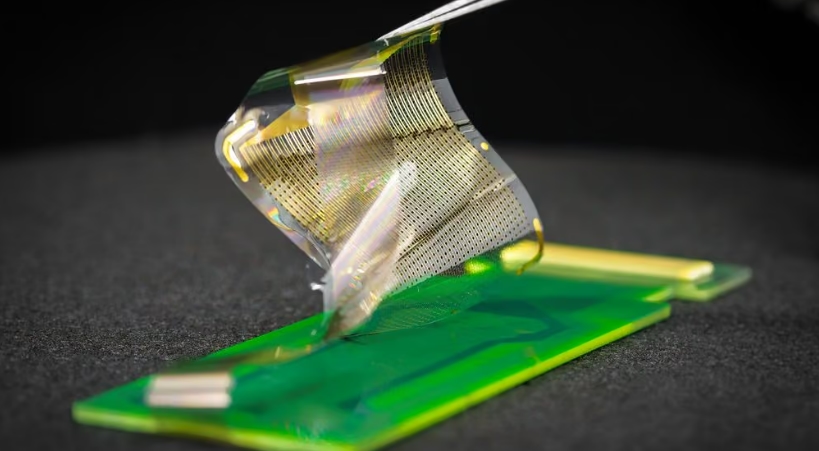
During surgery, each patient had a 256-channel electrode grid placed on the cerebral cortex. They were asked to speak a syllable aloud, then to imagine it — no sound, no movement. The trial ran in two stages: overt speech, then imagined speech.
The article is careful to note what this is not. It used a small set of syllables, not continuous speech. Whether the method scales to a larger vocabulary remains to be determined. This is a proof of concept, not a speech prosthetic.
What the recordings actually showed
Two patterns underlie the result. In the planning zones of the frontal and parietal lobes, the same activity appeared whether the syllable was spoken or merely imagined. The brain, it seems, does not much care whether you actually say the word or just think about saying it — at least not in the planning stage.
In the motor cortex strip, however, the picture was messier. Individual electrodes responded only to imagined speech, scattered among those tracking real articulation. They did not form their own map. The motor cortex, in other words, is not a tidy bureaucracy.
The authors reference earlier work in which imagined speech was decoded using thinner electrodes that penetrate the cortex and register individual neurons. The grids used here sit on the surface. Their decoder also handled syllables it had not been trained on — a detail worth noting, because generalization is where many decoding studies quietly fail.
Why this matters — and why it does not, yet
The stated aim is to help develop brain-computer interfaces that could restore communication for people with severe speech impairments — after a stroke, or with motor neuron disease such as ALS. These are people who can still form language internally but cannot produce it. The gap between intention and output is where the tragedy lives. If surface recordings can bridge even a small part of that gap, it is worth the effort.
But the caveats are real. Nine patients. A small syllable set. Surface grids, not penetrating electrodes. And a decoder that, while generalizing to untrained syllables, has not yet been tested on anything resembling natural speech.
So: a promising result, carefully hedged, published in a serious journal. The kind of science that does not shout. It simply records, decodes, and waits for the next experiment.