
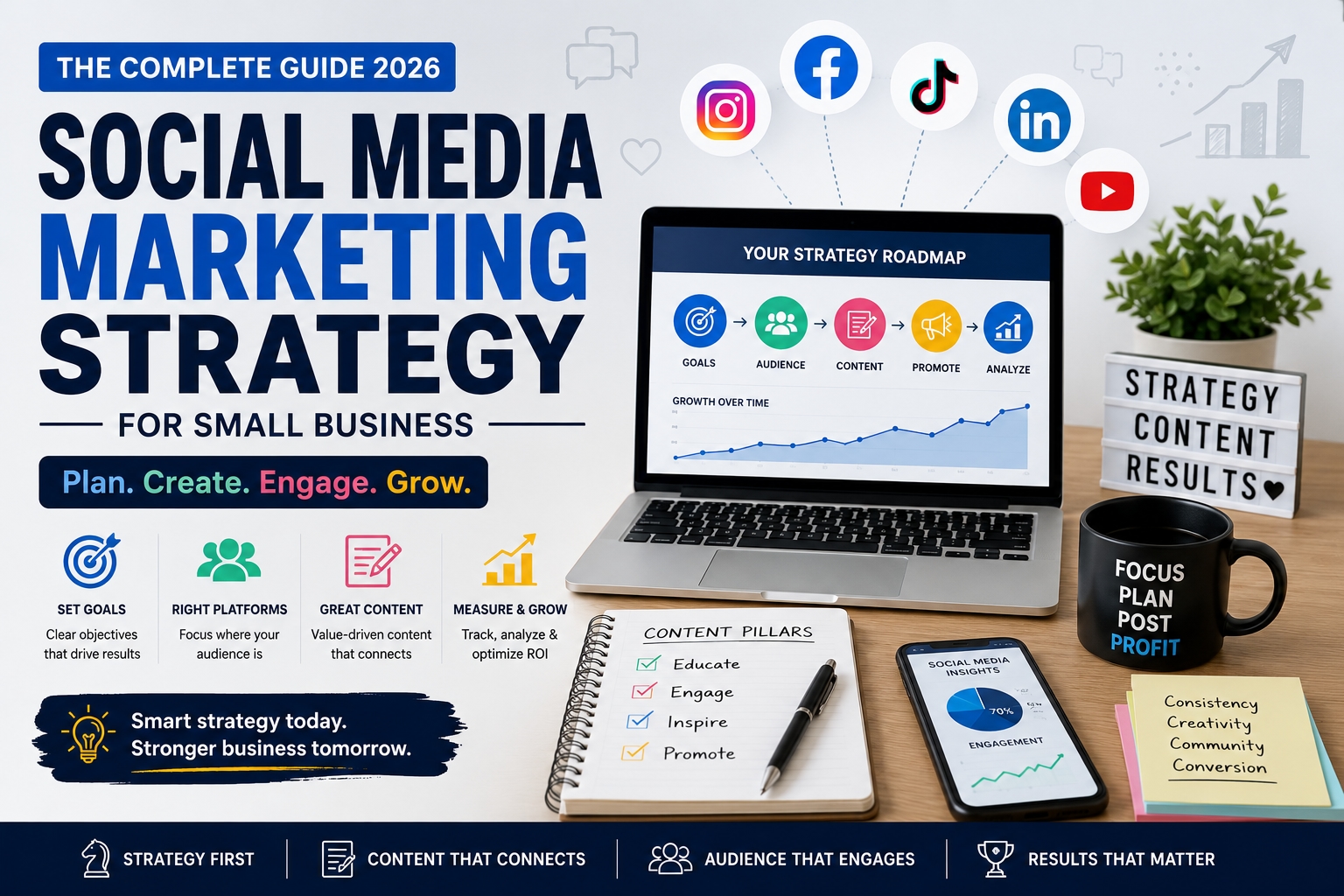
An effective social media strategy for a small business in 2026 comes down to five core steps:
(1) set clear, measurable goals instead of vague ones like "get more followers (2) focus on just two or three platforms where your actual target audience spends time, rather than spreading yourself thin across every network, (3) build consistent content pillars around educating, entertaining, and promoting, (4) prioritize short-form video, since it remains the highest-ROI content format going into 2026, and (5) track revenue-linked metrics — leads, conversions, cost per acquisition — instead of vanity metrics like likes. The rest of this guide breaks down exactly how to execute each step, with current industry data to back it up.
Table of Contents
Why a Documented Strategy Matters More Than Ever in 2026
Step 1 — Set the Right Goals
Step 2 — Choose the Right Platforms
Step 3 — Build Your Content Pillars
Step 4 — Prioritize the Right Content Formats
Step 5 — Balance Organic and Paid Social Media
Step 6 — Build a Real Content Calendar
Step 7 — Measure Analytics and ROI Properly
Tools That Make This Easier
Common Mistakes Small Businesses Make
A Realistic 30-Day Starter Plan
FAQs (People Also Ask)
Conclusion and Next Steps
E-E-A-T & Content Quality Notes
1. Why a Documented Strategy Matters More Than Ever in 2026
Most small business owners approach social media the same way: they post when they remember to, share whatever feels relevant that day, and hope something sticks. There's no written plan, no clear goal behind each post, and no system for measuring whether any of it is actually working.
The data shows this "post and hope" approach leaves real money on the table. Businesses with an active social media presence generate roughly twice as many leads on average compared to businesses without one, and social media marketing delivers a 100% higher lead-to-close rate than traditional outbound methods like cold calling and direct mail. (Source: Socioapt, 2026)
What's even more telling is how few businesses actually have a plan in place. Despite near-universal adoption of platforms like Facebook, only about 26% of small businesses have a documented social media strategy. (Source: Socioapt, 2026) That means roughly three out of every four small businesses on social media are essentially improvising.
This gap is actually good news if you're reading this article. It means you don't need a bigger budget or a bigger team to outperform most of your competitors — you just need a clearer plan than they have, and the discipline to follow it consistently.
It's also worth noting that 2026 is shaping up to be a year where artificial intelligence plays a much bigger role in how marketing gets planned and executed. Marketers are increasingly using AI tools to automate repetitive workflows, generate first drafts of content, analyze audience data, and fine-tune campaign performance — which means the businesses that combine a clear human strategy with smart use of AI tools tend to move faster than those relying on either alone.
2. Step 1 — Set the Right Goals
Before you write a single post, answer one question honestly: what do I actually want social media to do for my business?
Vague goals like "grow our following" or "be more active online" don't give you anything to measure, and they don't tell you what kind of content to prioritize. Instead, pick one or two specific, measurable goals from a list like this:
Brand awareness — more people recognizing your name and what you offer
Website traffic — driving visitors from social platforms to your site
Lead generation — capturing emails, form fills, or DMs from interested prospects
Direct sales — driving purchases through shoppable posts or links
Customer support and retention — using social channels to answer questions and keep existing customers engaged
Community building — creating a loyal audience that engages repeatedly, not just once
Once you've picked a primary goal, work backward to define what success actually looks like. If your goal is sales, your key metric shouldn't be likes — it should be click-through rate, conversion rate, and cost per acquisition. If your goal is brand awareness, reach and impressions matter more, but you should still track whether that awareness eventually turns into branded search volume or direct traffic.
A simple way to frame this: every goal needs a number attached to it. "Grow our email list" is a wish. "Get 200 new email signups from Instagram over the next 90 days" is a goal you can actually plan around and measure.
3. Step 2 — Choose the Right Platforms
One of the biggest mistakes small businesses make is trying to be everywhere at once. You don't need to be active on every platform — you need to be active where your specific audience already spends their time, and you need enough consistency on those platforms to actually build momentum.
Recent industry research gives some useful direction here. Instagram and Facebook currently warrant the most investment for most brands, while LinkedIn deserves its own dedicated B2B strategy separate from the broader social content calendar. (Source: HubSpot 2026 Social Media Marketing Report) That doesn't mean every business needs all three — it means you should match the platform to your audience and business type, not to what's trendy.
Here's a simplified way to think about platform selection:
Instagram — strong for visually-driven products, lifestyle brands, food, fashion, beauty, and local businesses that rely on repeat, engaged audiences.
Facebook — still valuable for local businesses, community groups, and slightly older demographics; also has one of the most mature advertising systems available.
TikTok — best for reaching younger audiences and for brands that can commit to fast, authentic, short-form video content.
LinkedIn — essential for B2B businesses, consultants, agencies, and anyone selling to other businesses rather than individual consumers.
YouTube (including Shorts) — valuable for education-heavy or how-to businesses, and for long-term discoverability since YouTube content is searchable for years.
Pinterest — strong for businesses in home decor, recipes, fashion, weddings, and other visually-inspired, planning-heavy purchase categories.
It's worth noting that larger, more resourced brands often run five or more channels at once. Recent data shows that 68.9% of brands actively use five or more marketing channels. (Source: HubSpot, 2026) But that number reflects businesses with dedicated marketing teams and budgets. For a small business owner wearing five different hats, trying to replicate that from day one is a recipe for burnout and inconsistent posting. Start with one or two platforms, get genuinely good at them, and expand only once that foundation is solid.
4. Step 3 — Build Your Content Pillars
Content pillars are the small number of recurring themes that every piece of content you post should fall under. Without pillars, content becomes reactive and random — you post whatever crosses your mind that day, which makes it hard for your audience to know what to expect from you, and hard for you to plan ahead.
A simple, proven framework is the three-pillar model:
A) Educate
Share tips, how-tos, behind-the-scenes processes, and insights related to your industry. This is the content that builds trust and positions you as knowledgeable, not just someone trying to sell something.
B) Entertain
Relatable moments, humor, trending formats, and personality-driven content. This is what keeps people scrolling, engaging, and sharing — and it's often what introduces new people to your brand in the first place.
C) Promote
Direct product or service content — offers, launches, testimonials, and calls to action. This content matters, but it should generally make up no more than 20–30% of your overall posting mix. An account that's constantly selling tends to lose followers faster than it gains customers.
Once you have your three pillars defined, break each one down into 4–5 specific content ideas you can rotate through. For example, if you run a small bakery, your "Educate" pillar might include baking tips, ingredient breakdowns, and answers to common customer questions; your "Entertain" pillar might include behind-the-scenes kitchen moments or trending audio paired with your products; and your "Promote" pillar might include new flavor launches, limited-time offers, and customer reviews.
The same logic applies to almost any small food business. A local pizzeria, for instance, could use its "Educate" pillar to show how dough is prepared or how toppings are sourced; its "Entertain" pillar to post fun, fast-paced kitchen clips; and its "Promote" pillar to unveil something as simple as a new set of custom empty pizza boxes featuring the brand's logo and colors — a small branding touch that photographs well, reinforces recall every time a customer orders delivery, and gives followers a tangible reason to comment and share.
5. Step 4 — Prioritize the Right Content Formats
Choosing the right format matters just as much as choosing the right message. Going into 2026, the data is unusually clear on this point.
Among the highest-ROI content formats for 2026, short-form video leads by a wide margin, followed by long-form video, live streaming, and blog posts. (Source: HubSpot 2026 State of Marketing Report) This trend is echoed across multiple industry reports. According to 2026 marketing data, 60% of marketers now use short-form video as part of their content strategy — making it the most widely used format, the top-ROI format, and the format receiving the largest share of planned investment going forward. (Source: HubSpot, 2026)
That doesn't mean written content is dead — small businesses are actually 23% more likely than average to see strong ROI from blog posts, and website/blog/SEO remains the number one ROI-generating channel overall according to marketers, closely followed by paid social media. (Source: HubSpot 2026 State of Marketing Report) The takeaway isn't "abandon everything except video." It's that video should be your primary format for social platforms specifically, while a blog or website content remains a critical complementary channel for long-term, compounding SEO traffic.
Practical allocation for a small business just getting started:
60–70% of content effort on short-form video (Reels, TikTok, YouTube Shorts)
15–20% on static images and carousels for platforms/audiences that respond well to them
10–15% on written content — blog posts, long captions, and community posts that support your SEO and give AI search tools something substantive to reference
One more trend worth planning around: community, not just content, is becoming a differentiator. 85% of marketers now agree that building an active online community is crucial to a successful social media strategy, and 40% plan to invest more in community building in 2026 than they did the previous year. (Source: HubSpot, 2026) Communities — whether that's an engaged comment section, a private group, or a loyal set of repeat customers who interact with every post — generate organic feedback, amplify content without any extra spend, and create the kind of familiarity that turns occasional buyers into repeat customers.
6. Step 5 — Balance Organic and Paid Social Media
Relying purely on organic content is a slow, and increasingly unreliable, growth strategy on its own. Algorithms shift constantly, reach fluctuates unpredictably, and a strategy built entirely on hoping the algorithm favors you is fragile. A more sustainable approach blends both organic and paid efforts, each doing a different job:
Organic content builds trust, nurtures your existing community, and establishes your brand's voice and personality over time. It's slower, but it compounds.
Paid content delivers fast, targeted reach to specific audiences and can be tightly measured against real business outcomes like leads and sales.
The return on paid social spend, when targeting is done well, can be genuinely strong. For small-to-mid-size businesses running Facebook and Instagram ad campaigns, the average return on ad spend sits around 4-to-1 — meaning roughly four dollars returned for every one dollar spent, according to industry data. (Source: Socioapt, citing Insider Intelligence, 2026)
That figure varies significantly by industry, offer, and how well the campaign is targeted, but it illustrates an important point: even a modest ad budget, spent with clear targeting and a specific goal, can meaningfully outperform organic-only efforts — especially in the early stages when you don't yet have an existing following to lean on.
A reasonable starting approach for a small business: spend the first 60–90 days building a foundation of organic content and understanding what resonates with your specific audience, then introduce a small, controlled paid budget to boost your best-performing organic posts and test targeted campaigns around a specific offer or goal.
7. Step 6 — Build a Real Content Calendar
A content pillar strategy only works if it's actually scheduled and followed. This doesn't need to be complicated — a simple spreadsheet or a free planning tool is enough for most small businesses. At minimum, your calendar should track:
Date and platform for each post
Content pillar it falls under (educate, entertain, or promote)
Format (short-form video, image, carousel, story, etc.)
Caption/hook idea
Call to action (what you want the viewer to do next)
Status (idea, drafted, scheduled, posted)
Batch-creating content — for example, filming five to seven short videos in a single afternoon — is far more sustainable than trying to create something new every single day. This is especially useful for small business owners who are also handling operations, customer service, and everything else that comes with running a business.
A realistic starting cadence for most small businesses is 3–5 posts per week on your primary platform, plus daily engagement (responding to comments and DMs), rather than trying to post daily from day one and burning out within a month.
8. Step 7 — Measure Analytics and ROI Properly
Many small businesses stop at vanity metrics — likes, followers, impressions — without ever connecting that activity back to actual business results. The real question should always be: is this activity moving the needle on revenue, leads, or retention?
This is a widely acknowledged challenge across the industry, not just for small businesses. Only about 37% of marketers say it's easy to connect social media activity to concrete business outcomes. (Source: HubSpot 2026 Social Media Marketing Report) If even well-resourced marketing teams struggle with this, it's worth being intentional about it from the start rather than treating it as an afterthought.
To close that gap, focus on a few practical habits:
Use UTM parameters on every link you share, so you can see exactly which platform and which post drove traffic to your site.
Track intent signals beyond reach — DM inquiries, branded search volume (people searching your business name directly), and social share of voice all indicate real interest, not just passive viewing.
Build a simple monthly report that follows the full funnel: reach → engagement → website clicks → leads → sales. Reviewing this every month (not just glancing at follower counts) is what actually lets you refine your strategy over time.
Revisit your goals quarterly. What worked in month one may need adjusting by month four as you learn more about what your specific audience responds to.
9. Tools That Make This Easier
You don't need an expensive marketing stack to run a solid social media strategy. A lean, small-business-friendly toolkit typically includes:
A scheduling tool to plan and queue posts in advance, so you're not manually posting every day in real time.
A simple design tool for creating graphics, thumbnails, and branded templates without needing a designer for every post.
A basic analytics dashboard — many platforms provide this natively, and it's often enough for a small business to start with before investing in third-party analytics software.
A shared content calendar (even a free spreadsheet works) so that if you ever bring on a freelancer or team member, they can plug into an existing system rather than starting from scratch.
The goal isn't to collect tools — it's to remove enough friction that consistency becomes realistic given your actual time and resources.
10. Common Mistakes Small Businesses Make
Posting the same content, unedited, across every platform. Each platform has its own style, audience expectations, and content format norms — what works natively on TikTok often falls flat when reposted as-is on LinkedIn.
Posting almost exclusively promotional content. An account that only sells tends to lose followers faster than it converts them.
Inconsistent posting. One post a week, followed by three weeks of silence, rarely builds any meaningful momentum with an algorithm or an audience.
Ignoring analytics entirely. Without reviewing what's actually working, you're guessing — and guessing rarely scales.
Spreading effort across too many platforms at once, rather than doing a genuinely good job on one or two.
Treating social media as a one-way broadcast channel instead of engaging with comments, messages, and community — which is often where the real relationship-building (and sales) happens.
Chasing every trend regardless of fit. Not every viral format suits every brand; forcing it can feel inauthentic and actually hurt trust.
11. A Realistic 30-Day Starter Plan
If you're starting from scratch, here's a simple way to structure your first month:
Week 1 — Foundation Define your primary goal, pick one or two platforms, and outline your three content pillars with 4–5 specific ideas under each.
Week 2 — Content Batch Set aside a few hours to batch-create your first two weeks of content, focused primarily on short-form video, using your content pillars as a guide.
Week 3 — Launch and Engage Start posting on your chosen cadence (3–5 times per week), and prioritize responding to every comment and message within 24 hours.
Week 4 — Review and Adjust Look at your basic analytics: which posts got the most engagement, clicks, or inquiries? Double down on what worked, and drop or adjust what didn't. Use this insight to plan month two.
This structure keeps things manageable while still building the habit of consistency, which is ultimately what separates the businesses that see results from those that give up after a few weeks.
12. FAQs (People Also Ask)
Q1: How often should a small business post on social media? Consistency matters more than raw volume. Three to five quality posts per week on your primary platform, aligned with your content pillars, is generally enough to build momentum without becoming unsustainable.
Q2: Do I need paid ads, or is organic content enough? A combination works best. Organic content builds long-term trust and community; paid ads accelerate reach and can be tightly targeted toward specific, measurable goals like leads or sales.
Q3: What's the most effective content format going into 2026? Short-form video is currently the most widely used and highest-ROI content format across platforms, though blog content and long-form video remain valuable, especially for SEO and deeper storytelling.
Q4: How long does it take to see results from social media marketing? Organic growth typically takes three to six months of consistent effort to show clear results. Paid campaigns can show measurable results — clicks, leads, sales — within days to a few weeks, since they're not dependent on algorithmic reach.
Q5: How many social media platforms should a small business be on? Start with one or two platforms where your specific target audience is genuinely active, rather than spreading thin across five. Expand only once you have a consistent, working system on your primary platform.
Q6: What metrics actually matter for a small business? Metrics tied to your specific goal — website clicks, lead form submissions, DM inquiries, and sales — matter far more than likes or follower counts alone.
13. Conclusion and Next Steps
Success in social media marketing rarely comes down to a secret trick or a viral moment. It comes down to clarity and consistency: the right goals, the right platform, the right content pillars, the right format mix, and a habit of actually reviewing your results instead of posting blindly. You don't need a large budget to compete — you need a documented plan that you're willing to follow for months, not days.
Your next step: Write a simple one-page social media plan for your business today — your primary goal, your chosen platform(s), your three content pillars, and your posting schedule. Commit to following it consistently for the next 30 days before making major changes, and use the analytics habits in this guide to decide what to adjust going into month two.
14. E-E-A-T & Content Quality Notes (Aligned With Google's Guidelines)
This guide has been structured with Google's helpful-content principles in mind. Google's own documentation is explicit on this point: Google's automated ranking systems are designed to prioritize content that's genuinely helpful and reliable for people, rather than content created primarily to manipulate search rankings. (Source: Google Search Central)
If you're publishing content like this on your own website, a few practical steps will strengthen how both Google and AI search tools evaluate it:
Add a real example or case study from your own business — this demonstrates first-hand Experience, one of the four pillars of E-E-A-T (Experience, Expertise, Authoritativeness, Trustworthiness).
Include an author bio with relevant credentials to reinforce Expertise and Authoritativeness.
Mark up your FAQ section with FAQ schema so search engines and AI tools can parse and surface it directly.
Update the content periodically as platforms, formats, and data evolve — refreshed, up-to-date content consistently outperforms content that's published once and never revisited.
Cite your sources, as this guide does, rather than presenting statistics without attribution — this builds trust with both readers and ranking systems.
Sources Cited in This Article
Socioapt — Social Media Marketing Statistics for Small Businesses (2026)
HubSpot — 2026 Social Media Marketing Report
HubSpot — How to Create a Great Social Media Strategy in 2026
HubSpot — 2026 Marketing Statistics, Trends & Data
HubSpot — The Future of Social Media: What Marketers Need to Know in 2026
Google Search Central — Creating Helpful, Reliable, People-First Content




