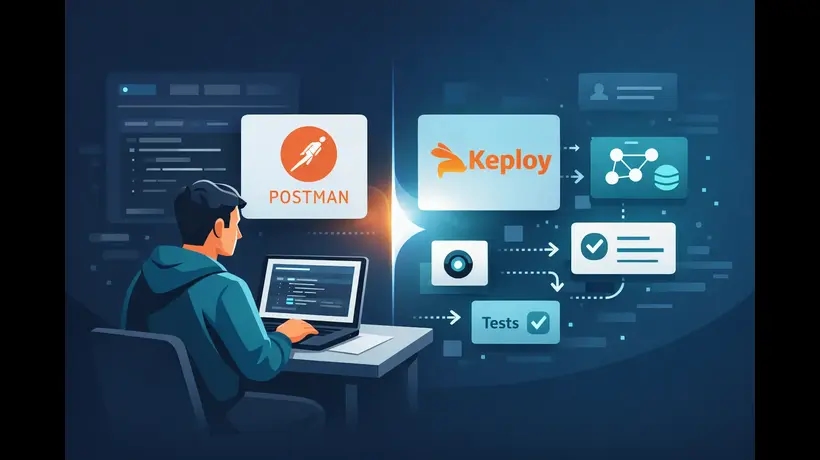
The decision to look for a postman alternative usually starts with a specific frustration. Maybe it's the pricing. Maybe it's the collection management headache. Maybe it's that the CI integration feels like it was added as an afterthought. But the specific frustration points toward a specific solution, and picking a replacement without being clear about which problem you're solving means trading one set of limitations for a different one.
The honest picture of the alternatives market is that different tools are genuinely better for different workflow needs, and no single tool is universally superior to Postman across every dimension. What's true is that for most specific use cases, there's something better calibrated.
For Teams Whose Main Problem Is Version Control
If the frustration with Postman traces back to collections that exist outside the codebase, sync that breaks down, or test coverage that lives in a separate system from the code it covers, Bruno addresses this problem more directly than any other tool in the space.
Bruno stores collections as plain text files on the local filesystem. They go in the same Git repository as the code. They get reviewed in the same pull requests. They have the same history. When a developer changes an endpoint, updating the corresponding Bruno collection file is part of the same commit. The divergence between code and tests that accumulates invisibly in Postman simply doesn't happen with Bruno because the storage model makes it a version control problem rather than a synchronization problem.
The tradeoff is that Bruno is a desktop-only, offline-first client. There's no cloud collaboration, no shared workspace, no web interface. For teams that want their tests in Git anyway, this is fine. For teams that need cloud-based sharing as a primary workflow, it's a significant gap.
For Teams Whose Main Problem Is Pricing and Simplicity
Hoppscotch is the answer when the primary concern is cost and the primary use case is manual exploration. It runs in the browser without installation, requires no account to use in its basic form, supports REST, GraphQL, WebSocket, and SSE, and is fully open source with a self-hosted option for teams that need everything on their own infrastructure.
It's not an automation platform. The test scripting capabilities are basic compared to Postman's, and the CI integration story is limited. But for the "I need to fire requests at an API and see what comes back" workflow, it's faster and cleaner than Postman and costs nothing.
For Teams Whose Problem Is the Testing Model Itself
There's a version of the Postman frustration that isn't really about the client at all. It's about the fact that manually writing request-response tests doesn't scale, doesn't reflect real usage, and requires constant maintenance to stay current with the API it's supposed to cover.
Keploy approaches this from a different angle entirely. Rather than providing a better place to write manual tests, it captures real API traffic and generates test cases from that traffic automatically. The tests reflect what the system actually does rather than what developers predicted it would do. The mocks for downstream dependencies come from real responses. The coverage grows as traffic grows.
This doesn't replace the need for an API client for manual exploration and debugging. But it changes the regression testing layer from a maintenance burden to something that grows on its own.