
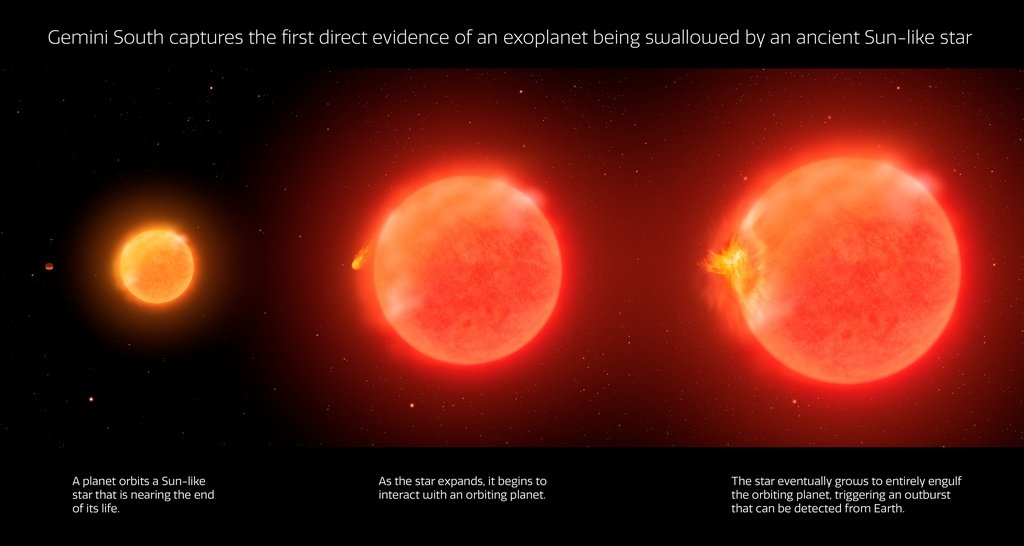
Theory has a clean prediction about aging stars: when a Sun-like star exhausts the hydrogen in its core, the core contracts, the outer layers balloon, and the star swells into a red giant. Anything orbiting closer than about one astronomical unit gets dragged inward by tides and swallowed. This is not a gap in the theory. It is the theory's cleanest prediction.
Three planets found years ago are still there.
A team led by Wen-Xu Lin of Yunnan University, with 11 colleagues, most at Yunnan University and the Yunnan Observatories of the Chinese Academy of Sciences, has reported three stars that appear to have made that climb while retaining a planet close in. The paper was published online Oct. 22 in the Proceedings of the National Academy of Sciences.
The planets are not the new part. HD 12648 b has been on the books since 2015, TYC 4282-605-1 b since 2017 and 24 Boo b since 2018, each detected by a different team through a slight rhythmic wobble in its star's motion, measured through shifts in its light. What is new is what those three stars turned out to be. Lin and colleagues read the stars' own pulsations, a technique called asteroseismology, to infer the evolutionary stage of each one. They classify all three as red-clump giants: stars burning helium in the core. A star reaches that state only after its helium ignites, following the red-giant ascent. Each of the three, the authors write, "has already undergone dramatic expansion and contraction following helium ignition."
So the expansion has happened, and the planets are still there. The paper reports that all three now orbit closer in than the maximum radius their host star is calculated to have reached during its expansion, "implying that they should not have survived."
24 Boo b is the extreme case. It orbits at 0.183 astronomical units, about a fifth of Earth's distance from the Sun, with an orbital period of 30 days. The authors call it the closest planet known around a red-clump giant. When Takuya Takarada and colleagues found the planet in 2018 with the spectrograph at Okayama Astrophysical Observatory, they measured its star at about ten times the Sun's radius. That is swollen, but nowhere near the star's former red-giant size, because it has already shrunk back.
How far inside the limit the planets lie can be assessed using an older calculation. In 2011, Kunitomo and colleagues calculated which planetary orbits around giants more massive than the Sun would lie inside the star as it expanded, deriving a survival limit below which tidal forces could draw a planet inward. They noted that no planet had then been found within 0.6 astronomical units of a clump giant and that every planet found by the surveys lay outside the limit. That is what the engulfment picture predicts. Two of the three host stars in the new study have estimated masses just under one solar mass, which matters because the survival limit is sensitive to stellar mass. These are the kinds of stars the prediction was designed to describe, and ours is one of them: Earth orbits at one astronomical unit.
The other two planets orbit farther out but are still well inside the predicted survival limit. TYC 4282-605-1 b, confirmed by González-Álvarez and colleagues using the HARPS-N and GIANO spectrographs at the Telescopio Nazionale Galileo, orbits an evolved giant at 0.422 astronomical units. HD 12648 b has the widest orbit of the three, and the 2015 survey paper that announced its discovery, by Lee and colleagues, named a second planet that matters here more.
That planet is 8 Ursae Minoris b, the single "forbidden" planet the new paper says had been identified before these three. Marc Hon and colleagues reported in Nature in 2023 that its host, too, is a giant burning helium in its core, with the planet at 0.5 astronomical units around a star that standard single-star evolution says should once have reached a radius of 0.7 astronomical units. They did not conclude that something is missing from planetary physics. They proposed that the star never finished the climb: a merger with another star could have ignited its helium early or could have produced 8 Ursae Minoris b afterward as a second-generation planet.
Lin and colleagues make a stronger claim about their three systems. The paradox, they write, "is not an isolated anomaly" but "signals the emergence of a class of evolved planetary systems," whose survival "points to unexplored physics shaping planetary architectures around post-RGB stars." That last phrase identifies what remains unexplained without establishing that new physics is needed, and the merger route is still on the table. If these three hosts have histories like 8 Ursae Minoris, the missing piece could lie in how those particular stars evolved, not in how planets survive.
Telling the two apart means applying this paper's approach to more red-clump giants: find the planet first, then ask the star's pulsations where it has been. Few stars have both answers in hand yet, which is why one awkward case remained an isolated puzzle for so long.




