
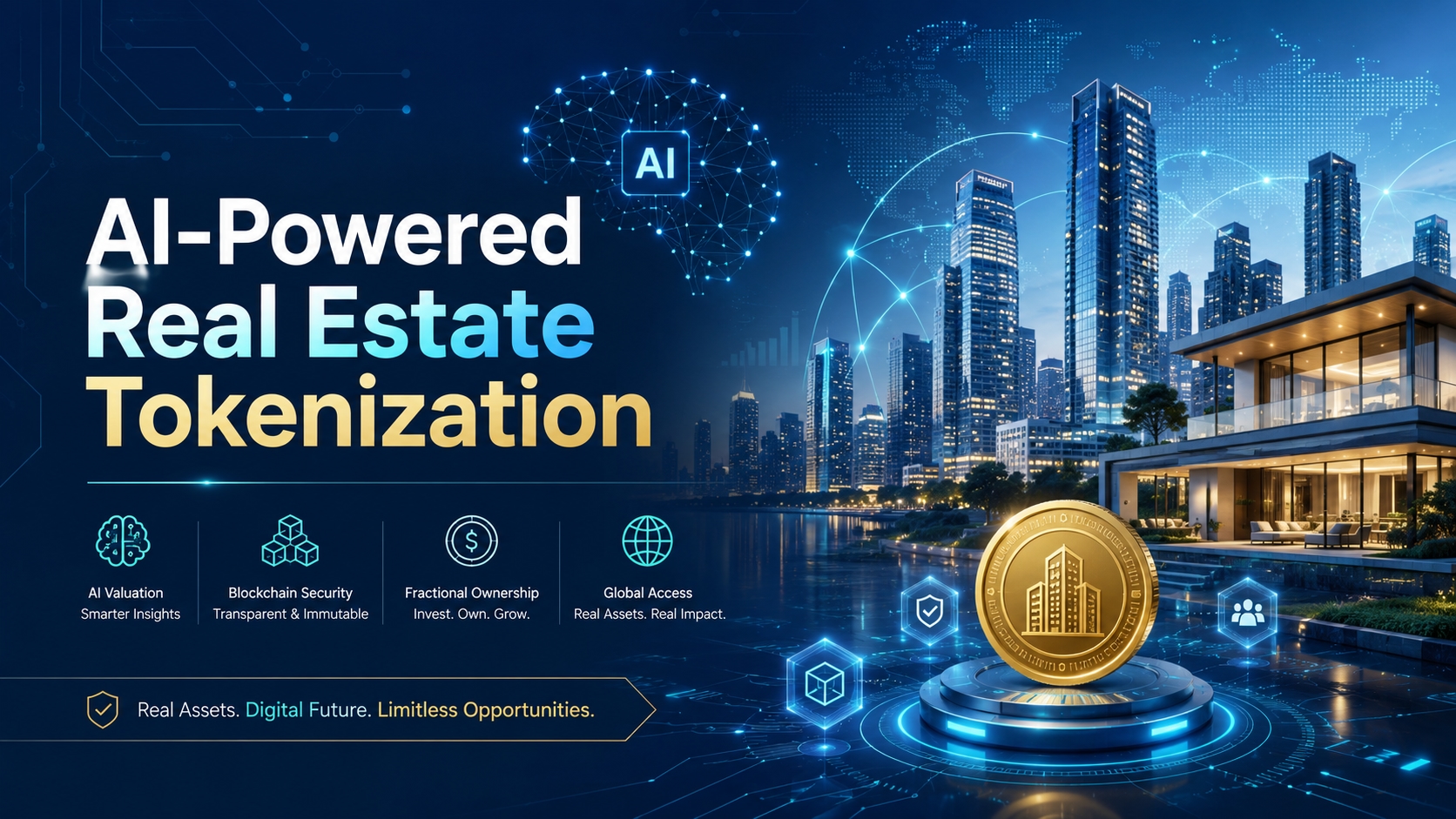
The real estate sector has traditionally been known for high capital requirements, lengthy paperwork, limited liquidity, and slow transaction processes. Over the last few years, blockchain-based tokenization has started transforming the industry by converting physical property assets into digital tokens that represent fractional ownership. In 2026, the integration of artificial intelligence into these tokenization systems is taking this transformation to a much higher level. AI-powered real estate tokenization platforms are not only digitizing property ownership but also making investment decisions smarter, faster, safer, and more scalable.
The combination of artificial intelligence and blockchain technology is redefining how investors discover, evaluate, manage, and trade real estate assets. These platforms use machine learning, predictive analytics, automation, natural language processing, and computer vision to optimize every stage of the tokenization lifecycle. From property valuation and compliance checks to fraud detection and investor personalization, AI is helping tokenized real estate ecosystems become more intelligent and efficient.
Understanding AI-Powered Real Estate Tokenization
Real estate tokenization refers to the process of converting ownership rights of a physical property into blockchain-based digital tokens. Each token represents a fractional share of the asset, allowing investors to own a percentage of a property instead of purchasing the entire building or land parcel.
When artificial intelligence is integrated into these systems, the platform gains the ability to analyze huge datasets, automate operations, predict market movements, and improve decision-making. AI can evaluate property performance, identify investment opportunities, detect suspicious activities, optimize pricing models, and automate investor communications in real time.
This combination creates a more transparent, accessible, and intelligent investment environment for both retail and institutional participants.
Enhanced Property Selection Through Predictive Analytics
One of the biggest advantages of AI-powered real estate tokenization platforms is their ability to identify high-potential properties before they become mainstream investment opportunities. Traditional real estate analysis often depends on manual research, broker insights, and historical comparisons. AI systems can process far larger volumes of data with much greater speed and accuracy.
Modern AI platforms evaluate infrastructure developments, employment growth, rental demand, population movement, permit approvals, tourism activity, and regional economic indicators simultaneously. Machine learning models identify patterns that humans may overlook and use them to forecast future appreciation potential.
This predictive capability helps tokenization platforms onboard stronger assets into their ecosystem. Investors benefit because they gain access to properties that are selected using data-driven intelligence rather than assumptions or limited market visibility.
AI also enables micro-market analysis. Instead of evaluating an entire city broadly, algorithms can analyze specific neighborhoods, districts, or commercial corridors to identify the best-performing zones for long-term returns.
Accurate Real-Time Property Valuation
Traditional property valuation methods can be slow, inconsistent, and highly dependent on human judgment. AI-powered valuation systems improve pricing accuracy by continuously monitoring real estate data across multiple sources.
Machine learning algorithms analyze comparable sales, rental trends, occupancy rates, infrastructure development, demographic changes, and economic indicators to estimate fair market value. Some platforms even use satellite imagery and computer vision technologies to evaluate building conditions and neighborhood improvements.
This real-time valuation capability offers several advantages:
Investors receive more transparent pricing information.
Token prices better reflect current market conditions.
Asset managers can react quickly to changing market trends.
Overvaluation and undervaluation risks are reduced.
Continuous AI-driven valuation updates also improve secondary market efficiency because token prices remain aligned with underlying asset performance.
Improved Liquidity for Traditionally Illiquid Assets
Real estate has historically been considered one of the most illiquid asset classes. Selling a property often takes weeks or months and involves multiple intermediaries. AI-powered tokenization platforms significantly improve liquidity by enabling fractional ownership and digital trading.
Tokenization divides large assets into smaller units that can be traded more easily. AI further enhances liquidity by analyzing market demand, trading behavior, investor activity, and price movements to optimize trading environments.
AI systems can predict liquidity trends and recommend optimal pricing strategies to maintain healthy trading volumes. Some platforms also use automated market-making algorithms to improve transaction efficiency and reduce price volatility.
This improved liquidity benefits both investors and property owners. Investors gain greater flexibility to enter or exit positions, while property owners can access capital faster without selling entire assets.
Lower Investment Barriers Through Fractional Ownership
AI-powered tokenization platforms are democratizing access to real estate investments. Instead of requiring millions of dollars to purchase premium commercial or residential properties, investors can buy fractional shares with significantly smaller capital commitments.
Artificial intelligence improves this process by personalizing investment opportunities according to investor preferences, budgets, and risk tolerance. Recommendation engines analyze user behavior and investment goals to suggest suitable tokenized assets.
This accessibility expands the investor base dramatically. Retail investors, younger participants, and international buyers can now access high-value real estate markets that were previously limited to institutions or wealthy individuals.
Fractional ownership also allows investors to diversify their portfolios across multiple properties, regions, and asset types instead of concentrating capital into a single investment.
Automated Smart Contract Operations
AI-powered tokenization platforms heavily rely on blockchain smart contracts to automate operational processes. Smart contracts are self-executing agreements programmed to perform actions automatically when predefined conditions are met.
Artificial intelligence enhances these systems by monitoring transactions, validating conditions, and optimizing workflows. Automated operations may include:
Rental income distribution
Dividend payouts
Ownership transfers
Investor onboarding
Compliance checks
Voting rights management
Revenue-sharing calculations
Automation reduces administrative overhead and minimizes human error. Property managers and platform operators can handle thousands of investors efficiently without manual intervention.
Advanced Fraud Detection and Security
Security remains one of the most critical concerns in digital asset ecosystems. AI-powered fraud detection systems help protect tokenized real estate platforms from suspicious activities, cyber threats, and financial manipulation.
Machine learning algorithms monitor transaction patterns continuously and identify anomalies that may indicate fraud or unauthorized behavior. AI systems can flag unusual wallet activity, suspicious transfer requests, fake identities, or abnormal trading behavior in real time.
Some platforms also use biometric verification, facial recognition, and behavioral analytics to strengthen identity authentication during investor onboarding.
Faster and Smarter Compliance Management
Regulatory compliance is one of the most complex aspects of real estate tokenization. Platforms must comply with securities laws, anti-money laundering regulations, investor verification requirements, and cross-border legal frameworks.
AI simplifies compliance management through intelligent automation. Natural language processing tools can analyze legal documents, identify regulatory obligations, and monitor changes in compliance requirements across jurisdictions.
AI-driven compliance systems also automate:
KYC verification
AML screening
Risk scoring
Document validation
Jurisdiction-based investor restrictions
These automated workflows reduce operational costs and accelerate onboarding processes. Instead of taking days or weeks, investor verification can often be completed within minutes.
Faster compliance management enables tokenization platforms to scale more efficiently while maintaining regulatory integrity.
Personalized Investor Experiences
Artificial intelligence significantly improves user experience within tokenized real estate platforms. AI-driven personalization engines analyze investor behavior, financial goals, search activity, and portfolio preferences to provide customized investment recommendations.
Investors can receive:
Tailored property suggestions
Risk-adjusted portfolio recommendations
Personalized market insights
Automated investment alerts
Predictive performance analytics
This personalization improves investor engagement and simplifies decision-making for users who may not have extensive real estate expertise.
AI-powered chatbots and virtual assistants also provide instant support, answer investment questions, and guide users through onboarding or trading processes.
Greater Transparency and Data Accessibility
Transparency has long been a challenge in traditional real estate markets. AI-powered tokenization platforms improve visibility by combining blockchain transparency with intelligent data analysis.
Investors can access real-time information about:
Property performance
Occupancy levels
Rental income
Market trends
Asset appreciation
Transaction histories
AI dashboards transform complex datasets into easy-to-understand visual insights, helping investors make informed decisions quickly.
Blockchain records are immutable and publicly verifiable, while AI tools organize and interpret that information efficiently. This creates a more trustworthy investment environment with reduced information asymmetry.
Global Investment Accessibility
AI-powered tokenization platforms remove geographical barriers that traditionally restricted international real estate investment. Investors can participate in global property markets digitally without needing physical presence or extensive local infrastructure.
Artificial intelligence supports this globalization by:
Translating legal and investment documents
Automating currency analysis
Evaluating regional market conditions
Managing international compliance requirements
Assessing geopolitical risk
Cross-border investment becomes faster, more transparent, and more scalable.
This global accessibility benefits property developers as well because they can attract capital from a much broader investor audience.
Reduced Operational Costs
Traditional real estate investment processes involve brokers, banks, legal teams, escrow services, and multiple administrative layers. AI-powered tokenization platforms streamline many of these functions through automation.
Operational savings are achieved through:
Automated documentation
Smart contract execution
AI-driven customer support
Digital compliance verification
Reduced paperwork
Faster settlements
Lower operational expenses improve overall platform efficiency and may increase returns for investors over time.
AI also reduces repetitive manual tasks, allowing platform operators to focus on strategic growth and asset management.
Better Portfolio Diversification
AI-powered tokenization platforms make portfolio diversification easier and more efficient. Investors can allocate smaller amounts across multiple asset classes, geographic locations, and property types.
Machine learning algorithms can recommend diversification strategies based on market trends, investor goals, and historical performance data.
Investors may diversify across:
Residential properties
Commercial office spaces
Hospitality assets
Warehouses
Industrial facilities
Mixed-use developments
AI-driven portfolio analysis tools help investors balance risk exposure and identify underperforming assets more effectively.
Scalability for Large Real Estate Ecosystems
As tokenization adoption grows, platforms must handle increasing volumes of investors, transactions, and assets. AI enables scalability by automating operational processes and optimizing infrastructure performance.
Machine learning systems can dynamically allocate computing resources, detect bottlenecks, and improve transaction throughput. AI automation also allows platforms to manage thousands of investors simultaneously without requiring proportional increases in staffing.
This scalability is particularly important for enterprise-level tokenization ecosystems and institutional adoption.
Smarter Secondary Markets
Secondary trading markets are essential for liquidity in tokenized real estate ecosystems. AI enhances these marketplaces by analyzing trading activity, forecasting demand, and optimizing token pricing.
Advanced algorithms can detect market sentiment, monitor trading volumes, and identify emerging investor trends. Some platforms may use AI-driven matching engines to connect buyers and sellers more efficiently.
This intelligent trading infrastructure contributes to healthier markets with better price discovery and reduced inefficiencies.
The Future of AI-Powered Real Estate Tokenization
The integration of AI and blockchain is still evolving, but its impact on real estate is becoming increasingly significant. Industry forecasts suggest that tokenized real estate markets could grow substantially over the next decade as institutional adoption accelerates and regulatory frameworks mature.
Future advancements may include:
Autonomous property management systems
AI-generated investment portfolios
Real-time global property analytics
Decentralized AI investment advisors
Predictive urban development modeling
Intelligent digital asset insurance systems
As technology continues to advance, AI-powered tokenization platforms are expected to become more efficient, secure, and globally interconnected.
Conclusion
AI-powered real estate tokenization platforms are transforming property investment by combining blockchain transparency with intelligent automation and predictive analytics. These systems improve liquidity, reduce investment barriers, automate operations, strengthen security, simplify compliance, and create more personalized investor experiences.
By leveraging artificial intelligence, tokenized real estate ecosystems can analyze market trends more accurately, optimize asset management, and provide investors with data-driven insights that were previously difficult to access. Fractional ownership models are opening real estate markets to a broader global audience, while smart contracts and automation reduce inefficiencies across the investment lifecycle.