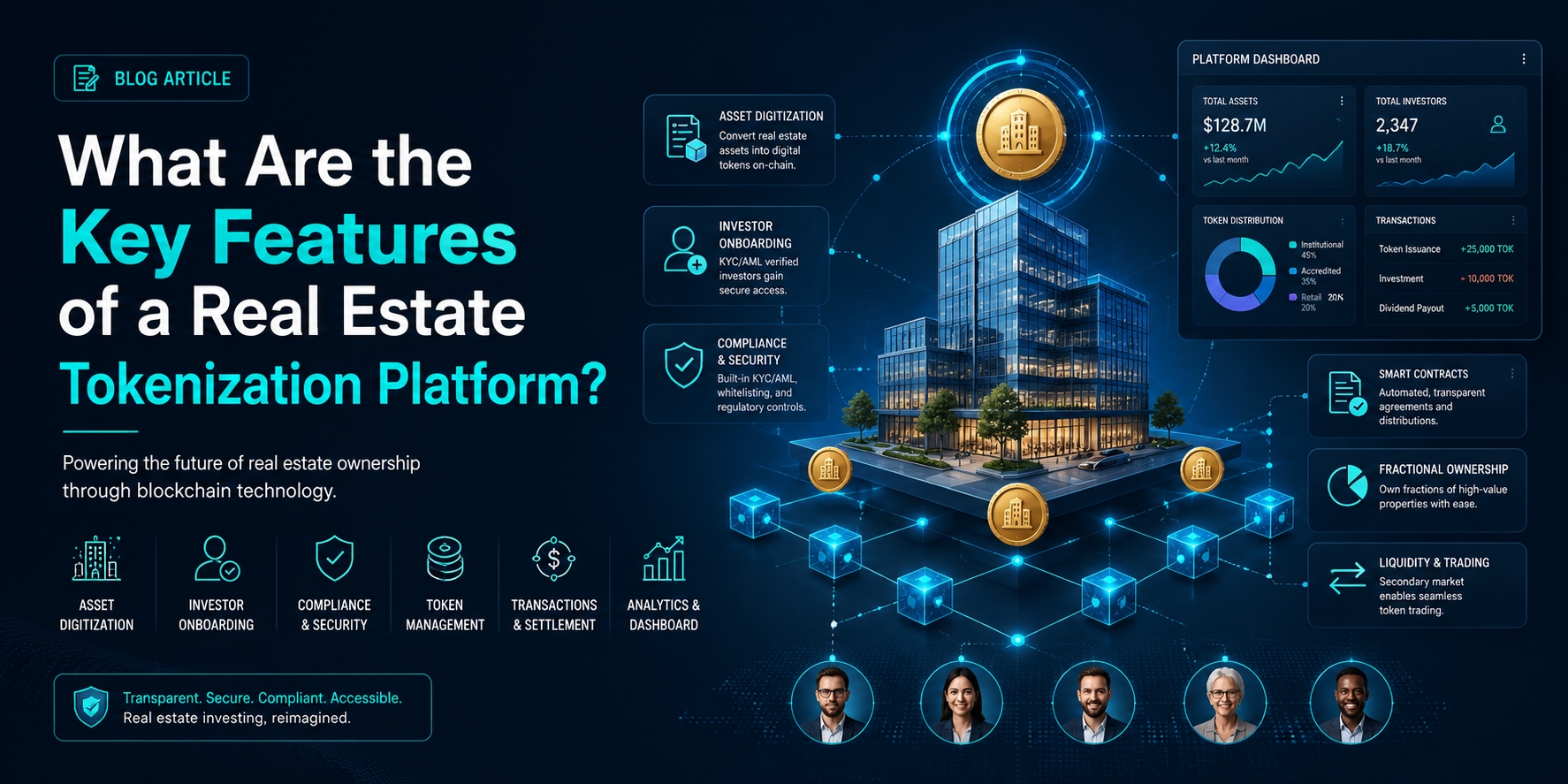
Real estate has traditionally been one of the most valuable asset classes, but investing in property has also involved significant barriers. High capital requirements, lengthy transaction processes, limited liquidity, geographical restrictions, extensive documentation, and complex ownership structures can make property investment difficult for smaller investors. Real estate tokenization is emerging as a technology-driven approach to address some of these challenges by representing ownership interests or economic rights associated with real estate through blockchain-based tokens.
A real estate tokenization platform brings together the technology, compliance, asset management, investor onboarding, and marketplace infrastructure required to create and manage these tokenized assets. Importantly, tokenization does not automatically change the legal nature of an underlying investment. For example, the U.S. Securities and Exchange Commission has emphasized that tokenized securities can remain securities and may therefore be subject to existing securities laws.
The technology is still developing, but the market is becoming more substantial. A 2026-revised BIS working paper analyzing U.S. tokenized real estate found that more than 800 property-level tokenized real estate properties had been recorded cumulatively by early 2025, representing roughly $175–180 million in associated value. The research also found that tokenization has been particularly active in areas with weaker traditional liquidity and more limited access to credit.
This evolution makes the architecture of a tokenization platform particularly important. A successful platform needs to do much more than generate digital tokens. It must establish a reliable connection between physical property, legal ownership, investor rights, blockchain infrastructure, compliance controls, and ongoing asset administration.
Understanding a Real Estate Tokenization Platform
A real estate tokenization platform is a digital ecosystem that enables property owners, developers, investment firms, and investors to interact with tokenized real estate assets. Depending on the structure, a property may be placed into a legal entity such as a special-purpose vehicle (SPV) or LLC, while blockchain tokens represent ownership interests, economic rights, or another legally defined claim associated with that structure.
The fundamental objective is to divide a traditionally illiquid asset into smaller digital units while creating an infrastructure for issuing, transferring, administering, and potentially trading those units.
For example, consider a commercial property valued at $10 million. Instead of requiring one investor to purchase the entire property, an appropriately structured offering could divide the economic interest into a large number of tokenized units. Investors could potentially acquire smaller interests, subject to applicable laws, offering restrictions, and the legal structure of the transaction.
The key point is that fractionalization alone is not enough. A credible platform needs mechanisms that determine who can invest, what investors legally own, how income is distributed, how transfers occur, and how the underlying asset is administered.
1. Property Onboarding and Asset Due Diligence
One of the most important features of a real estate tokenization platform is a comprehensive property onboarding system.
Before an asset can be tokenized, the platform should support the collection and verification of relevant property information. This can include ownership documents, title information, valuation reports, inspection records, insurance information, financial statements, rental agreements, tax information, liens, and other legal documentation.
This feature is critical because blockchain can make a record tamper-resistant, but it cannot automatically determine whether the original property information is accurate. The platform therefore needs a reliable due-diligence process connecting off-chain property information with the on-chain token.
A modern platform can provide a centralized property dashboard where administrators upload documents, complete verification procedures, establish the asset's valuation, define ownership structures, and approve the property before token issuance.
This creates a crucial bridge between real-world asset verification and blockchain-based representation.
2. Fractional Ownership and Token Issuance
Fractional ownership is arguably the feature most closely associated with real estate tokenization.
A tokenization platform should provide an issuance engine capable of converting an approved legal or economic interest into digitally represented units. The issuer should be able to configure parameters such as total token supply, token price, ownership limits, investor eligibility, distribution rights, transfer restrictions, and other offering-specific conditions.
For instance, a $5 million property could theoretically be represented by 500,000 tokens at an initial reference price of $10 each. The token structure, however, must correspond to clearly defined legal rights rather than simply creating 500,000 arbitrary blockchain assets.
This distinction is important because tokenization can take different forms. The SEC's 2026 statement explains that tokenized securities can be issuer-sponsored or created through third-party structures, and the rights associated with the token can vary depending on the model.
Therefore, a strong platform should make the relationship between the token and the underlying asset transparent.
3. Smart Contract Infrastructure
Smart contracts form the automation layer of a tokenization platform.
Rather than relying entirely on manual intermediaries for every transaction, smart contracts can execute predefined rules. These rules may govern token issuance, transfers, investor eligibility, distribution calculations, voting, redemptions, and other lifecycle events.
For example, if an offering permits only verified investors from specific jurisdictions to hold tokens, smart contracts can work alongside compliance systems to prevent unauthorized transfers.
Smart contracts can also automate income distributions. If a property generates rental income, the platform can calculate eligible distributions according to the ownership structure and facilitate payments according to predefined rules.
However, smart contracts must be carefully designed and audited. A coding error in an automated financial system can potentially create significant consequences. For that reason, smart contract auditing, access-control mechanisms, emergency procedures, upgrade governance, and comprehensive testing should be treated as core platform requirements rather than optional additions.
4. KYC, AML, and Investor Eligibility Management
Compliance is one of the most important characteristics separating a serious tokenization platform from a simple blockchain application.
Real estate token offerings can potentially fall within securities, property, investment, tax, and financial regulations depending on their structure and jurisdiction. Consequently, the platform needs an investor onboarding system that can support identity verification, Know Your Customer (KYC), Anti-Money Laundering (AML) screening, sanctions checks, accreditation verification where applicable, and jurisdiction-based eligibility rules.
The platform should ideally connect investor identity with blockchain wallet permissions without unnecessarily exposing sensitive personal information on a public blockchain.
Permissioned transfer mechanisms can be particularly useful. In a 2025 submission to the SEC, Securitize argued that tokenized securities can use whitelisted wallets and smart contracts to enforce lawful transfers and track ownership changes.
This illustrates an important principle: compliance should be integrated into the platform architecture rather than added after token issuance.
5. Secure Digital Wallet Integration
Investors need a secure way to receive, hold, transfer, and manage their tokenized real estate interests.
A platform may provide its own wallet infrastructure or integrate with external wallets, depending on its business model and regulatory requirements. The wallet should support appropriate authentication, transaction signing, asset visibility, and compliance controls.
For mainstream users, the platform should also hide unnecessary blockchain complexity. Investors should not need advanced knowledge of gas fees, blockchain explorers, private-key management, or smart-contract addresses simply to understand their investment.
A well-designed wallet dashboard could show:
Token holdings
Property ownership percentage
Current asset valuation
Distribution history
Transaction history
Available income
Governance proposals
Investment documents
Eligibility status
This combination of blockchain functionality and conventional financial UX is essential for adoption beyond technically sophisticated crypto users.
6. Transparent Property and Investment Dashboard
Transparency is another major platform requirement.
Investors should be able to evaluate an asset before committing capital. The platform can provide information such as property location, valuation, rental income, occupancy, historical performance, operating expenses, debt information, inspection reports, photographs, legal documents, and investment terms.
Lofty provides an example of this approach. Its current platform states that property listings include financial information, rent history, inspection reports, photos, and other investment information.
The objective is not simply to display attractive investment figures. Instead, the platform should give investors enough structured information to understand what they are purchasing and what risks are involved.
7. Automated Income Distribution
Income distribution is especially important for income-producing real estate.
A tokenization platform can automate the distribution of rental income or other property-generated cash flows according to predefined ownership rules. Instead of manually maintaining numerous investor records and calculating payments individually, smart contracts and backend financial systems can coordinate the process.
Suppose 1,000 investors collectively hold interests in a rental property. If the property generates distributable income, the platform can calculate each investor's entitlement based on their ownership percentage and distribute the appropriate amount.
Lofty's model demonstrates one practical implementation: the platform states that rental income is distributed to investors daily.
The exact distribution model will vary by legal structure and jurisdiction, but automation can significantly improve administrative efficiency.
8. Secondary Marketplace and Liquidity Features
One of the strongest arguments for tokenization is the potential to improve liquidity in traditionally illiquid real estate investments.
Traditional property transactions can involve brokers, negotiations, legal reviews, financing, title processes, and substantial settlement periods. Tokenized interests can potentially be transferred digitally, subject to legal and platform restrictions.
A tokenization platform can therefore include a secondary marketplace where eligible investors can buy and sell tokenized interests.
However, it is important not to describe tokenization as guaranteeing liquidity. A token can technically be transferable while still having limited buyers. Liquidity depends on market demand, regulatory restrictions, trading infrastructure, asset quality, and other factors.
BIS research provides an interesting perspective. Its analysis found that trading in tokenized properties increased by 35% cumulatively over the two days following certain disaster declarations, suggesting that tokenization can provide liquidity under specific conditions. However, the study also found that this effect depended on platform buyback mechanisms, which can introduce additional solvency risks.
This makes marketplace design and liquidity management important features rather than simple add-ons.
9. Governance and Voting Mechanisms
Real estate investments often involve decisions about repairs, property managers, refinancing, rent adjustments, renovations, or eventual asset sales.
A tokenization platform can integrate blockchain-based governance mechanisms that allow eligible investors to participate in defined decisions.
Voting rights can be based on token ownership, although the exact governance model depends on the legal structure.
Lofty, for example, describes a model where property ownership is held through property-specific LLCs and token holders receive voting rights associated with their ownership.
For larger institutional platforms, governance may be more complex and could involve trustees, asset managers, administrators, or regulated entities. The key requirement is that governance rights must be clearly documented and legally enforceable.
10. Asset Management and Lifecycle Administration
Tokenization does not end when tokens are issued.
A property continues to generate expenses, rental income, maintenance requirements, insurance obligations, tax considerations, refinancing events, and potentially corporate actions. Therefore, the platform should support the entire asset lifecycle.
This could include:
Property acquisition
Token issuance
Investor onboarding
Income collection
Distribution management
Property management
Governance
Ownership transfers
Reporting
Redemptions
Asset sale
Token retirement
This lifecycle approach is becoming increasingly important as tokenization moves beyond experimental projects. In 2026, a real estate technology filing describing a tokenization architecture included separate wallet, token engine, smart-contract, investment, and asset-registry layers for handling onboarding, issuance, transfers, distributions, governance, and asset records.
11. Blockchain-Based Asset Registry and Data Management
An asset registry provides a reliable record of the tokenized property's identity and lifecycle.
The registry can connect the blockchain representation with relevant off-chain documentation. For example, an asset record might reference a property's deed, valuation, inspection, insurance, ownership structure, and transaction history while keeping confidential information outside the public blockchain.
This hybrid architecture is important because storing every piece of real estate documentation directly on a public blockchain is neither practical nor necessarily desirable.
Instead, the blockchain can maintain verifiable references and transaction records while secure off-chain infrastructure stores sensitive documents.
12. Security, Auditing, and Fraud Prevention
Security needs to operate at multiple levels.
The platform should protect smart contracts, wallets, APIs, databases, user accounts, administrative controls, and financial transactions. Multi-factor authentication, role-based access controls, encryption, transaction monitoring, audit logs, penetration testing, and smart contract audits can all contribute to platform security.
Security also has a legal dimension. The SEC has emphasized that tokenized securities remain subject to investor-protection and securities-law considerations.
Therefore, platform security should not be viewed solely as a cybersecurity issue. It should also include custody, investor protection, operational resilience, disclosures, and recovery procedures.
13. Analytics, Reporting, and Investor Insights
Advanced analytics can make a tokenization platform significantly more useful.
Investors and administrators can use dashboards to monitor property valuations, rental yields, occupancy, distributions, transaction activity, portfolio diversification, and historical performance.
For property owners, analytics can help evaluate investor demand and funding performance. For investors, portfolio-level analytics can show how their tokenized real estate exposure is distributed across properties and geographical markets.
As the number of tokenized assets increases, analytics can become an important differentiating factor between platforms.
A Real-World Example: Lofty
Lofty provides a useful example of how several of these features can work together. The platform currently reports more than $100 million invested, more than 40,000 investors, and over $5.2 million distributed to investors. It offers fractional ownership of U.S. rental properties, property-specific ownership structures, daily rental distributions, and a marketplace for buying and selling shares.
An earlier Algorand case study reported that Lofty had tokenized 148 properties across 11 U.S. states, with an average of approximately 231 buyers per property at the time of the study.
The example demonstrates that a real estate tokenization platform is not simply a token generator. It combines property onboarding, fractional ownership, blockchain infrastructure, investor management, income distribution, governance, and marketplace functionality.
Why Compliance Should Be at the Core of Platform Design
Perhaps the most important lesson for developers and businesses is that blockchain functionality should follow the legal and economic structure of the investment rather than the other way around.
The legal rights represented by a token must be clearly defined. Depending on jurisdiction and structure, those rights might relate to ownership of an entity holding property, economic participation, debt, fund interests, or another financial arrangement.
The SEC's 2026 guidance makes clear that tokenization itself does not remove an asset from securities regulation when the underlying instrument qualifies as a security.
Therefore, businesses developing a platform should establish the legal structure, investor rights, compliance model, custody arrangements, and transfer restrictions before finalizing the technical architecture.
The Future of Real Estate Tokenization Platforms
The future of real estate tokenization is likely to involve increasingly integrated platforms rather than isolated token issuance systems.
Instead of simply converting property interests into blockchain tokens, next-generation platforms are likely to combine asset registries, compliance engines, digital identity, smart contracts, investor dashboards, custody, marketplaces, analytics, property management, and automated financial administration.
At the same time, industry research remains cautious. BIS notes that tokenization offers potential benefits such as efficiency, transparency, lower costs, and broader access, but also highlights regulatory uncertainty, operational complexity, and liquidity risks.
This balanced perspective is important. Tokenization is not a shortcut around the fundamental challenges of real estate investing. Rather, it is an infrastructure technology that can potentially make certain processes more programmable, transparent, divisible, and accessible when supported by appropriate legal and financial structures.
Conclusion
A well-designed real estate tokenization platform needs to combine fractional ownership, compliant token issuance, smart contracts, KYC/AML, secure wallets, property due diligence, automated income distribution, secondary-market functionality, governance, asset registries, analytics, and strong security into one integrated ecosystem. The strongest platforms will not compete simply on the ability to create tokens; they will differentiate themselves through legally sound ownership structures, investor protection, seamless user experiences, reliable asset data, and efficient lifecycle management. As the tokenized real estate market continues developing, businesses looking to enter this space need experienced technical and blockchain expertise to build infrastructure that can scale with regulatory and market requirements. Blockchain App Factory provides best-in-class real estate token development services and real estate tokenization solutions, helping businesses create secure, scalable, and feature-rich platforms designed around their specific business and investment requirements.