Imagine a company investing in artificial intelligence to improve customer service, automate daily operations, and make faster business decisions. It purchases advanced AI tools, hires technical professionals, and begins implementation. However, the results are disappointing. Employees struggle to use the technology, existing data is poorly organized, and business processes are not prepared for integration.
The problem may not be the technology itself. It could be a lack of preparation.
Before adopting artificial intelligence, businesses need to understand whether their people, processes, infrastructure, and data can support it. This preparation is known as AI readiness. It helps organizations identify potential gaps, evaluate their existing capabilities, and build a practical AI strategy for adoption.
Understanding this concept can help businesses avoid unnecessary investments and build a stronger foundation for long-term AI transformation.
What Is AI Readiness?
AI readiness refers to an organization’s ability to successfully adopt, integrate, manage, and scale artificial intelligence technologies across its business operations.
It involves evaluating several areas, including data quality, technical infrastructure, employee skills, organizational goals, security, and management support. Organizations that meet these requirements are often described as an AI-ready organization, and the same principles apply whether a company is running a small pilot or planning enterprise AI deployment.
For example, a retail company planning to introduce AI-powered inventory management must first ensure that its sales records, stock information, and supply chain data are accurate and accessible. Without reliable information, even advanced AI systems may produce inaccurate predictions.
Therefore, preparing for AI is not simply about purchasing software. It requires aligning technology with business objectives and ensuring that the organization has the necessary resources to support implementation.
Why Is Preparation Important for Modern Businesses?
Many businesses are exploring AI to improve efficiency and remain competitive. However, adopting technology without proper preparation can create operational challenges.
Here is why preparation matters:
Better Investment Decisions: Businesses can identify the right AI use cases instead of spending money on tools that do not address their actual requirements.
Improved Operational Efficiency: Evaluating existing workflows helps organizations identify processes that can benefit from automation and intelligent decision-making.
Stronger Data Management: AI systems depend on relevant and reliable information. Preparing data helps improve the accuracy and usefulness of AI-generated results.
Employee Adaptability: Assessing workforce capabilities helps businesses identify training requirements and prepare employees for AI-supported workflows.
Reduced Implementation Risks: Evaluating security, privacy, and AI governance requirements helps organizations manage potential risks before deploying AI solutions.
Clearer Return on Investment: Defined goals make it easier to measure the ROI of AI and justify further investment.
Key Factors That Determine Whether a Business Is Ready for AI
AI adoption involves more than technical capabilities. Businesses must consider different organizational factors before moving forward.
1. Data Quality and Accessibility
Data is one of the most important foundations of artificial intelligence. Businesses should evaluate whether their information is accurate, organized, secure, and accessible.
Incomplete customer records, duplicated information, and disconnected databases can affect AI performance. Establishing proper data management practices helps create a reliable foundation for machine learning and predictive analytics.
2. Technology and Infrastructure
Organizations need suitable technical infrastructure to support AI applications. This may include cloud computing platforms, data storage systems, integration tools, and computing resources.
Businesses should also evaluate whether their existing software can connect with new AI technologies without disrupting regular operations.
3. Employee Skills and Knowledge
Employees play an important role in successful AI implementation. Even the most advanced technology may deliver limited value if employees do not understand how to use it.
Companies should identify skill gaps and provide appropriate training in AI tools, data interpretation, automation, and responsible technology usage.
4. Business Goals and Leadership Support
AI initiatives should solve specific business problems rather than follow technology trends.
Leadership teams must identify measurable objectives, allocate resources, and establish clear responsibilities. Strong management support, combined with effective change management, also helps employees adapt to changes in their working environment.
5. Security, Privacy, and AI Governance
AI systems may process confidential business information and customer data. Organizations should establish appropriate security measures, access controls, privacy practices, and responsible AI policies.
A structured AI governance approach helps businesses maintain transparency, accountability, and trust throughout implementation.
AI Readiness Assessment: How to Evaluate Your Business
A readiness assessment is a structured evaluation that helps organizations understand their current capabilities and identify areas that require improvement before implementing artificial intelligence.
Instead of investing immediately in AI software, businesses can use this assessment to determine their strengths, weaknesses, and implementation priorities. Many organizations also refer to an AI maturity model to see where they currently stand, from early experimentation to fully scaled enterprise AI.
The assessment generally involves the following steps:
Step 1: Evaluate Existing Business Processes
Review daily operations and identify repetitive tasks, operational bottlenecks, and processes that consume significant time and resources. This helps determine where AI can deliver meaningful improvements.
Step 2: Examine Data Infrastructure
Check the quality, availability, accessibility, and security of existing business data. Identify disconnected systems or information gaps that could affect AI performance.
Step 3: Review Technical Capabilities
Evaluate current software, hardware, cloud platforms, and integration capabilities. Determine whether the existing infrastructure can support the required AI applications.
Step 4: Identify Workforce Skill Gaps
Understand employees’ familiarity with AI technologies and identify training requirements. Consider whether additional technical expertise is needed for implementation and maintenance.
Step 5: Prioritize AI Use Cases
Compare potential AI use cases based on business value, implementation costs, complexity, and expected outcomes. Start with those that address important business challenges.
The results of this evaluation can help organizations develop a realistic AI implementation roadmap.
Readiness Framework and Checklist for Businesses
A readiness framework gives organizations a simple structure for reviewing their position. Most frameworks are built around four pillars: data, people, processes, and technology.
Use this readiness checklist as a quick starting point:
Data: Is your business data accurate, centralized, and secure?
People: Do employees have the skills and willingness to work with AI tools?
Processes: Have you identified workflows suitable for automation?
Technology: Can your current systems integrate with AI applications?
Strategy: Do you have a clear AI strategy with measurable goals?
Governance: Are privacy, security, and AI governance policies in place?
If several answers are “no”, those areas should be addressed before large-scale investment begins.
Common Challenges Businesses Face Before AI Adoption
Even organizations interested in digital transformation may encounter difficulties while preparing for AI implementation.
Some common challenges include:
Poor Data Quality: Unstructured or incomplete data can affect the reliability of AI-generated insights.
Limited Technical Expertise: A shortage of skilled professionals can slow down implementation and maintenance.
High Initial Investment: Infrastructure upgrades, software, and employee training may require considerable resources.
Employee Resistance: Workers may feel uncertain about changing their existing responsibilities and workflows. Clear communication and structured change management can reduce this concern.
Unclear Business Objectives: Implementing AI without measurable goals can make it difficult to evaluate its actual value.
Recognizing these challenges early allows organizations to develop suitable strategies rather than facing unexpected problems during deployment.
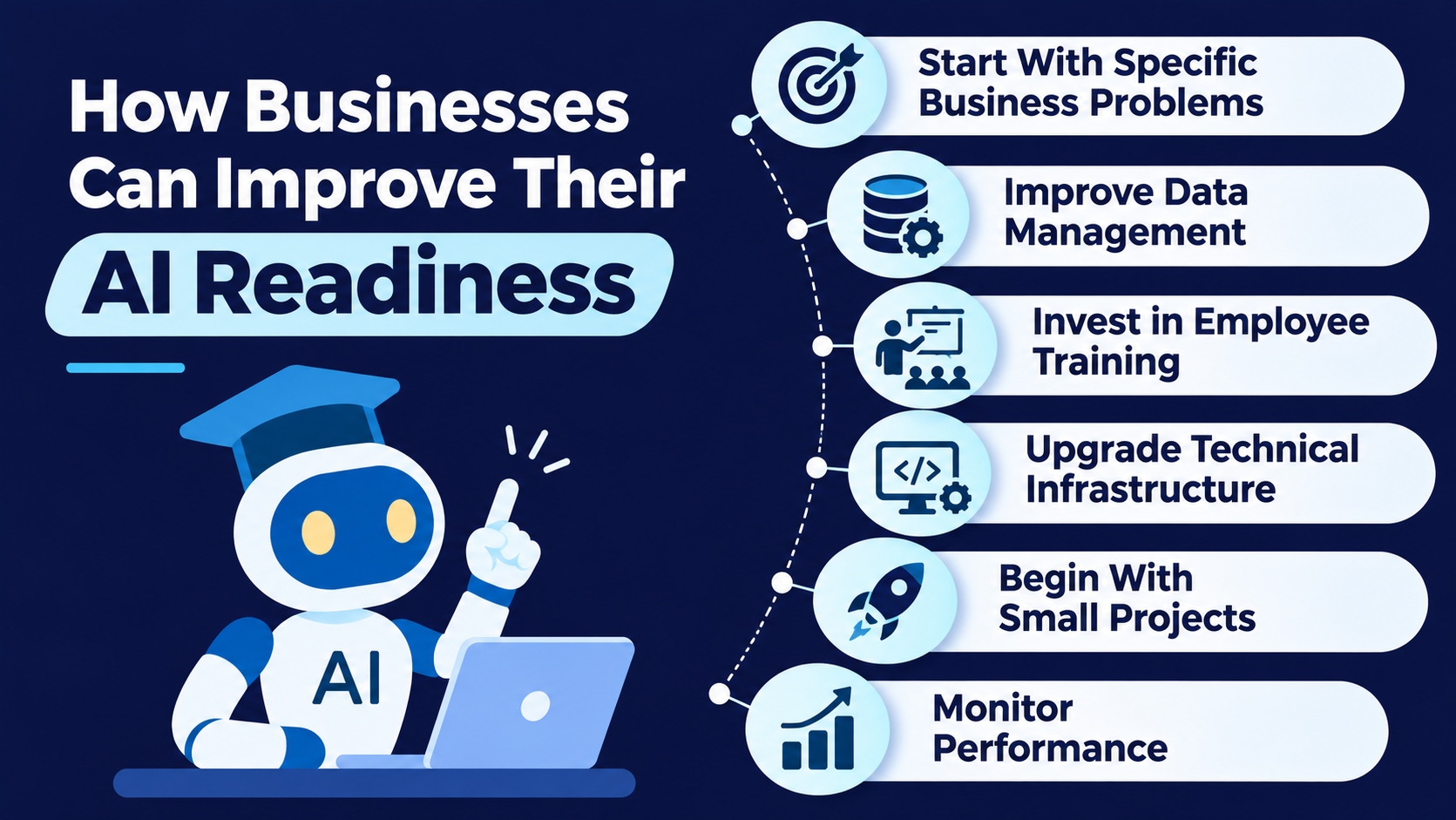
How Businesses Can Improve Their AI Readiness
Preparing an organization for artificial intelligence requires continuous improvement and a well-defined AI strategy.
Here are some practical approaches:
Start With Specific Business Problems: Identify operational challenges that AI can realistically address.
Improve Data Management: Establish consistent data collection, storage, cleaning, and governance practices.
Invest in Employee Training: Help employees understand AI applications and develop the skills needed to work alongside intelligent systems.
Upgrade Technical Infrastructure: Strengthen cloud platforms, cybersecurity, and system integration capabilities where necessary.
Begin With Small Projects: Test AI applications through pilot projects before expanding them across multiple departments.
Monitor Performance: Track relevant KPIs to understand whether AI initiatives are improving productivity, reducing costs, or enhancing customer experiences, and to calculate the ROI of AI.
These practices help businesses move from experimentation towards more structured and scalable AI implementation.
The Role of AI Solutions in Business Transformation
Once an organization understands its requirements and prepares its infrastructure, the next step is identifying suitable AI solutions.
Different technologies can address different business challenges.
For example, AI chatbots can improve customer interactions, facial recognition systems can support identity verification, and predictive analytics can help businesses make informed decisions. Generative AI tools can also support content creation, document summarization, and internal knowledge search.
Similarly, AI-powered automation can reduce repetitive manual work, while machine learning applications can identify patterns in large datasets.
Choosing the right technology depends on business objectives, available resources, and operational requirements.
Rubixe, an Innovative AI Solution, helps businesses explore artificial intelligence opportunities through solutions and services designed to address industry-specific requirements. From AI automation and chatbots to facial recognition and AI consulting, businesses can explore relevant technologies to support their digital transformation goals.
What Does the Future Hold for AI-Ready Businesses?
Artificial intelligence is becoming an important part of business operations across industries. However, successful adoption will depend on how effectively organizations combine technology, people, data, and business strategy.
Companies that continuously improve their technical infrastructure, encourage employee learning, and establish responsible AI practices will be better positioned to adapt to changing business requirements.
The focus will gradually shift from simply experimenting with AI tools to integrating intelligent technologies into everyday workflows. As AI transformation moves forward, measuring business impact will become just as important as adopting the technology.
Frequently Asked Questions (FAQs)
1. What is AI readiness for businesses?
It refers to a business’s ability to adopt, integrate, and manage artificial intelligence effectively. It involves evaluating data quality, technical infrastructure, employee skills, security, and business objectives.
2. What is a readiness assessment?
A readiness assessment evaluates an organization’s existing capabilities to identify gaps in data management, technology, workforce skills, and business processes before implementing AI solutions.
3. How can businesses prepare for AI adoption?
Businesses can get ready by strengthening data management, upgrading technical infrastructure, training employees, identifying suitable AI use cases, and starting with small pilot projects.
4. Why is preparation important before AI implementation?
Preparation helps organizations reduce implementation risks, avoid unnecessary investments, improve operational efficiency, and ensure that AI technologies align with their business goals.
5. What is an AI maturity model?
An AI maturity model describes the stages of AI adoption, from early experimentation to fully integrated enterprise AI. It helps businesses understand their current level and plan the next steps in their AI strategy.
Adopting artificial intelligence without proper preparation can lead to wasted investments, operational difficulties, and disappointing outcomes. Businesses must first understand their existing capabilities, address infrastructure gaps, and establish clear implementation goals.
Businesses looking to strengthen their AI adoption strategy can connect with our team.