
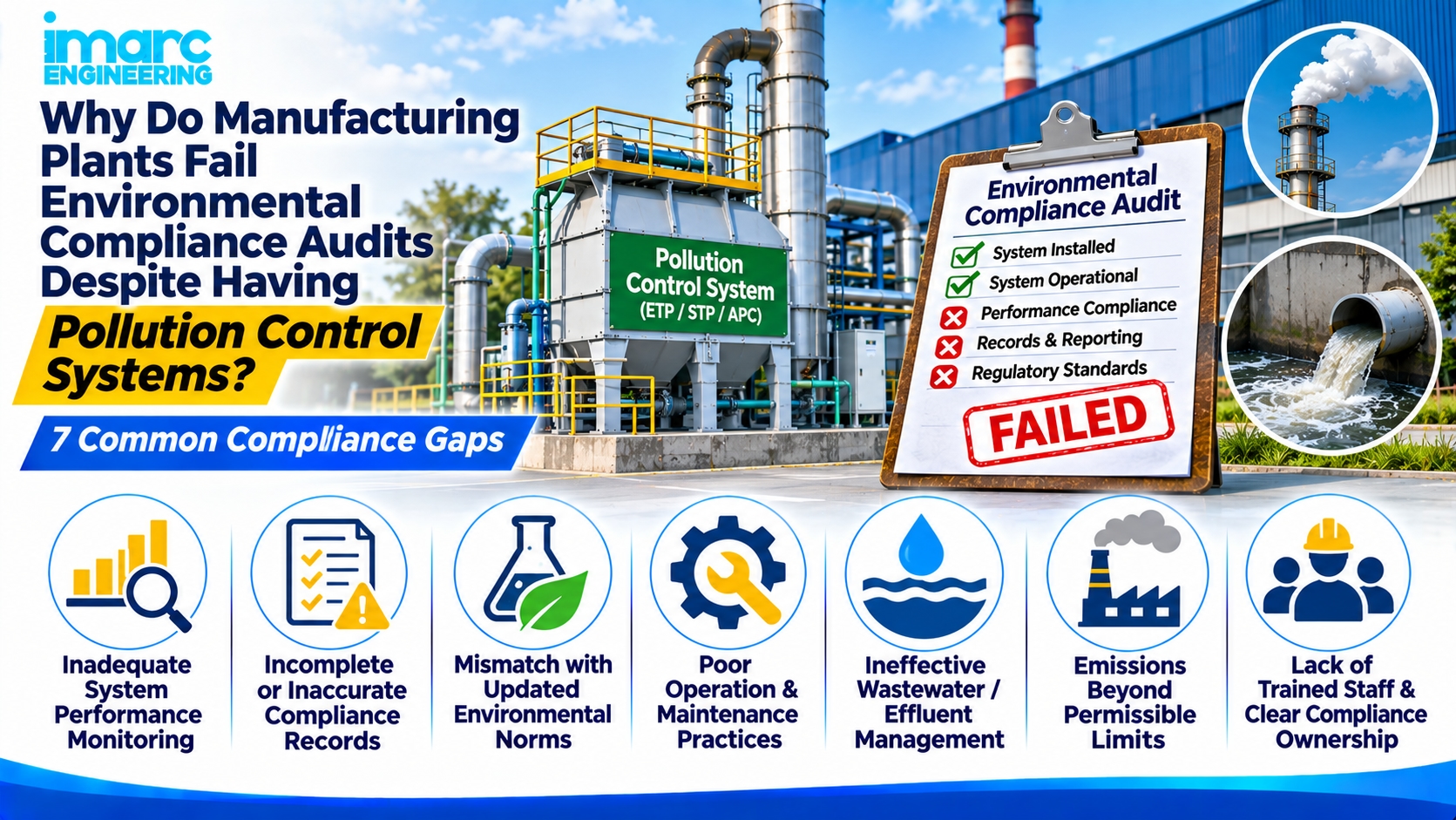
Many manufacturing plants invest in effluent treatment plants, air pollution control equipment, stacks and monitoring systems and still receive non-compliance findings during environmental audits. The systems are present, consents are valid on paper, yet inspectors or auditors record gaps in performance, records, operation or condition compliance. The failure is rarely the complete absence of pollution control hardware. It is usually the gap between installed systems and how those systems are operated, maintained, monitored and aligned with current consent conditions.
Plants fail environmental compliance audits when pollution control systems do not consistently meet the performance, documentation and operational discipline that regulators and auditors expect under real plant conditions. Manufacturers preparing for regulatory inspections or looking to identify recurring compliance gaps can benefit from environmental compliance audit services in India to assess pollution control performance, review consent conditions and identify operational and documentation gaps before an audit.
What Failure Looks Like in Practice
Audit findings typically appear as:
Treatment systems operating below design efficiency or intermittently offline
Incomplete, inconsistent or missing monitoring records and calibration data
Emission or effluent parameters exceeding consent limits during sampling
Hazardous waste storage, labelling or disposal practices that do not match authorisation
Online continuous emission monitoring data that does not reconcile with manual records
Process changes or capacity increases not reflected in updated consents
Fugitive emissions, secondary outlets or storm-water pathways left uncontrolled
Operator knowledge gaps on system operation and emergency response
The plant may have spent significantly on pollution control equipment. The audit still flags operational and evidence gaps.
Why Plants Fail Despite Having Pollution Control Systems
Systems sized for earlier capacity or process
Many plants expand production, add product lines or change raw materials without correspondingly upgrading or revalidating treatment capacity. The installed system no longer matches the actual load.
Operation and maintenance discipline is weak
Equipment is present but may run intermittently, with bypass practices, delayed media replacement or neglected critical components. Performance drops between formal checks.
Monitoring and records do not support continuous compliance
Sampling frequency, parameter coverage, laboratory accreditation and calibration status often lag consent requirements. Auditors examine the quality and continuity of records, not only the existence of a treatment plant.
Consent conditions are not fully operationalised
Consent to Establish and Consent to Operate contain specific limits, monitoring points, reporting frequencies and conditions. These details are sometimes not translated into daily operating instructions and checklists.
Secondary and fugitive sources are overlooked
Focus remains on the main ETP or stack while material handling, storage areas, process vents, storm-water drains or sludge handling create additional compliance exposure.
Process changes outpace regulatory updates
Capacity increases, new chemicals or altered waste streams may require consent amendment or additional authorisation. Operating under an outdated consent creates findings even when hardware exists.
Online monitoring and manual data do not align
Where continuous monitoring is required, discrepancies between OCEMS readings, laboratory results and logbooks raise questions about reliability and data integrity.
Cross-functional ownership is unclear
Environmental systems often sit between production, utilities, maintenance and a nominal EHS role. When no single owner ensures day-to-day performance and records, gaps accumulate.
How to Diagnose and Close Environmental Compliance Gaps
A practical pre-audit approach includes:
Map current consent conditions against actual plant capacity, processes and waste streams.
Verify design capacity and current hydraulic/organic load of the treatment systems.
Walk the full pollution pathway — generation points, collection, treatment, discharge or disposal, including secondary and fugitive sources.
Review monitoring records, calibration status and laboratory reports for completeness and consistency with consent requirements.
Check operational logs for continuous running, maintenance history and any bypass events.
Reconcile online monitoring data (where applicable) with manual sampling and records.
Inspect hazardous waste storage, labelling, inventory and disposal documentation.
Confirm that process or capacity changes have been reflected in updated consents or applications.
Test operator understanding of critical system parameters and response procedures.
Close high-risk gaps and document evidence before the formal audit or inspection.
When findings have been repeated or when expansion has occurred without system revalidation, a structured environmental compliance assessment is justified.
Practical Scenarios
Scenario A: Hardware present, performance weak
An ETP exists and looks complete. Sampling during the audit shows parameters outside limits because media and aeration had not been maintained at design levels.
Scenario B: Capacity mismatch
The plant increased production. The original treatment system remained unchanged. Peak loads exceeded design capacity and created intermittent non-compliance.
Scenario C: Record and data gaps
Monitoring reports existed but were incomplete, delayed or based on uncalibrated instruments. The auditor treated the evidence as unreliable.
Scenario D: Secondary source exposure
Main stack and ETP were in order. Material handling and storm-water pathways created uncontrolled discharges that were observed during the site walk.
Decision Point: Installed System—or Demonstrated Continuous Compliance?
Ask:
Does the treatment system still match current production load and waste characteristics?
Are monitoring records complete, timely and supported by valid calibration?
Can the plant demonstrate continuous operation rather than intermittent or audit-day performance?
Have process or capacity changes been reflected in consent conditions?
Are secondary emission and waste pathways controlled and documented?
Is there clear ownership for day-to-day environmental performance and records?
If the answers rely mainly on the presence of equipment rather than evidence of consistent performance, audit risk remains high.
Environmental Compliance Pre-Audit Checklist
Current Consent to Operate and related conditions reviewed against actual operations
Treatment system capacity versus current load verified
Full pollution pathway walked, including secondary and fugitive sources
Monitoring records, calibration and laboratory reports checked for completeness
Operational logs reviewed for continuous running and maintenance
Online monitoring data reconciled with manual records where applicable
Hazardous waste storage, inventory and disposal documentation inspected
Process or capacity changes checked for consent update needs
Operator knowledge of critical parameters confirmed
High-risk gaps closed and evidence prepared before the audit
When to Address These Gaps
Before a scheduled SPCB or third-party environmental audit
After any significant capacity increase or process change
When previous audits produced repeated or serious findings
Before applying for consent renewal or expansion
When online monitoring or data integrity questions have been raised
Prior to investor, buyer or lender environmental due diligence
The costliest time to discover performance or documentation gaps is during the formal inspection itself.
How IMARC Engineering Can Help
IMARC Engineering supports manufacturers who need environmental compliance grounded in actual system performance, consent alignment and operational evidence rather than the mere presence of pollution control equipment.
Relevant support is available through environmental compliance audit services for plants preparing for regulatory inspections or addressing recurring findings.
Talk to IMARC Engineering if an environmental audit is approaching or previous findings have highlighted gaps between installed systems and demonstrated compliance: https://www.imarcengineering.com/contact?service=environmental-compliance-audits
Conclusion
Manufacturing plants fail environmental compliance audits despite having pollution control systems when those systems no longer match current loads, when operation and maintenance are inconsistent, when monitoring records are incomplete, and when consent conditions and secondary sources are not fully controlled. Hardware alone does not equal continuous compliance.
Closing the gap requires verifying capacity, performance, records and operational discipline against the actual consent and plant conditions. The practical takeaway is clear: treat environmental compliance as a living operating system. Equipment is necessary, but only consistent performance and evidence will pass a serious audit.
Contact Us
IMARC Engineering
Phone: +91-120-433-0800
Email: sales@imarcengineering.com
India: C-130, Sector 2, Noida, Uttar Pradesh 201301
LinkedIn: https://www.linkedin.com/showcase/imarc-engineering/



