A Place That Changes More Than Your Travel Plans
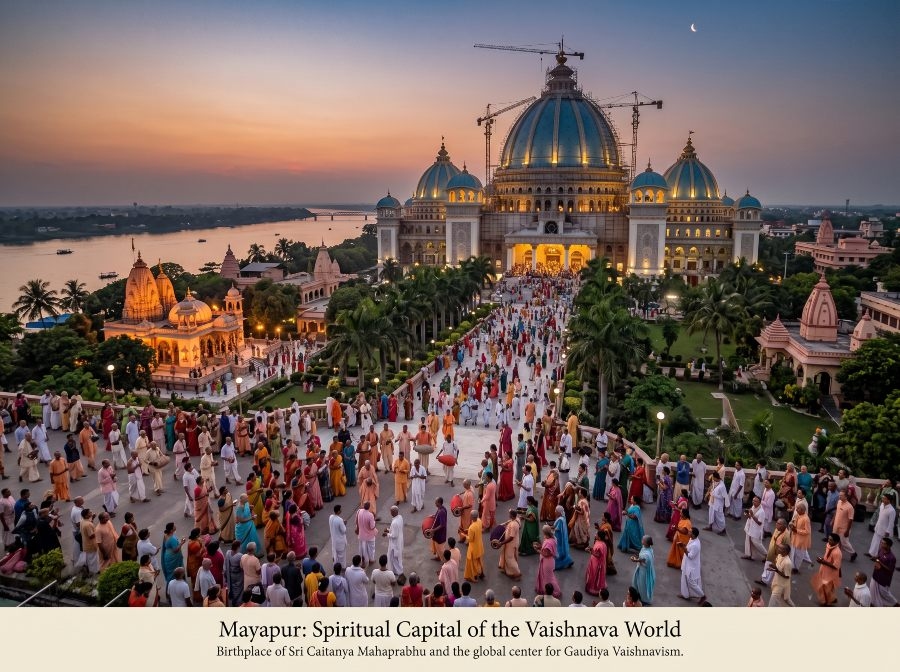
Imagine arriving in a town where the day begins not with traffic horns but with the sound of temple bells, sacred chanting, and thousands of devotees walking peacefully toward a magnificent temple before sunrise. It feels different from the very first moment. Many visitors come expecting to see another pilgrimage destination, yet they leave carrying something far more valuable—a renewed sense of purpose. That is the quiet power of ISKCON Mayapur, a place that has earned worldwide recognition as the spiritual heart of Gaudiya Vaishnavism.
But why is Mayapur often called the Spiritual Capital of the Vaishnava World? Is it simply because of its grand temples, or is there a deeper story hidden beneath its sacred soil? The answer reaches into history, philosophy, devotion, and a living tradition that continues to inspire millions across every continent.
More Than a Sacred Town—A Living Spiritual Civilization
Many pilgrimage sites preserve history. Mayapur lives it every single day.
Located in the Nadia district of West Bengal, India, Mayapur is widely accepted as the birthplace of Sri Chaitanya Mahaprabhu, whose teachings transformed devotional spirituality during the 15th and 16th centuries. His message was beautifully simple: every soul has an eternal relationship with Lord Krishna, and that relationship can be awakened through sincere devotion and the chanting of the holy names.
That message did not remain within Bengal. Over the centuries, it crossed oceans, languages, and cultures.
Today, devotees from more than a hundred countries visit Mayapur every year. You can walk through the temple grounds and hear conversations in English, Spanish, Russian, Bengali, Hindi, French, Japanese, and dozens of other languages—all united by the same spiritual practice.
That extraordinary diversity is one reason Mayapur stands apart. It is not built around nationality or ethnicity. It is built around shared devotion.
The Birthplace of Sri Chaitanya Mahaprabhu Changed Everything
Every great spiritual movement has a defining moment.
For Gaudiya Vaishnavism, that moment began in Mayapur with the appearance of Sri Chaitanya Mahaprabhu in 1486.
Unlike many religious reformers who emphasized ritual or philosophical debate, Mahaprabhu focused on something deeply personal: awakening love for Krishna through heartfelt chanting.
His movement encouraged everyone to participate.
It did not matter whether someone was wealthy or poor.
Educated or uneducated.
A scholar or a farmer.
Devotion was open to everyone.
This inclusive vision reshaped devotional practice throughout India and eventually influenced spiritual communities around the world.
His followers documented not only his teachings but also his daily life, travels, conversations, and ecstatic devotion. These writings became the foundation of a spiritual tradition that continues to flourish centuries later.
Why the Word "Capital" Fits So Well
When people hear the word "capital," they usually think about politics or economics.
Mayapur represents something entirely different.
It functions as the central meeting point for an international devotional community.
Think about what happens here every year.
Thousands of pilgrims arrive from every corner of the globe.
Major Vaishnava festivals are celebrated with remarkable enthusiasm.
Spiritual education takes place daily.
Scriptures are studied systematically.
Devotional music fills the atmosphere.
Cultural traditions remain alive instead of becoming museum exhibits.
A true capital influences the rest of its community.
That is exactly what Mayapur does.
Ideas born here inspire temples worldwide.
Festivals celebrated here are echoed across hundreds of ISKCON communities.
Teachers trained here travel internationally.
Books distributed here reach readers in dozens of languages.
Rather than serving only local visitors, Mayapur continuously nourishes a worldwide devotional family.
The Vision That Spread Across Continents
Sri Chaitanya Mahaprabhu planted the seed.
Centuries later, that seed grew into a global movement through the dedicated efforts of A.C. Bhaktivedanta Swami Prabhupada, the founder-acharya of the International Society for Krishna Consciousness.
When Srila Prabhupada traveled to New York in 1965, few could have imagined what would happen next.
Within a remarkably short period, Krishna consciousness spread across Europe, North America, South America, Africa, Australia, and Asia.
Yet despite this worldwide expansion, Srila Prabhupada repeatedly emphasized the importance of Mayapur.
He envisioned it as a spiritual city where people from every nation could gather, learn authentic Vaishnava philosophy, and return home inspired to share devotional culture.
That vision continues unfolding today.
Instead of existing as a symbolic headquarters, Mayapur functions as an active center of learning, worship, service, and cultural exchange.
Every Corner Reflects Devotion
Some religious destinations impress visitors with architecture.
Others impress with historical significance.
Mayapur offers both, yet neither tells the complete story.
Its greatest attraction cannot be photographed.
It is the atmosphere.
Early mornings begin before sunrise.
Devotees gather for Mangala Arati, singing with remarkable enthusiasm despite the early hour.
Scriptural discussions continue throughout the day.
Children learn Sanskrit prayers alongside modern education.
Volunteers prepare thousands of meals.
Pilgrims chant while walking through peaceful temple gardens.
Even ordinary daily activities become expressions of devotion.
That consistency shapes the identity of Mayapur.
Faith is not reserved for special occasions.
It becomes part of everyday life.
The Temple That Symbolizes a Global Spiritual Dream
One of the most remarkable landmarks in Mayapur is the magnificent Temple of the Vedic Planetarium (TOVP).
Its impressive architecture attracts visitors immediately, yet its purpose reaches far beyond aesthetics.
The temple represents an ambitious vision:
Bringing people closer to Krishna.
Presenting Vedic wisdom in an accessible way.
Preserving spiritual traditions for future generations.
Welcoming seekers regardless of nationality or background.
Its design combines traditional inspiration with modern engineering, creating a structure that reflects both timeless philosophy and contemporary excellence.
For many visitors, seeing the temple is memorable.
Participating in its devotional atmosphere leaves an even deeper impression.
Festivals That Feel Like Living History
Many festivals around the world become commercial events.
Mayapur preserves something far older.
Its celebrations remain deeply rooted in devotion.
Among the most significant is Gaura Purnima, commemorating the appearance of Sri Chaitanya Mahaprabhu.
During this festival, the town transforms completely.
Thousands upon thousands of pilgrims gather.
Kirtan continues for hours.
Sacred processions fill the streets.
Scriptural discussions attract audiences from around the globe.
Prasadam is distributed generously.
The atmosphere combines celebration with heartfelt gratitude.
Visitors often describe these festivals not as performances but as experiences that invite active participation.
Everyone sings.
Everyone serves.
Everyone becomes part of the celebration.
Education Forms the Heart of Mayapur
A spiritual capital cannot survive on emotion alone.
It must educate.
Mayapur excels in this area.
Students study timeless scriptures such as:
Bhagavad Gita
Srimad Bhagavatam
Chaitanya Charitamrita
Works of the Six Goswamis
Classes range from introductory philosophy for newcomers to advanced discussions suitable for experienced practitioners.
Teachers encourage thoughtful questions rather than blind acceptance.
Learning extends beyond classrooms.
Visitors observe practical demonstrations of devotional living through:
Temple worship
Community service
Sacred music
Sanskrit pronunciation
Traditional cooking
Cow protection
Simple living principles
Knowledge becomes practical instead of remaining theoretical.
A Rare Blend of Ancient Wisdom and Modern Life
One fascinating aspect of Mayapur is its ability to balance tradition with contemporary realities.
Modern visitors arrive carrying smartphones, cameras, and busy schedules.
Yet within hours, many naturally slow down.
The rhythm changes.
Meals become opportunities for gratitude.
Walking replaces rushing.
Conversation becomes more meaningful.
Digital distractions lose some of their urgency.
This balance explains why Mayapur attracts both lifelong devotees and curious first-time visitors.
It never demands that people abandon modern life.
Instead, it encourages them to rediscover timeless values that modern life often pushes aside.
Why Millions Feel Connected Without Living Here
Perhaps the strongest evidence supporting Mayapur's reputation as the Spiritual Capital of the Vaishnava World lies in its global influence.
Most people who identify Mayapur as their spiritual home do not actually live there.
They live in:
London
New York
Johannesburg
Moscow
São Paulo
Sydney
Singapore
Nairobi
Toronto
Kuala Lumpur
Yet they celebrate the same festivals.
Read the same scriptures.
Chant the same holy names.
Honor the same traditions.
Many dream of visiting Mayapur at least once in their lifetime because they see it as the source from which their devotional culture continually flows.
That emotional connection cannot be manufactured.
It grows naturally through generations of authentic spiritual practice.
What Makes Mayapur Different from Other Pilgrimage Destinations?
India is home to countless sacred places. Each has its own history, traditions, and spiritual identity. Places like Vrindavan, Jagannath Puri, Rameswaram, and Badrinath hold immense importance in Hindu tradition. Yet Mayapur occupies a unique position within the Vaishnava world.
The difference is not based on size or popularity alone. It comes from the purpose of the place.
Many pilgrimage sites are visited to seek blessings, fulfill vows, or honor an important event from sacred history. In Mayapur, visitors certainly pray and worship, but they are also encouraged to transform their daily lives through devotional practice.
Rather than offering a temporary spiritual experience, Mayapur inspires a lifelong journey.
Several qualities make it stand apart:
Daily devotional practices are central, not occasional events.
Pilgrims become participants, not just observers.
Education accompanies worship, helping visitors understand the philosophy behind every tradition.
International participation creates an atmosphere unlike anywhere else.
Community service is viewed as an expression of devotion rather than charity alone.
For many first-time visitors, this combination comes as a pleasant surprise. They arrive expecting to see temples. They leave having experienced an entire way of living.
Navadvipa: Nine Islands with One Spiritual Heart
To understand Mayapur fully, it is important to look beyond the town itself.
Mayapur forms part of the sacred region known as Navadvipa Dhama, a collection of nine islands traditionally associated with nine forms of devotional service described in Vaishnava scriptures.
Each island symbolizes one aspect of bhakti:
Hearing about Krishna
Chanting His holy names
Remembering Him
Serving His lotus feet
Worship
Prayer
Service
Friendship
Complete surrender
Pilgrims often perform the famous Navadvipa Parikrama, walking through these sacred places while listening to scriptural explanations and devotional songs.
The journey is more than physical.
Every stop encourages reflection on one's own spiritual growth.
Many devotees describe the parikrama as one of the most meaningful experiences of their lives because it combines history, philosophy, nature, and devotion into a single pilgrimage.
The Ganges Adds Another Layer of Sacredness
The holy Ganges flows gently through the region, shaping both the geography and the spiritual identity of Mayapur.
For centuries, devotees have gathered along its banks for prayer, meditation, and kirtan.
Early mornings often reveal a peaceful scene.
The first rays of sunlight reflect on the river.
Pilgrims chant softly.
Temple bells echo in the distance.
The atmosphere feels calm without becoming silent.
The river reminds visitors that spiritual life is not separate from nature. Water, trees, birds, and open skies become part of the devotional experience.
Many pilgrims spend quiet moments by the river simply reflecting on the teachings they have heard throughout the day.
Those peaceful moments often become lasting memories.
Kirtan: The Sound That Connects the World
One of the first things visitors notice in Mayapur is the sound.
It is everywhere.
Walking through temple courtyards.
During festivals.
Inside classrooms.
Along village roads.
In family homes.
The chanting of the Hare Krishna maha-mantra is more than music.
Within Gaudiya Vaishnava tradition, kirtan is considered a direct spiritual practice capable of purifying the heart and awakening love for Krishna.
This emphasis on congregational chanting traces directly to the teachings of Sri Chaitanya Mahaprabhu.
Unlike practices reserved for specialists, kirtan welcomes everyone.
You do not need formal training.
You do not need to speak Sanskrit.
You simply participate.
Perhaps that explains why devotees from different cultures quickly feel connected.
Language barriers disappear when everyone chants together.
A Spiritual Home for Every Nation
One remarkable feature of Mayapur is its international character.
Visitors come from every continent.
Some have practiced Krishna consciousness for decades.
Others arrive knowing almost nothing about Vaishnavism.
Yet they share temple halls, attend classes together, honor prasadam together, and participate in festivals side by side.
Walking through Mayapur often feels like taking a journey around the world.
You might hear:
Bengali
Hindi
English
Russian
Spanish
Portuguese
French
Chinese
Japanese
Italian
Despite these differences, the atmosphere remains surprisingly harmonious.
Shared devotion creates a sense of unity that goes beyond nationality.
That unity reflects one of Sri Chaitanya Mahaprabhu's most beautiful teachings—that every living being is part of Krishna's eternal family.
Service Is Considered Worship
Many people associate spirituality with meditation or prayer alone.
Mayapur presents a broader understanding.
Here, service is worship.
Volunteers prepare meals for thousands.
Others clean temple grounds before sunrise.
Some translate scriptures into new languages.
Teachers educate children.
Doctors provide medical care.
Farmers care for cows.
Artists create devotional paintings.
Musicians lead kirtan.
Writers publish spiritual books.
Every skill finds a place in devotional service.
This practical approach reminds visitors that spirituality is not limited to rituals performed inside temples.
Ordinary work becomes extraordinary when offered with sincerity.
Preserving Ancient Knowledge for Future Generations
One reason Mayapur continues to influence the Vaishnava world is its dedication to preserving authentic teachings.
Ancient scriptures are carefully studied, translated, printed, and distributed worldwide.
Children grow up learning not only academic subjects but also devotional culture, Sanskrit prayers, music, and traditional values.
Scholars continue researching classical Vaishnava literature.
Monks spend years studying philosophy.
Teachers organize seminars for visitors from around the world.
Rather than treating sacred texts as historical artifacts, Mayapur keeps them alive through regular study and practical application.
That ongoing commitment strengthens its role as a global spiritual center.
Festivals Create Memories That Last a Lifetime
Anyone who has attended a major festival in Mayapur understands why people return again and again.
The celebrations combine devotion, music, culture, learning, and community in a way that feels both joyful and deeply meaningful.
During Gaura Purnima, the atmosphere becomes unforgettable.
The streets fill with colorful processions.
Thousands of voices join together in kirtan.
Devotees decorate temples with flowers.
Spiritual teachers share inspiring lectures.
Families, monks, students, and visitors celebrate side by side.
The energy comes not from entertainment but from shared devotion.
Many pilgrims begin planning their next visit before they even leave.
Why People Return Again and Again
Tourist destinations often lose their charm after one visit.
Mayapur tends to have the opposite effect.
The more people visit, the deeper their appreciation becomes.
Every pilgrimage reveals something new.
Perhaps a scripture class suddenly makes sense.
Perhaps a conversation with a devotee changes one's perspective.
Perhaps participating in simple temple service brings unexpected happiness.
The external surroundings remain familiar.
The inner experience continues to grow.
Many longtime devotees describe Mayapur not as a destination but as a spiritual home they long to revisit.
Common Misconceptions About Mayapur
People unfamiliar with Mayapur sometimes form inaccurate assumptions.
Let's clear up a few common myths.
Myth 1: It is only for monks.
Reality: Families, students, professionals, retirees, and travelers visit throughout the year.
Myth 2: You must already know Vaishnava philosophy.
Reality: Beginners are welcomed warmly, and introductory classes are available for newcomers.
Myth 3: It is only important for Indians.
Reality: The global community visiting Mayapur demonstrates its international significance.
Myth 4: There is nothing to do except visit temples.
Reality: Visitors participate in seminars, cultural programs, parikrama, devotional music, community service, educational tours, and festivals.
Understanding these points helps explain why Mayapur continues attracting people from every background.
Lessons Every Visitor Carries Home
Even those who spend only a few days in Mayapur often return with insights that remain valuable long afterward.
Many discover that happiness grows through gratitude rather than constant consumption.
Others realize that meaningful community brings lasting satisfaction.
Some begin reading sacred texts more regularly.
Others adopt simple practices such as daily chanting or mindful prayer.
The greatest gift Mayapur offers may not be something visitors purchase.
It is a different way of seeing life.
One that places compassion before competition.
Service before selfishness.
Inner growth before external recognition.
Why "Spiritual Capital" Is More Than a Beautiful Title
Titles are easy to claim.
They are much harder to earn.
Mayapur has earned its reputation through centuries of living tradition, authentic teachings, and a worldwide community united by devotion to Krishna.
Its influence extends far beyond West Bengal.
Temples across the globe celebrate festivals inspired by Mayapur.
Books studied worldwide trace their roots to this tradition.
Millions of devotees look toward Mayapur as the spiritual center of their faith.
That influence continues to grow because it is built on practice rather than publicity.
Every morning prayer.
Every scripture class.
Every act of service.
Every kirtan.
Together, they keep the spirit of Sri Chaitanya Mahaprabhu alive for future generations.
Frequently Asked Questions (FAQs)
Why is Mayapur called the Spiritual Capital of the Vaishnava World?
Mayapur is regarded as the spiritual capital because it is the birthplace of Sri Chaitanya Mahaprabhu and serves as the worldwide center of Gaudiya Vaishnava philosophy, education, festivals, and devotional practice.
Where is Mayapur located?
Mayapur is located in the Nadia district of West Bengal, India, within the sacred region known as Navadvipa Dhama.
Who founded the modern international movement centered in Mayapur?
A.C. Bhaktivedanta Swami Prabhupada established the International Society for Krishna Consciousness (ISKCON), helping spread the teachings of Sri Chaitanya Mahaprabhu across the globe.
What is the best time to visit Mayapur?
Many pilgrims prefer visiting during Gaura Purnima, when the town hosts one of its largest and most vibrant annual festivals. The cooler months from October to March are also comfortable for travel.
Can first-time visitors enjoy Mayapur?
Yes. Mayapur welcomes visitors from every background. Whether someone is deeply familiar with Vaishnava philosophy or simply curious about spiritual culture, there are guided tours, educational programs, and temple activities suitable for all.
Final Thoughts
Mayapur's reputation as the Spiritual Capital of the Vaishnava World is rooted in far more than history. It is a place where ancient teachings continue to shape modern lives, where people from different nations gather with a shared purpose, and where devotion is expressed through learning, service, music, and community.
Its influence reaches far beyond the banks of the Ganges. Every temple inspired by Sri Chaitanya Mahaprabhu's teachings, every devotee who carries the holy name to another corner of the world, and every seeker who discovers the joy of bhakti reflects the living spirit of Mayapur.
For many, a visit begins as a pilgrimage. It often becomes the start of a lifelong spiritual connection.