When Winston Churchill famously dubbed Uganda the "Pearl of Africa" in 1907, he wasn't exaggerating. This landlocked East African country is a visual masterpiece. From the snow-capped Rwenzori Mountains to the misty forests of Bwindi, and from the thundering Murchison Falls to the quiet shores of Lake Bunyonyi, Uganda is a paradise for adventurers, wildlife enthusiasts, and soul-searchers alike.
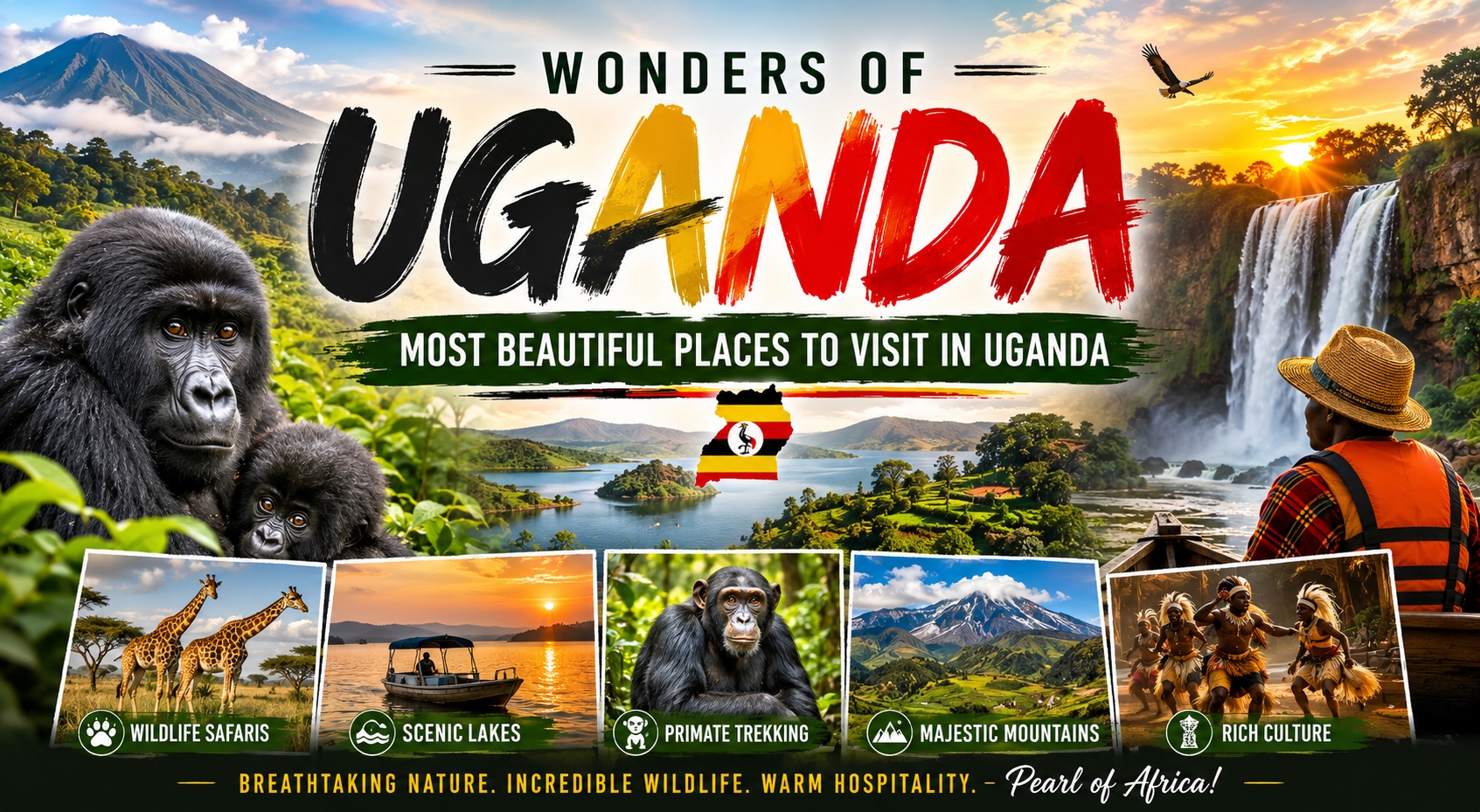
If you are planning your next big adventure, this ultimate guide covers the most beautiful places to visit in Uganda, packed with practical tips and answers to the most common questions travelers ask.
1. Why is Uganda called the "Pearl of Africa"?
The title "Pearl of Africa" is not just a marketing slogan; it is a fitting description of Uganda’s incredible variety. Unlike some of its neighbors that are dominated by dry savannahs, Uganda is exceptionally green and lush.
It sits right at the meeting point of the East African savannah and the West African jungle. This unique geographic sweet spot gives Uganda:
Unmatched biodiversity: Half of the world’s remaining mountain gorillas live here.
Diverse landscapes: You can find crater lakes, volcanic mountains, rainforests, and vast rivers all within a few hours' drive.
Pleasant weather year-round: Thanks to its high altitude and equatorial position, Uganda enjoys warm, spring-like weather almost all year.
2. What are the top natural wonders of Uganda?
Uganda is home to several natural wonders that you won't find anywhere else on the planet. If you are drafting your bucket list, these seven sights are considered the official "Wonders of Uganda":
The Mountain Gorillas of Bwindi.
The Rwenzori Mountains (the famed "Mountains of the Moon").
Murchison Falls, where the mighty Nile River is squeezed through a tiny 7-meter gorge.
Kibale Forest, the absolute capital for wild chimpanzees.
The Source of the River Nile in Jinja.
The Kazinga Channel in Queen Elizabeth National Park.
The Mount Elgon Caldera, one of the largest intact volcanic calderas in the world.
3. Where is the best place to see mountain gorillas in Uganda?
Without a doubt, Bwindi Impenetrable National Park is the premier destination for gorilla trekking. Located in southwestern Uganda, this ancient, misty rainforest is home to roughly 400 mountain gorillas—nearly half of the global population.
Trekking here is a deeply emotional experience. You will walk through thick tangled vines and steep hills guided by expert rangers. Once you find a habituated gorilla family, you have exactly one hour to watch them eat, play, and interact.
Alternative Option: You can also track gorillas in Mgahinga Gorilla National Park, which sits on the slopes of the beautiful Virunga Volcanoes. It is quieter and offers spectacular volcanic backdrops, though it has fewer habituated gorilla families than Bwindi.
4. What makes Murchison Falls a must-visit destination?
Imagine the world’s longest river, the Nile, suddenly forced to squeeze through a rocky gap that is only 7 meters (23 feet) wide. The result is Murchison Falls, the most powerful natural flow of water on earth. The water plunges 43 meters down into the "Devil’s Cauldron" with a roar that shakes the ground beneath your feet.
But Murchison Falls National Park is about more than just the waterfall. It is Uganda’s largest conservation area. Here, you can take a classic savannah safari to spot elephants, giraffes, lions, leopards, and giant herds of buffaloes. A boat cruise along the Nile to the base of the falls is the absolute highlight, offering close-up views of giant hippos and massive Nile crocodiles.
5. Can you see tree-climbing lions in Queen Elizabeth National Park?
Yes, but you have to head to a very specific area called the Ishasha Sector in the southern part of the park.
Lions usually stay on the ground, but the lions of Ishasha have developed the unique habit of climbing up into the massive branches of sycamore fig trees. They do this for two main reasons: to escape the heat of the ground and to stay away from annoying biting insects like tsetse flies.
Seeing a full-grown male lion lazily draped over a tree branch like a heavy rug is a surreal and unforgettable sight. Be sure to bring a good pair of binoculars and a camera with a decent zoom lens!
6. Why is Kibale Forest considered the primate capital of East Africa?
If you love primates, Kibale Forest National Park is your absolute dream destination. This dense rainforest boasts one of the highest concentrations and diversities of primates in the entire world.
Kibale is home to 13 different primate species, including:
Over 1,500 wild chimpanzees.
L'Hoest's monkeys.
Red-colobus monkeys.
Black-and-white colobus monkeys.
Bushbabies and pottos (which you can spot on night walks).
Chimpanzee tracking in Kibale has an incredibly high success rate (over 95%). Walking through the forest and listening to the wild, echoing screams of chimps communicating high up in the canopy will make you feel like you've stepped straight into a nature documentary.
7. Is Lake Bunyonyi safe for swimming and relaxation?
Yes! Unlike most other lakes in East Africa, Lake Bunyonyi is completely safe for swimming. It is free from bilharzia (a water parasite), and there are absolutely no hippos or crocodiles.
Located in southwestern Uganda near the border with Rwanda, Lake Bunyonyi is incredibly beautiful. The name "Bunyonyi" means "place of many little birds," and the lake is dotted with 29 green, terraced islands.
It is the perfect place to unwind after a tiring gorilla trek. You can rent a dugout canoe, try stand-up paddleboarding, or simply sit on the grassy shores of an eco-lodge and watch the morning mist lift off the water.
8. What adventures await travelers at the Source of the Nile in Jinja?
Jinja is widely known as the "Adventure Capital of East Africa." Located on the shores of Lake Victoria, this historic town is where the mighty Nile River begins its long, 6,600-kilometer journey north to the Mediterranean Sea.
If you are an adrenaline junkie, Jinja has plenty to keep your heart racing:
Grade V White-Water Rafting: Navigate some of the wildest rapids on the planet.
Kayaking & Tubing: Take a more relaxed float down the historic river.
Quad Biking & Horseback Riding: Explore the local villages and dirt tracks along the riverbanks.
Bungee Jumping: Take a leap of faith over the waters of the Nile.
9. Are the Rwenzori Mountains harder to climb than Mount Kilimanjaro?
While Mount Kilimanjaro is higher, the Rwenzori Mountains (also known as the "Mountains of the Moon") are widely considered a much tougher, more technical, and more physically demanding climb.
The Rwenzoris are a non-volcanic mountain range running along the border of Uganda and the Democratic Republic of Congo. The highest peak, Margherita Peak on Mount Stanley, reaches 5,109 meters and is permanently covered in glaciers and snow.
Climbing the Rwenzoris involves traversing deep bogs, thick mud, bamboo forests, and steep rocky faces. It is a wild, wet, and incredibly rewarding challenge for serious mountaineers who want to avoid the massive crowds found on Kilimanjaro.
10. Where can you see wild white rhinos in Uganda?
During Uganda’s turbulent political history in the 1970s and 80s, wild rhinos were completely wiped out due to poaching. Fortunately, the Ziwa Rhino Sanctuary was established to bring them back.
Located on the main highway between Kampala and Murchison Falls, Ziwa is currently the only place in Uganda where you can see rhinos in the wild.
Visitors can go on a guided foot safari to track these massive, peaceful giants. Walking through the bush and standing just a few meters away from a southern white rhino is an awe-inspiring experience that directly funds the sanctuary's breeding program to eventually reintroduce rhinos back into Uganda's national parks.
11. When is the absolute best time to visit Uganda for a safari?
Because Uganda sits right on the equator, its temperatures remain warm and pleasant all year. However, the country has distinct wet and dry seasons:
The Dry Seasons (June to August & December to February): This is widely considered the best time to visit. Wildlife gathers around waterholes, making animals much easier to spot. The hiking trails in Bwindi and the Rwenzoris are also less muddy and easier to navigate.
The Wet Seasons (March to May & September to November): Don't write off the rainy months! The countryside turns an incredibly vibrant green, flights and lodges are often cheaper, and you can enjoy popular parks without the crowds.
12. Is Uganda safe for solo and first-time tourists?
Yes, Uganda is widely regarded as one of the safest and most welcoming countries in Africa for international travelers.
The Ugandan people are legendary for their warmth, friendliness, and hospitality. In major tourist destinations, national parks, and hotels, security is taken very seriously. The specialized Uganda Tourism Police works closely with the Uganda Wildlife Authority (UWA) to ensure all visitors are protected.
Of course, as you would in any country, you should use common sense:
Avoid walking alone in dark, quiet urban areas at night.
Keep your expensive gadgets and jewelry tucked away in busy city markets.
Always follow your safari ranger's instructions when near wild animals.
13. How do you apply for a Uganda e-Visa online?
Getting your travel documents sorted before you board your flight is the most important step of your trip. Fortunately, Uganda has made the process incredibly easy by introducing the digital e-Visa.
Instead of waiting in long, stressful lines at Entebbe International Airport or visiting an embassy in your home country, you can apply for your tourist visa entirely online. The process is completely paperless and takes only a few minutes to complete.
Before you start filling out your application, it is highly recommended to check if your nationality requires a visa and what specific documents you will need to upload. You can quickly verify this on the official Uganda Visa Eligibility Map.
Why Choose Us for Your Travel Visa?
Planning an international safari should be exciting, not stressful. If you want to bypass the confusing paperwork and ensure your travel authorization is handled professionally, we are here to help.
Reliable Travel Visa Services Our global approach has assisted numerous travelers in obtaining their Visa. We understand the fine print so you don't have to.
Round-the-Clock Assistance Reach out to us 24/7, and our experts will respond within 72 hours to answer your questions and guide you through any issues.
Experienced Visa Consultants Receive expert guidance to ensure the acceptance of your application. We check your details thoroughly before submission to prevent costly delays or rejections.
Efficient Visa Application Process Apply for your Visa in minutes with our simplified form. We cut out the unnecessary jargon and make the process completely stress-free.
Ready to see the tree-climbing lions and mist-shrouded mountain gorillas for yourself? Check your status on the Uganda Visa Eligibility Map today and let us handle the rest of your travel paperwork!