
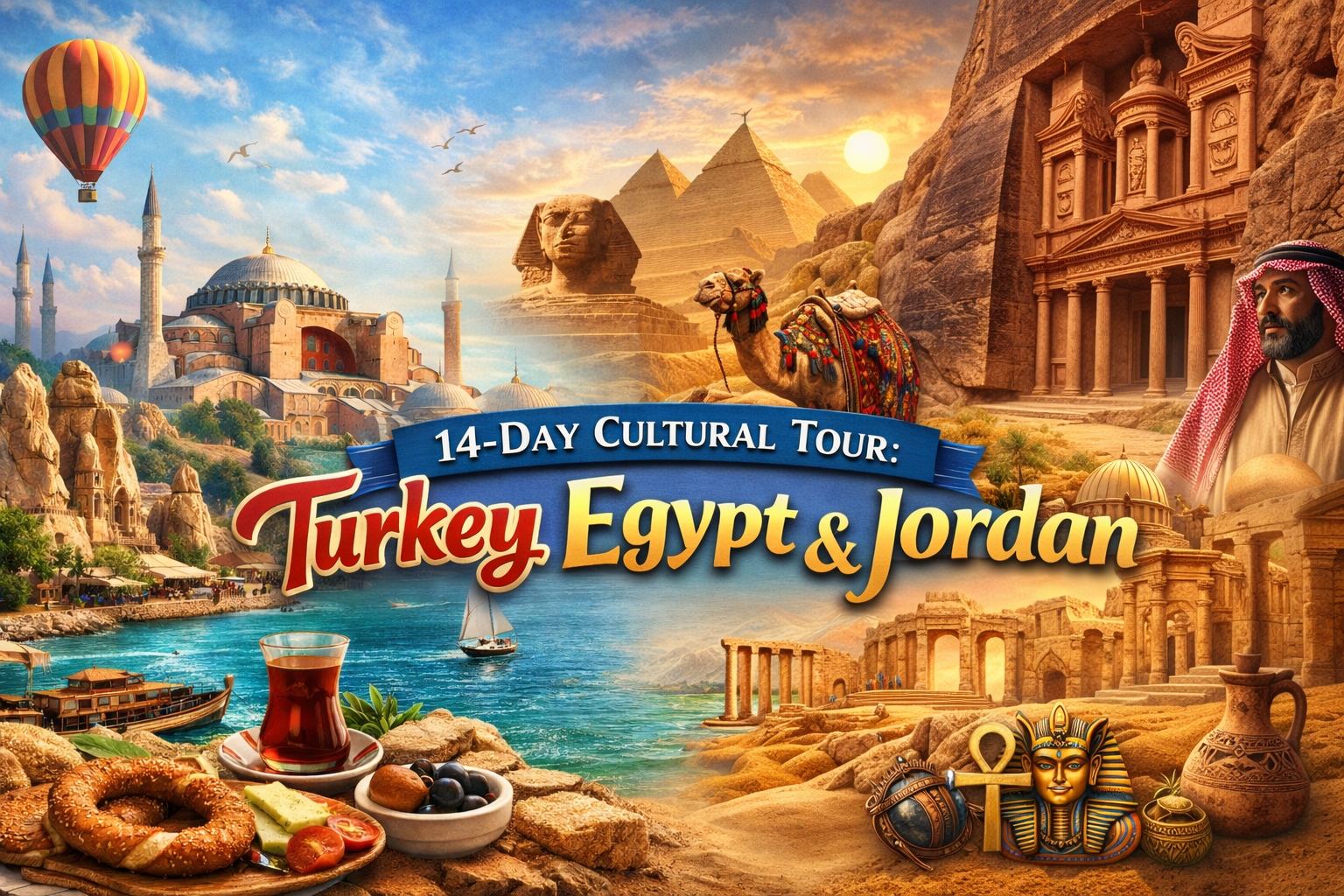
Are you ready to embark on a journey that spans three countries, two continents, and five thousand years of human history? A 14-day cultural tour of Turkey, Egypt, and Jordan is not just a holiday; it is an immersive experience into the heart of the ancient world. From the minarets of Istanbul and the timeless Pyramids of Giza to the rose-red cliffs of Petra, this itinerary is designed for those who crave deep historical knowledge and breathtaking landscapes.
In this comprehensive guide, we explore every facet of this legendary route, helping you plan a trip that is seamless, educational, and profoundly moving.
1. Why Choose a 14-Day Multi-Country Itinerary?
Many travelers wonder if visiting three countries in two weeks is too ambitious. However, Turkey, Egypt, and Jordan form a perfect geographical and historical "golden triangle."
A 14-day window allows for a balanced "slow travel" experience within a fast-paced region. You can dedicate five days to the Ottoman and Byzantine layers of Turkey, five days to the Pharaonic wonders of Egypt, and four days to the Nabataean and Roman ruins of Jordan. This timeframe ensures you aren't just ticking boxes but actually sitting down for tea with locals, exploring hidden side-streets, and watching the sunset over ancient horizons.
2. Turkey: Where East Meets West in Grandeur
Your journey typically begins in Turkey, a land that has served as the bridge between Europe and Asia for millennia.
What are the Architectural Marvels of Istanbul?
Istanbul is a city defined by its skyline. A cultural tour must begin at the Sultan Ahmed Mosque, popularly known as the Blue Mosque, famous for its six minarets and 20,000 handmade Iznik tiles. Directly opposite sits the Hagia Sophia, a masterpiece of Byzantine architecture that has served as both a cathedral and a mosque, representing the complex religious history of the region.
Walking through the Topkapi Palace offers a glimpse into the lavish lives of Ottoman Sultans, while a stroll through the Grand Bazaar—one of the largest and oldest covered markets in the world—connects you to the ancient Silk Road trade routes.
Is Cappadocia Worth the Trip?
Absolutely. A short flight inland takes you to Cappadocia, a landscape that looks like it belongs on another planet. Here, the "fairy chimneys" (tall, cone-shaped rock formations) houses ancient cave dwellings. Exploring the Goreme Open Air Museum, a UNESCO World Heritage site, reveals rock-cut churches adorned with 10th-century frescoes. Of course, the iconic sunrise hot air balloon ride provides the best vantage point for this geological wonder.
3. Egypt: Unveiling the Mysteries of the Pharaohs
From Turkey, a short flight south brings you to Cairo, the gateway to the Nile and the land of the Pharaohs.
How Do You Best Experience the Giza Plateau?
No photo can truly prepare you for the scale of the Great Pyramids of Giza. While the Pyramid of Khufu is the only remaining Ancient Wonder of the World, the surrounding plateau holds the secrets of the Sphinx and the smaller pyramids of Queens. For a truly informative experience, visiting the Grand Egyptian Museum (GEM) is essential to see the treasures of Tutankhamun and understand the chronological history of Egyptian dynasties.
What is the Significance of Luxor and the Nile?
Traveling south to Luxor is like stepping back in time. The Valley of the Kings is home to over 60 tombs, including those of Ramses II and Seti I. Across the river, the Karnak Temple Complex remains one of the largest religious buildings ever constructed. Many cultural tours include a Nile Cruise, which is the most traditional way to see the temples of Edfu and Kom Ombo while observing life along the riverbanks that hasn't changed in centuries.
4. Jordan: The Rose City and the Martian Desert
The final leg of your journey takes you to the Hashemite Kingdom of Jordan, a land of hospitality and rugged beauty.
Why is Petra a Bucket-List Destination?
Petra, the "Rose City," was the capital of the Nabataean Kingdom. The entrance through the Siq—a narrow gorge over 1km long, flanked by 80-meter-high cliffs—leads you to the Treasury (Al-Khazneh). Beyond the Treasury lies a vast city of tombs, theaters, and a Monastery (Ad Deir) that requires a hike of 800 steps but offers a view that spans across the border to Israel and beyond.
What Makes Wadi Rum Unique?
Known as the "Valley of the Moon," Wadi Rum is a protected desert wilderness in southern Jordan. It is famous for its red sand, towering sandstone mountains, and prehistoric rock carvings. Spending a night in a Bedouin camp allows you to experience traditional hospitality, eat "Zarb" (food cooked in an underground oven), and witness a night sky free from light pollution.
5. The Dead Sea: Nature’s Ancient Spa
Before concluding your tour, a stop at the Dead Sea is mandatory. At 430 meters below sea level, it is the lowest point on Earth. The water is nearly ten times saltier than the ocean, making it impossible to sink. Beyond the novelty of floating, the mineral-rich mud is world-renowned for its skin-healing properties, a tradition of wellness that dates back to Cleopatra’s time.
6. Planning the Logistics: Best Time and Packing
When is the Ideal Season for This Tour?
Climate is a major factor in the Middle East. Spring (March to May) and Autumn (September to November) are the most comfortable. During these windows, you avoid the blistering summer heat of the Egyptian desert and the surprisingly cold winter snows of the Turkish highlands.
What Should You Pack for Cultural Sensitivity?
While these countries are accustomed to tourists, showing respect for local customs goes a long way.
Modest Attire: Carry clothing that covers shoulders and knees.
Headscarves: Essential for women when entering mosques in Istanbul or Cairo.
Footwear: You will walk miles on uneven stone; high-quality hiking sandals or sneakers are vital.
Hydration: The dry air of Jordan and Egypt can lead to dehydration quickly; always carry a reusable water bottle.
7. Navigating the Visa Process for Three Countries
One of the biggest hurdles for a multi-country tour is the paperwork. Each of these nations has its own entry requirements, but the modernization of the "e-Visa" has made the process significantly easier. Instead of spending hours at a consulate, you can now apply online.
Simplifying Your Travel Documents
To ensure your trip goes smoothly without any boarding denials or border delays, it is highly recommended to use professional visa portals. These services streamline the application by providing clear forms and expert reviews.
If you are heading to the bazaars of Istanbul, you can easily secure your Turkey e-Visa online.
For those planning to explore the Pyramids, make sure to apply for your Egypt visa application well in advance.
To walk through the Siq in Petra, don't forget to obtain your Jordanian travel authorization before your flight.
8. Why Trust a Professional Visa Service?
In an era of complex travel regulations, having a partner in your corner makes a world of difference. Here is why travelers prefer using our dedicated platforms:
Reliable Travel Visa Services: Our global perspective ensures that we stay updated on the latest policy changes for Turkey, Egypt, and Jordan, assisting thousands of travelers in securing their documents.
Round-the-Clock Assistance: Travel doesn't happen on a 9-to-5 schedule. Our support team is available 24/7, ensuring that any query you have is addressed within 72 hours.
Experienced Visa Consultants: One small mistake on a form can lead to a rejection. Our experts review your application to ensure every detail matches your passport perfectly.
Efficient Visa Application Process: Time is money. Our simplified forms are designed to be completed in minutes, leaving you more time to plan your actual sightseeing.
9. Cultural Etiquette: How to Be a Respectful Traveler
To get the most out of your 14-day tour, understanding local etiquette is key.
Tipping (Baksheesh): In Egypt, tipping is a way of life. Small amounts for temple guards, drivers, and waiters are expected.
Photography: Always ask before taking photos of locals, especially in rural areas or near religious sites.
Bargaining: In the markets of Turkey and Jordan, haggling is part of the culture. Do it with a smile—it’s meant to be a social interaction, not a confrontation.
10. Final Thoughts: A Journey of a Thousand Memories
A 14-day cultural tour of Turkey, Egypt, and Jordan is an investment in your personal growth. You will return home with a deeper understanding of how modern civilization was built, a stomach full of incredible Mediterranean food, and memories of landscapes that seem too beautiful to be real.
Start your journey by checking your passport validity and securing your visas today. The ancient world is waiting for you!




